Scandal-weary Brazilians to vote as Lula faces Bolsonaro son
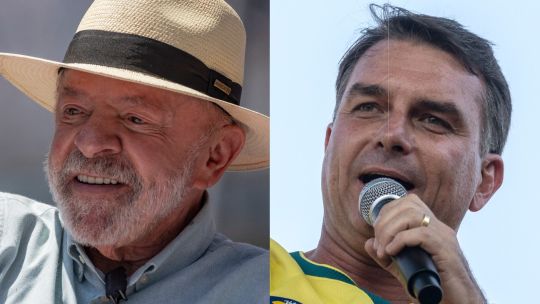
Jaded by a dizzying array of scandals, Brazilians vote Sunday in a nail-biter election pitting leftist President Luiz Inácio Lula da Silva against right-wing senator Flávio Bolsonaro.
The election will determine if Latin America's biggest economy joins a rightward shift in the region that has been cheered on by US President Donald Trump.
In a deeply polarised nation, Brazilians are feeling a weary sense of déjà vu in an election offering a familiar political script: Lula, 80, seeking a fourth term, is facing off against the son of far-right former president Jair Bolsonaro.
Many of the country's 160 million registered voters have yet to make up their minds after a campaign dominated by scandals that have shaken both sides.
"I'm still undecided. Because corruption is so blatant. It's difficult," said Joel da Silva, 42, a doorman in Rio de Janeiro who has voted for both Lula and Jair Bolsonaro in past elections.
Opinion polls show Lula slightly ahead of Flavio Bolsonaro in the first round vote.
The pair are in a dead heat in an expected runoff on October 25.
The Trump factor
Lula, a global leftist icon, made a dramatic return to office in 2023, following a stint in jail on corruption convictions that were later annulled on a jurisdictional technicality.
At home, he is loved and hated in equal measure, having never fully shrugged off the accusations.
Lula criss-crossed the country energetically in what is expected to be his final election race, boasting about his fitness routine.
His campaign leaned heavily on national sovereignty in the face of what he denounced as Trump's interventionism.
Trump has openly backed right-wing candidates who won elections in Chile, Colombia, and Peru in recent months.
"Brazil does not belong in anyone's backyard," Lula said last week at the UN General Assembly.
Trump has not openly endorsed the son of his ally Jair Bolsonaro, although he hosted the 45-year-old senator at the White House earlier this year.
In his third term, Lula has been credited with expanding social programmes, overhauling the tax system, and reducing deforestation in the Amazon.
Unemployment is at a record low and inflation is under control, but the economy is slowing, and Brazilians are most anxious about crime and violence.
With Flávio Bolsonaro nipping at his heels in the polls, Lula made several last-ditch bids to his working-class electorate: he upped social welfare benefits and banned online betting, which has driven millions into debt.
"Without wishing to idolise him, he is one of the greatest presidents this country has ever had," says Israel Gomes, 52, a hotel manager in Brasília.
'Very sceptical'
Flávio Bolsonaro was thrust into the electoral race after his father was jailed for attempting a coup against Lula when he lost a 2022 election bid.
He has styled himself as a "more moderate" version of his firebrand father, while relying heavily on his enduring political appeal.
He has promised a hard line on crime, pledging to build maximum-security mega-prisons.
Elias Camisero, a 74-year-old tailor, hopes Flávio will "wipe out" the criminal groups that control working-class neighbourhoods in various Brazilian cities.
"It has to end. Today, in Brazil, organised crime is in charge," he told AFP in São Paulo.
Many have given up hope that politics can solve their most pressing problems, such as security.
"I don't really see much changing ... if either Flávio or Lula wins. I'm very sceptical about that," said Eduardo Metzker, 29, a software developer in Rio de Janeiro who has been mugged three times.
The campaign was dominated by a cascade of revelations linked to jailed banker Daniel Vorcaro, who is accused of orchestrating one of Brazil's largest financial fraud cases, and had questionable ties with many in high places.
Flávio Bolsonaro is under investigation for suspected corruption and money laundering over the financing of a biopic about his father, bankrolled by Vorcaro.
Ties were revealed between Vorcaro and a powerful Supreme Court justice, tarnishing the image of the country's institutions, which analysts said hurt Lula's campaign.
The campaign was "marked by scandals rather than policy proposals," Joscimar Silva of the University of Brasilia's Institute of Political Science told AFP.
"There is voter fatigue. People think everyone is corrupt."
What is at stake in Brazil's elections?
A deeply polarised Brazil heads to the polls on Sunday to choose between two starkly different visions for the country proposed by leftist President Luiz Inácio Lula da Silva and right-wing senator Flavio Bolsonaro.
These are the key issues at stake:
Leftist holdout, or join rightward march
Latin America has swung sharply to the right in recent years, in elections in Argentina, Chile, Bolivia, Colombia, and Peru. A Lula victory would keep Brazil as a major leftist bastion in the region, alongside Mexico, while a Flavio Bolsonaro win would see the country join the shifting tide. Oliver Stuenkel, a professor at the Getulio Vargas Foundation, downplayed the importance of ideology in regional relations as more "rhetorical than substantive." Lula, a veteran and pragmatic leader, maintains normal ties with the right-wing leaders of Chile, Bolivia, and Paraguay. Even ties with Argentina, a strategic partner whose libertarian President Javier Milei has criticised Lula, have changed little, Stuenkel told AFP.
Relations with Washington
Ties with Washington have grown frosty under Lula. US President Donald Trump is an ally of far-right former president Jair Bolsonaro, father of the current candidate. His administration has imposed tariffs on Brazilian products and sanctions on judges and other officials. If Lula wins, Washington will likely continue resorting to threats and targeted tariffs to curb ties with China, said Regiane Bressan, a professor of International Relations at the Federal University of São Paulo. The US is Brazil's second-largest trading partner, behind China. A Flávio Bolsonaro presidency would have more alignment with Washington, "at least rhetorically," said Bressan.
A test for democracy
Jair Bolsonaro's Presidency from 2019 to 2022 put Brazil's democracy to the test. He spent years confronting institutions, attacking the Supreme Court, and casting doubt on the country's electronic voting system. After losing the election, Jair Bolsonaro and his allies plotted to overturn the result and prevent Lula from taking office. The former president was convicted in 2025 of attempting a coup and is serving a 27-year sentence under house arrest. In January 2023, thousands of his supporters invaded the headquarters of Brazil's three branches of government in Brasilia, seeking to overturn the election and trigger military intervention. Flávio Bolsonaro has also cast doubt on the electronic voting system, but later said he would respect the results. He has vowed to seek amnesty for his father and his convicted supporters, if elected. Lula defended Brazil's "modern and robust" electoral system at the United Nations last week and warned that he would not allow "enemies of democracy" to undermine popular will.
The future of the Supreme Court
Sunday's election will also renew the Chamber of Deputies and two-thirds of the Senate, which has held a conservative majority in recent years. This is significant because the next president will appoint up to four of the 11 Supreme Court justices, who must be confirmed by the Senate. In April, the upper house rejected Lula's nominee for the high court. This had not happened in over a century. Flávio Bolsonaro has lashed out at the court and called for the removal of Justice Alexandre de Moraes, who presided over his father's trial. The court has also been thrown into disarray as investigations have scrutinised links between several justices, their relatives or associates, and jailed, fraud-accused banker Daniel Vorcaro.
The Amazon and climate change
Brazil plays a pivotal role in the fight against climate change as home to much of the Amazon rainforest. However, the issue has been absent on the campaign trail. Deforestation dropped sharply during Lula's administration, and he vows to end it by 2030. However, he has come under fire for backing oil exploration near the mouth of the Amazon River. Flávio Bolsonaro has avoided attributing global warming to human activity. Nevertheless, he has vowed to end deforestation by 2029, though his support for agribusiness has cast doubts on whether he will follow through.
KioskNews shows a cleaned-up reading view extracted from the publisher’s page — the original always lives on their site, not ours.