Why unwanted fridges are piling up at recycling centres across England and Wales

“In Oxfordshire, recycling centres are filling almost three articulated lorries with discarded fridges every week,” says Simon Perry of W&S Waste Management, which runs a recycling centre in Ardley.
Together, those fridges would cover an area just under half the size of a football pitch. But the space to store them – in Oxfordshire and beyond – has become a growing problem after the Local Government Association (LGA) warned that a mountain of broken fridges was rising in waste centres across England and Wales, as this year’s heatwaves push more white goods to breaking point, and a trend for second/backup refrigeration products keeps growing.
Councils say there are now not enough facilities to recycle fridges after a major centre at Newport Docks went into liquidation last year, leaving more than 80,000 fridges and freezers stranded, overwhelming local storage capacity. Two other centres have shut in recent years.
Councils from Bradford to Gloucestershire, Durham and Nottinghamshire are among 26 to have suspended fridge collections this month, and the backlog is adding to financial pressures on local authorities.
At the centre in Ardley, four fridges sit waiting to be taken away – two small, two large, several looking barely worn. The council has managed capacity this year by asking people to book slots before bringing in fridges, but is having to tighten those restrictions further. Fridge and freezer drop-offs are temporarily limited to Oxfordshire residents only, and booking slots – limited to the week ahead – cannot be made for new appointments until 28 September, though existing district bulky waste collections will still be honoured.
Laura Gordon, an Oxfordshire county councillor, fears that unless the issue is resolved, for Oxfordshire and other councils the situation will get worse. “There’s a window of opportunity now to fix the problem,” she says. “The cost of not doing that – both financially and environmentally – will start to mount up really quickly if that window isn’t taken.” The Newport site could be brought back online, but otherwise the only option is a new facility opening in January, she says, which will take time to reach full capacity.
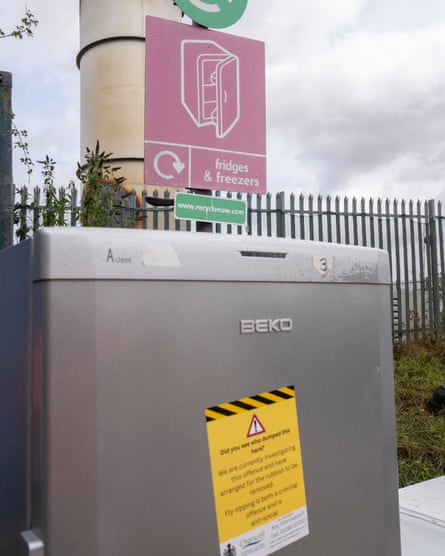
Part of the problem is that fridges are hard to recycle. Every fridge contains refrigerant gas that must be safely drained before the unit can be processed. Perry points to a small box fitted to the back of one fridge: the compressor, which holds the refrigerant and has to come out first. Even the foam insulation inside the walls is a hazard, meaning fridges cannot go through a standard metal recycling line – they need specialist plants equipped to degas them safely. That means sites holding fridges need an environmental permit or registered exemption, since they are classed as hazardous waste.
Purchasing patterns suggest the wave of fridges in recycling centres is not due to a sudden increase in new fridge purchases or replacements. Stefan Hay, the chief executive of the UK Home Appliance Association (AMDEA), said the market for fridges over the last five years had been “pretty flat”. He said: “Sales in the first half of 2026 were actually down slightly, as were WEEE (waste electrical and electronic equipment) collections against target.” The trend towards larger American-style fridges is also not contributing.
There has, however, been growth in additional refrigeration. Hildreth said: “In recent years there has been a growth in second/backup refrigeration products, driven initially by Covid but a trend that has continued and potentially because of the more recent advice from government to ‘stock up’ in preparation for El Niño. We expect extreme weather will drive it further.”
Jon Hubbard, the chair of the LGA’s neighbourhoods committee, said the situation was a “system failure”. With three facilities out of action, he said, there was not enough spare capacity and councils were facing complaints as some residents were told not to bring fridges in at all.
Under the “polluter pays” principle behind the WEEE recycling system, it should be manufacturers and retailers, not councils, who fund the collection, treatment and storage of old fridges, through producer compliance schemes. But because the treatment capacity is squeezed, those schemes have been unable to keep clearing council sites, leaving some local authorities footing the storage bill themselves. The Department for Environment, Food and Rural Affairs has said future compliance-fee rules could take the shortage into account, but any change is not expected to be decided until early 2027.
“We do not want the cost of a failure elsewhere in the system to be passed on to residents,” Hubbard said. “The recycling scheme is already funded by producers. If councils are being asked to step in and provide temporary solutions, the additional costs should be funded too.” Ultimately, he said, councils need confidence that the system works: “We cannot find ourselves putting out the same warnings about mountains of unwanted fridges every summer.”
KioskNews shows a cleaned-up reading view extracted from the publisher’s page — the original always lives on their site, not ours.