Trump's Next Two Years On The Line As US Midterms Counting Day Arrives

More than 230 million eligible voters across the United States are heading to the polls as the country votes in the 2026 midterm elections. With polling underway, the attention will now move to the counting of ballots which could reshape the balance of power in Washington.
The elections are being closely watched as a test of US President Donald Trump's leadership midway through his second term. Republicans currently control both chambers of Congress, but their majorities are narrow. Democrats are hoping to change that, with their eyes on key Senate races and all 435 seats in the House of Representatives.
If they succeed, Trump could face greater resistance to his legislative agenda, along with tougher Congressional scrutiny of his administration.
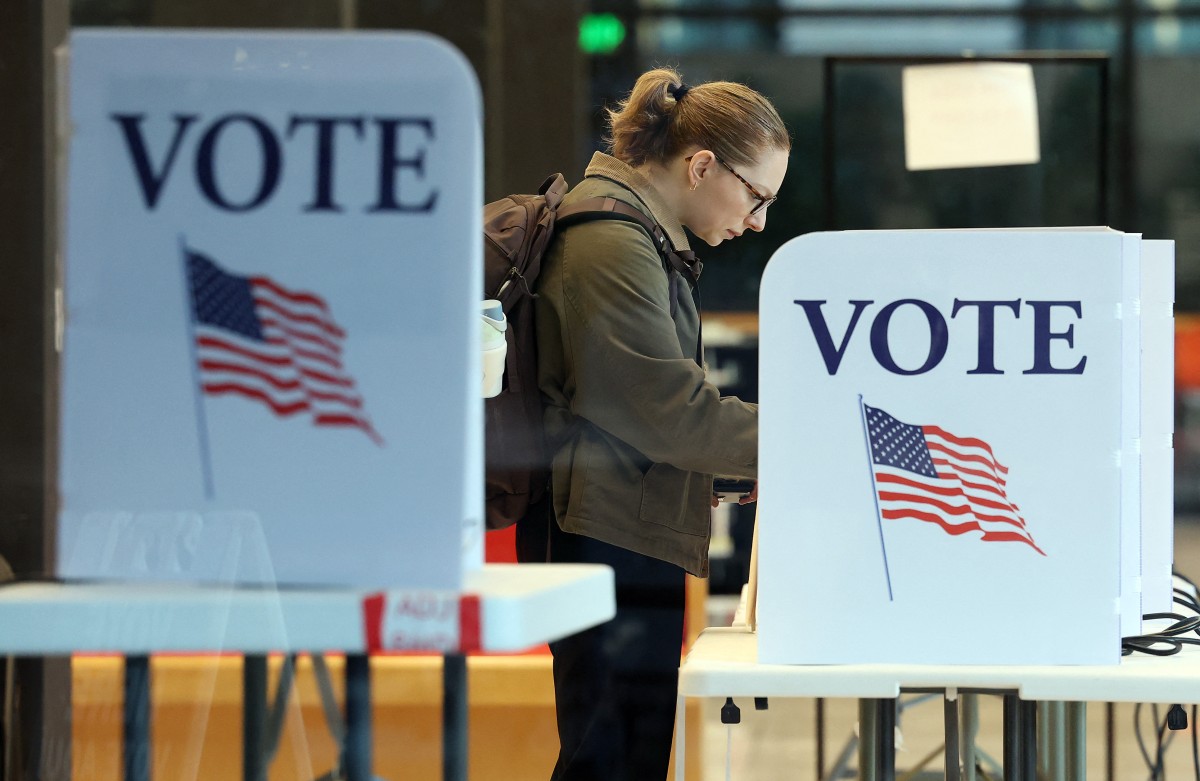
A voter fills out their ballot at the Martin Luther King Jr. Memorial Library on November 03, 2026 in Washington, DC
Photo Credit: AFP
Democrats Eye Seven Senate Seats
All 435 seats in the House of Representatives and 35 of the 100 seats in the Senate are up for grabs. Of the Senate seats being contested, 22 are currently held by Republicans.
Democrats are targeting these seven states in particular -- Michigan, Maine, Ohio, Kansas, Texas, Iowa and Alaska. Winning these races could put them in a position to take control of the Senate.

US Senate Minority Leader Chuck Schumer, Democrat from New York, votes at a polling location on Election Day during the midterm elections in New York City on November 3, 2026
Photo Credit: AFP
Recent pre-election polls released by The New York Times and Siena University show Democrats with an advantage over Republicans in nearly all seven battleground states.
The numbers suggest a difficult contest for Republicans, although the final outcome will depend on how voters turn out on Election Day.
The current numbers in Congress leave little room for Republicans to lose ground. In the House, Speaker Mike Johnson has 218 Republicans and one independent, Kevin Kiley of California, against 214 Democrats. Two seats are vacant.
The Senate currently has 53 Republicans and 47 Democrats. Democrats need a net gain of four seats to take control.
What A Democratic Win Could Mean For Trump
A change in control of either chamber would have major consequences for the White House.
If Democrats win control of Congress, they could use their position to step up investigations into the Trump administration, scrutinise its decisions and put greater checks on the President's policies.
It would also make it harder for Trump to push through his legislative agenda.

However, losing control of Congress would not leave the President without powers. Trump would still be able to govern through executive orders, although these can be challenged and overturned by courts or reversed by a future administration.
A Democratic victory would therefore change the political equation in Washington, even as Trump remains in the White House.
When Will US Midterm Results Come In?
With voting taking place across different time zones, the first major indications of the outcome will emerge as polling stations begin closing in the eastern United States.
The first closures are expected early Wednesday morning in India. Polling will then wind down across the country, moving westwards, with the last voting locations in Alaska expected to close around 11:30 am IST.
Counting will begin as polling stations shut and election officials start tabulating ballots. Preliminary results from the first major group of states could start coming in around 5:30 am IST on November 4.
However, there is no common counting schedule across the United States. Each state follows its own rules for processing and counting votes, including ballots cast in person, through mail-in voting and during early voting.
Some states allow officials to process mail-in ballots before Election Day, while others restrict when the process can begin. This means results will not come in at the same pace everywhere.
The 2024 elections offer an example of how long the process can take. According to an Al Jazeera report, it took eight days after voting to establish which party would control the House of Representatives.
READ | How Trump And His Administration May Interfere In US Midterm Elections
More Than 57 Million Ballots Already Cast
A large number of Americans have already voted before Election Day.
According to the Associated Press, more than 57 million ballots had been cast across 47 states and Washington DC as of Monday. This is higher than the little under 44.5 million ballots recorded across 49 states and Washington DC at the same stage in the 2022 midterm elections.
The early voting numbers will be another important indicator as officials begin counting ballots and the results start coming in.
The newly elected US Congress is scheduled to convene on January 3, 2027.
KioskNews shows a cleaned-up reading view extracted from the publisher’s page — the original always lives on their site, not ours.