Abdul El-Sayed faces Michigan Senate race controversy over Hamas remarks by Democratic activist

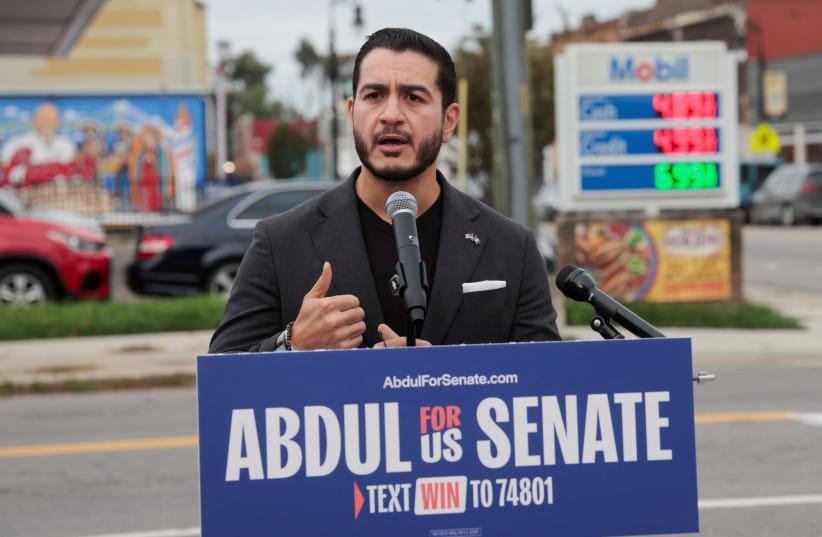
A political controversy has erupted in Michigan, roughly two weeks before the US midterm elections, after a conservative investigative group released hidden-camera footage featuring a Democratic campaign activist making allegations about Senate candidate Abdul El-Sayed.
The footage, published Monday by O'Keefe Media Group, an organization led by conservative journalist and activist James O'Keefe, shows an activist claiming that El-Sayed receives donations from people living outside the United States and cannot publicly distance himself from Hamas without risking the support of some of his voters.
The activist, Abdoul Beckwith, was identified as a field organizer for the Michigan Democratic Party's coordinated campaign, which supports Democratic candidates running for various offices, including El-Sayed.
After O'Keefe's organization requested comment, the Michigan Democratic Party confirmed that Beckwith was no longer employed by its campaign operation.
In one portion of the recording, Beckwith discusses donors living outside the United States, comments that O'Keefe presented as evidence of foreign funding for the campaign.
However, the video offers no independent evidence that El-Sayed's campaign received illegal contributions. It also does not identify the alleged donors or establish their citizenship or immigration status.
Under US election law, foreign nationals who are not lawful permanent residents cannot make political contributions, either directly or through intermediaries. US citizens living abroad and lawful permanent residents, commonly known as green card holders, may donate, subject to legal restrictions.
"He can't say that he doesn't support Hamas"
In another segment of the footage, Beckwith discusses El-Sayed's political positions and the expectations of his supporters.
"He has to play the game, he has to play the part," the activist said.
Beckwith claimed that El-Sayed could not simply declare, "No, I don't support Hamas, I reject all of them," because "he would lose the people who got him to where he is in the first place."
When asked why the candidate does not distance himself from allegations involving organizations such as Hamas and Hezbollah, Beckwith suggested that some supporters might interpret such a statement as siding with those they believe are responsible for genocide.
The remarks reflect Beckwith's personal assessment and do not establish that El-Sayed supports Hamas or has ties to the terrorist organization.
The footage also shows Beckwith making comments about what he perceived as the influence of Jewish people on the Democratic candidate.
"There are a lot of white people around him, a lot of Jewish people," he said, suggesting that spending extended periods around a particular group can lead someone to adopt its ideology and behavior.
"That means they're basically going to take control of him. That's what worries me," he added.
When asked whether he was concerned that El-Sayed might eventually change his political positions, Beckwith said he was.
Activist disputes allegations as campaign distances itself
O'Keefe contacted Beckwith for comment after obtaining the recordings.
During a telephone conversation included in the video, Beckwith disputed O'Keefe's characterization of his remarks, arguing that his answers had been taken out of context.
When asked which of O'Keefe's allegations were inaccurate, Beckwith replied, "Everything."
He later maintained that he had not mentioned El-Sayed by name in the context O'Keefe attributed to him. However, he did not clarify whom he meant when discussing donors living abroad.
The Michigan Democratic Party confirmed that Beckwith was no longer employed by its coordinated campaign and rejected his allegations, stressing that he had no knowledge of the internal operations of El-Sayed's campaign.
El-Sayed's campaign also rejected Beckwith's claims, saying his statements "are untrue, based on entirely false information, and do not reflect the campaign."
The campaign stressed that it complies with Federal Election Commission (FEC) regulations and clarified that El-Sayed's Senate campaign had not directly employed Beckwith.
El-Sayed: 'Israel is not really our friend'
The controversy comes as El-Sayed's criticism of Israel has become a prominent issue in Michigan's Senate race.
In an interview with ABC News published Monday, the Democratic candidate was asked whether he considered Israel an ally of the United States.
"An ally that takes your money to push you into wars you shouldn't be fighting is not an ally," he replied.
El-Sayed compared the relationship between the US and Israel to a friendship in which one person takes financial advantage of another, speaks about them behind their back, and draws them into conflicts.
"What would you tell your child to do with a friend like that? You would probably tell them that maybe they're not really a friend at all," he said.
"I think it's time we recognize that Israel is not really our friend."
El-Sayed has also rejected recent attempts to associate him with the Muslim Brotherhood.
At a campaign event on Saturday, he was asked whether he disavowed the organization.
"Yes, absolutely," he responded.
He then criticized the question itself, arguing that it reflected preconceived assumptions about him because of his Muslim faith.
Trump mocks his name: "I'm the president, I'll call him whatever I want"
El-Sayed, who is running against Republican Mike Rogers for Michigan's US Senate seat, has also faced personal attacks from President Donald Trump.
At a campaign rally in Kansas on Monday evening, Trump mocked the Democratic candidate's name.
"He got very upset because I called him Muhammad. I just felt like it," the president said.
"When they asked me how I could do that, I said: I'm the president. I can call him whatever the hell I want."
Trump continued, "If you call somebody from that part of the world Muhammad, you've got about a 65% chance of being right. So if you have a problem with names, just call the guy Muhammad. You'll probably be right."
The controversy over the hidden-camera footage comes as Democrats and Republicans compete for Michigan's Senate seat ahead of the November 3 midterm elections, with El-Sayed's criticism of Israel and his relationship with Muslim voters drawing increasing attention.
KioskNews shows a cleaned-up reading view extracted from the publisher’s page — the original always lives on their site, not ours.