Taiwan in Time: The ghosts of Kinmen’s movie theaters
Starting this month, the frontline island is without a cinema, despite once boasting at least 16 often-packed venues during military rule
By Han Cheung / Contributing reporter


Nov. 23 to Nov. 29
With the Golden Lion Cinemax closing on Nov. 1, Kinmen is now without a movie theater.
This wasn’t always the case; the frontline island once boasted at least 16 cinemas. Built primarily to entertain troops stationed there during Kinmen’s four decades following the Chinese Civil War, they were also popular with civilians.
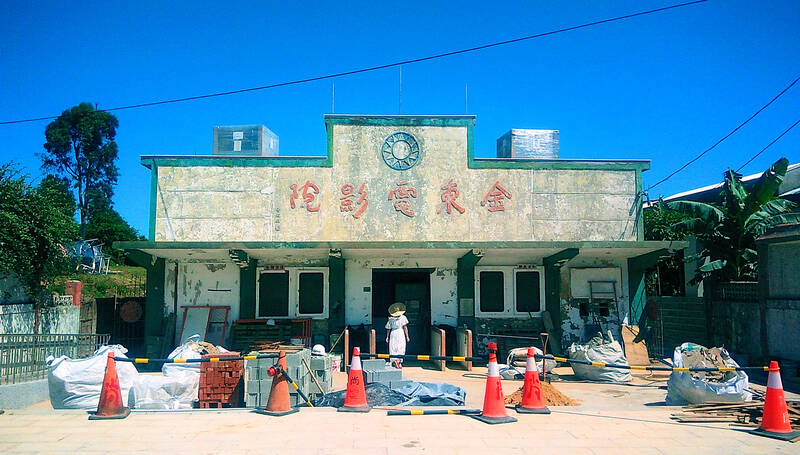
Jindong Theater during renovations in 2019
Photo courtesy of Wikimedia Commons
The theaters were often packed, with long lines forming to buy tickets. While waiting for screenings, people would visit nearby shops, often helping turn the surrounding streets into bustling business and entertainment districts.
But with the spread of television and the gradual reduction in troop numbers, the theaters began to go out of business in the 1980s. The privately owned Qiaosheng Theater (僑聲戲院), the last of the island’s original cinemas, closed in 2008, leaving Kinmen without a theater until Golden Lion Cinemax opened in 2014.
PRE-THEATER ERA
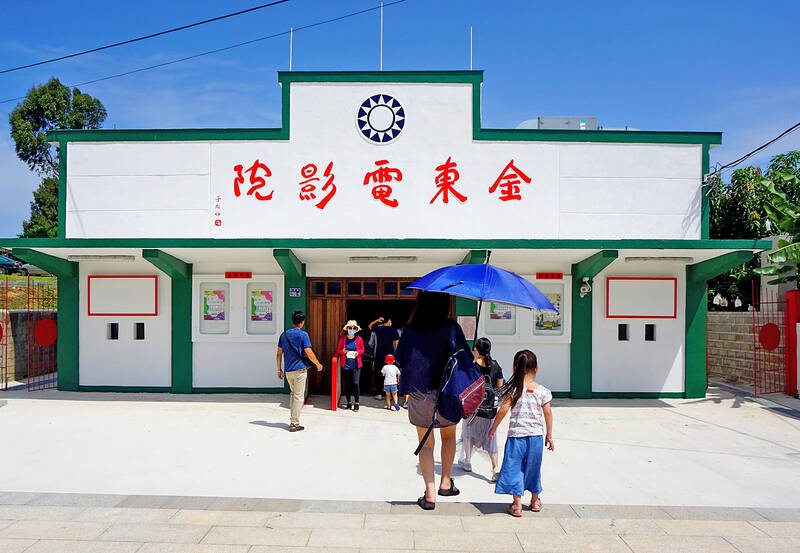
Jindong Theater today.
Photo courtesy of Wikimedia Commons
According to a study by Wang Hsien-jui (王賢瑞), the earliest recorded film screening in Kinmen took place in 1928. Wu Tien-shou (吳添壽), who had moved from Taiwan to open a photography studio on the island, rented film equipment from Xiamen and began charging admission for screenings at a local school. Newspaper reports described full houses at first, but screenings were frequently interrupted due to the operator’s inexperience, and audiences lost interest after a week.
During Japanese rule of Kinmen from 1937 to 1945, there were a few recorded instances of war propaganda movies being shown.
However, electricity limitations made it difficult to sustain a permanent cinema. A 1949 proposal to build a power plant was later abandoned after the Chinese Civil War reached Kinmen in October, when Chinese Nationalist Party (KMT) forces repelled a Communist landing during the Battle of Guningtou (古寧頭戰役).
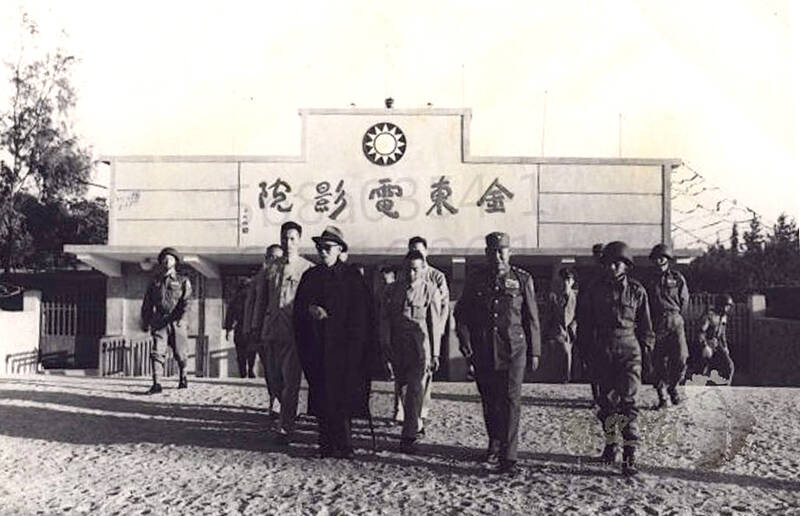
Then-president Chiang Kai-shek visits Jindong Theater in Kinmen in 1960.
Photo courtesy of Academia Historica
The battle turned Kinmen into a heavily fortified military frontline, and in 1956, the government formally placed the island under war-zone administration. Between 100,000 and 120,000 troops were stationed there. The military held periodic outdoor screenings at garrisons across the island, which were also attended by civilians.
With the help of Western Enterprises, a CIA front organization operating in Taiwan, Hollywood films that were not yet available on Taiwan proper were screened on Kinmen during the 1950s, according to a report by the Kinmen County Cultural Affairs Bureau.
MILITARY ENTERTAINMENT
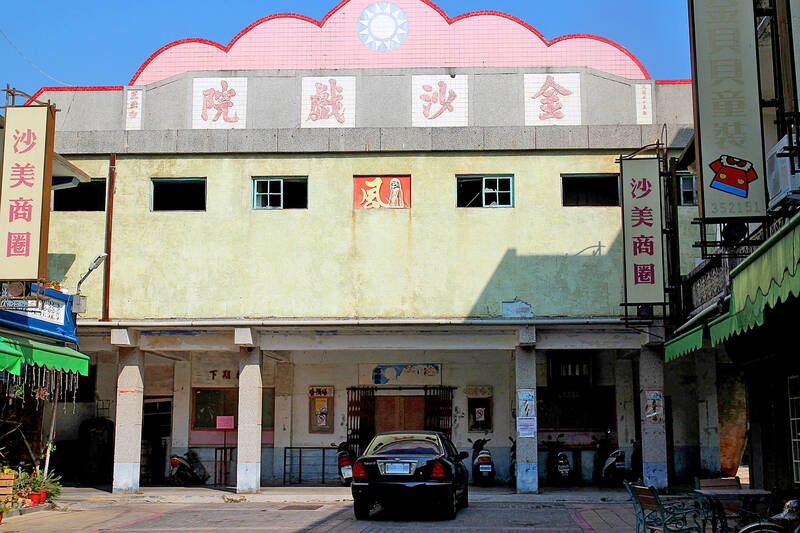
Jinsha Theater in 2019.
Photo: CNA
Kinmen’s first indoor movie screenings took place at Zhongzheng Hall in Jincheng (金城), which was built by the military in 1951 as a multipurpose venue for ceremonies, banquets, performances, seminars, weddings and other events.
After the People’s Liberation Army failed to capture Kinmen during the 1958 Second Taiwan Strait Crisis (also known as the 823 Artillery Battle), fighting largely subsided, although both sides continued shelling each other on alternate days.
Around 1960, the military began establishing cinemas in recreational centers across the island. According to the Kinmen County Cultural Affairs Bureau report, the earliest was Xiongshi Theater (雄獅戲院) in Jinhu Township (金湖), better known by its later name Nanxiong Theater (南雄戲院). It opened in September 1959 and lasted until March 1991.
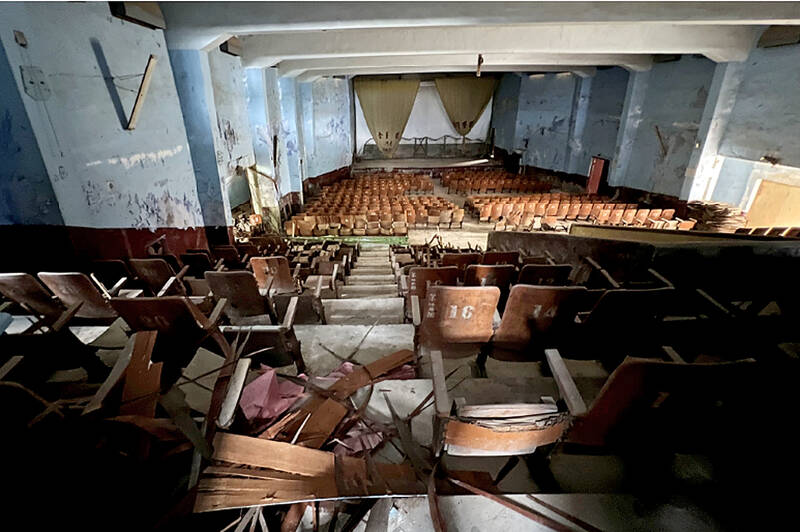
The interior of Jinsha Theater in February last year, before renovations.
Photo: Wu Cheng-ting, Taipei Times
In January 1960, Zhongzheng Hall was converted into the state-run Kinmen Theater (金門戲院). It closed in 1963 and became the assembly hall for Kinmen High School, a function it continues to serve today.
The first privately owned theater was Jincheng Theater (金城戲院), established in 1963.
Sources put the number of cinemas in Kinmen at its peak at 16 or 17, the majority of them run by the military or state. Five were owned by the Republic of China Army, one for each division, while two were established by the Kinmen Defense Command. The Navy and Air Force each operated one.
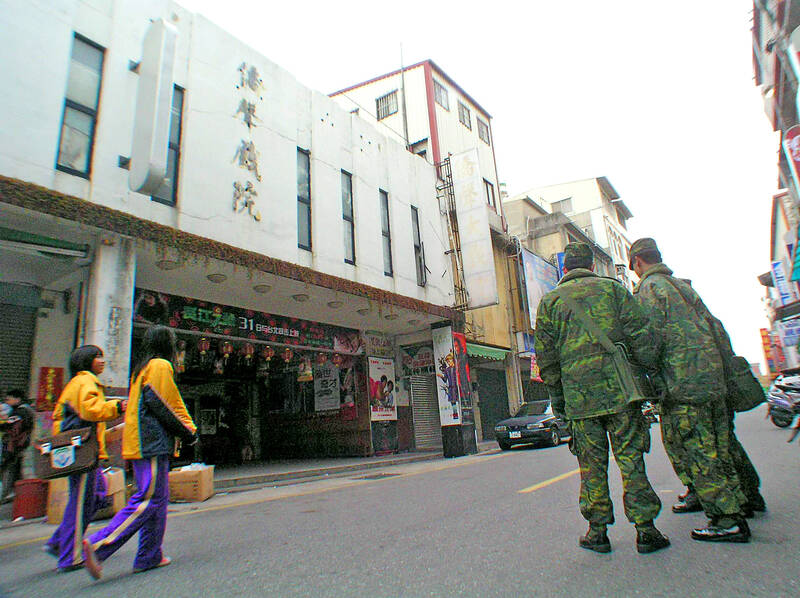
Qiaosheng Theater before its closure in February 2008. It was the last of Kinmen’s original cinemas to shut down.
Photo: Wu Cheng-ting, Taipei Times
The recreation hall at Chenggong Military Recreational Center (成功官兵休假中心), Qingtian Hall (擎天廳) and Qiaosheng Theater rotated film prints to screen first-run movies in step with Taipei. The screenings often played to full houses. Qingtian Hall was unusual in that it occupied a cavern blasted into Taiwu Mountain (太武山) for military purposes.
Nearby Lieyu Island (烈嶼) also had one cinema, which began as a rudimentary thatched-room structure built with earth. After inspecting the area, defense minister Yu Ta-wei (俞大維) allocated special funding for its reconstruction. Completed in May 1962, it was named Guoguang Theater (國光戲院), according to CNA.
PRESERVED STRUCTURES
After closing, some theaters were converted into other facilities, while others were demolished or fell into disrepair. Among the best-preserved former cinemas today are Jindong Theater (金東電影院) and Jinsha Theater (金沙戲院), both in Jinsha Township.
Jindong was built in 1960 with funds donated by then Taipei City Council speaker Chang Hsiang-chuan (張祥傳), who wanted to provide frontline troops with more entertainment options. The theater’s sign, bearing the KMT logo, features calligraphy by then-Control Yuan president Yu Yu-jen (于右任).
Tsai Chin-kuang (蔡金光) recalled in a CNA article that he served as the screening operator during his military service in the 1980s, running the theater with six other soldiers. They made extra money by screening advertisements for local businesses, he said.
Jinsha was a joint venture between the township office and local businesses, and its sign featured calligraphy by then-county magistrate, general Wang Yu-pai (王玉白). According to CNA, it was the first cinema on the island to install air conditioning, which greatly boosted summer attendance. Co-owner Yang Cheng-tung (楊振東) recalled that people sometimes bought tickets simply to escape the heat, often falling asleep during the show.
Both theaters closed in the late 1980s, as the military began reducing its troop numbers on Kinmen and new forms of entertainment, including MTV parlors and karaoke, competed for audiences. They have recently been renovated and repurposed as cultural and exhibition spaces.
After direct travel between Xiamen and Kinmen opened up in 2001, Chinese residents could easily visit Kinmen to watch movies banned in China. By then, only two theaters remained: the KMT-run People’s Recreation Center (民眾育樂中心) and Qiaosheng, which briefly closed in 2000.
Some Chinese visitors made a special trip to Kinmen for Golden Lion’s final day, recalling fond memories of watching movies on the island.
Taiwan in Time, a column about Taiwan’s history that is published every Sunday, spotlights important or interesting events around the nation that either have anniversaries this week or are tied to current events.
KioskNews shows a cleaned-up reading view extracted from the publisher’s page — the original always lives on their site, not ours.