Anwar’s balancing act on Myanmar? — Syed Hamid Albar
SEPTEMBER 19 — I understand why the Government is seeking a practical and durable solution to the presence of large numbers of Myanmar nationals in Malaysia, including the Rohingya. Malaysia cannot be expected to carry this burden indefinitely, and diplomacy requires engagement with difficult actors and the pursuit of solutions that serve both humanitarian and national interests.
But diplomacy is not simply about opening doors to anyone. It is about knowing what we want to achieve, building leverage and securing commitments before we make concessions.
That is why I do not believe that inviting Min Aung Hlaing to Malaysia is the right diplomatic move at this stage.
This is not about refusing to communicate with Myanmar or its leaders. It is about how we conduct diplomacy and what political value we choose to confer through that engagement.
A Prime Ministerial invitation gives Myanmar’s military leadership political access, international visibility and legitimacy. That is precisely why such an invitation should follow meaningful political movement, rather than precede it.
In serious negotiations, we establish our objectives, build leverage, seek reciprocal commitments and test whether the other side is prepared to change. We should not offer the diplomatic prize before the negotiation has even begun.
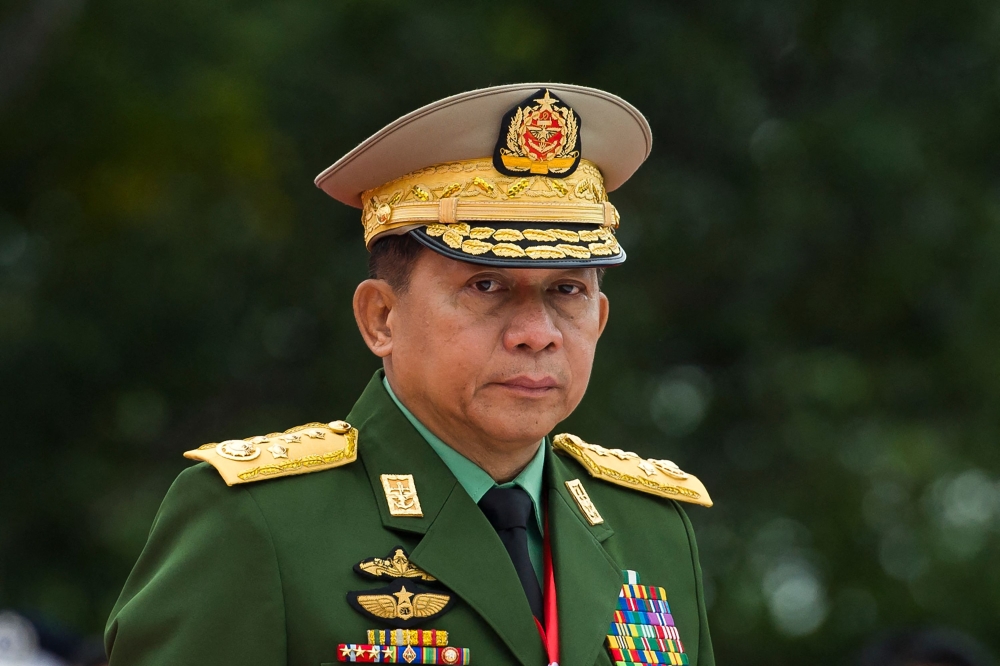
The author believes that inviting Min Aung Hlaing to Malaysia is not the right diplomatic move at this stage. — AFP pic
What has Myanmar actually committed to?
Today, the military continues to use violence against civilians, while political repression and violence continue across the country. There has been no indication that Naypyidaw is considering any amendment or abolition of the 1982 Citizenship Law which stripped
the Rohingya of their citizenship. They refuse even to refer to the Rohingya by their ethnic name — choosing instead to call them by the exclusionary and derogatory term “Bengali”. The situation facing the Rohingya in Rakhine State remains deeply insecure and legal protections are non-existent.
Of particular concern is the forced conscription and recruitment of Rohingya by the Myanmar military to fight the Arakan Army. This move is profoundly dangerous and destabilising. Forcing the already displaced and oppressed Rohingya into an ethnic conflict risks further turning them into targets, fuelling new cycles of violence and hatred, and triggering new waves of displacement.
More fundamentally, it risks cementing their permanent exclusion from Myanmar — making the conditions for safe, dignified and sustainable repatriation impossible to establish.
Repatriation cannot be separated from political reality
You cannot create the conditions for repatriation by forcing the very people you claim you want to bring home to fight in the conflict. That is a recipe for deeper hostility, further displacement and permanent exclusion.
There is also a fundamental political reality that Malaysia must recognise: the Myanmar military does not control most of Rakhine State. After five years of post-coup conflict, the Arakan Army has de facto control of the vast majority of the State.
Whatever one’s view of the Arakan Army, any serious discussion about the future of the Rohingya and the conditions for their return must take account of who exercises authority on the ground. That means that a bilateral discussion with Naypyidaw alone — and in particular with Min Aung Hlaing — cannot determine the conditions under which Rohingya will live and return in areas controlled by another armed authority.
This is why Malaysia should use its diplomatic weight differently.
Malaysia knows how to navigate conflict and difficult negotiations
Malaysia is not new to difficult political negotiations or conflict mediation.
Our experience in Mindanao and Southern Thailand has demonstrated the importance of understanding the interests and positions of different parties, building confidence, maintaining channels with difficult actors and ensuring that commitments can be monitored and implemented. These experiences have also taught us that dealing with conflict requires more than access to one powerful actor or a single high-level meeting.
Malaysia knows the difference between engagement and effective political negotiation. We know that access is not the same as leverage, that a meeting is not a negotiation, and that a promise is not a political settlement.
We should bring that experience to Myanmar.
A sustainable political settlement cannot be negotiated by one party alone, particularly when that party does not control most of the territory in which the Rohingya are expected to return.
Malaysia must protect the credibility it has built
There is another reason why we must approach this carefully: Malaysia’s international credibility and our commitment to international law.
In January 2020, the International Court of Justice unanimously imposed legally binding provisional measures requiring Myanmar to protect the Rohingya from acts prohibited by the Genocide Convention and, specifically, to ensure that its military does not commit such acts.
On 27 November 2024, the Prosecutor of the International Criminal Court applied for an arrest warrant for Min Aung Hlaing, alleging his criminal responsibility for the crimes against humanity of deportation and persecution of the Rohingya committed during the 2017 violence; that application remains for the Court’s judges to determine. These are not peripheral considerations.
Malaysia has rightly spoken forcefully on Gaza, insisting on international law, protection of civilians and accountability. We have argued that the lives and rights of civilians cannot become secondary to political convenience.
The same principles must apply to the Rohingya.
This is not about equating Gaza and Myanmar. They are different conflicts. It is about demonstrating that Malaysia’s commitment to international law and civilian protection is consistent and universal.
That consistency matters to our standing in Asean, in the Muslim world and in the wider international community.
Malaysia has built its foreign policy reputation over many years on being balanced, independent and principled — engaging even when we disagree, maintaining channels of communication while standing by our principles, and seeking practical solutions without abandoning international law.
This balance has been one of our diplomatic strengths. We should be building on it, not undermining it.
If Malaysia now appears to confer political legitimacy and prominence on the very military leadership facing international accountability for atrocities against the Rohingya, the reputational cost will not be confined to this particular issue. It risks raising wider questions about the consistency and credibility of Malaysia’s foreign policy.
Malaysia’s influence has never depended on being the biggest country or the most powerful country. It has depended in considerable measure on the credibility of our diplomacy — our ability to speak to different sides, maintain trust and act with principle while remaining pragmatic.
That is an asset we should protect, not spend lightly.
Malaysia can pursue diplomacy without legitimising Min Aung Hlaing. There are channels for communication that do not require us to confer the political legitimacy and prominence that a Prime Ministerial invitation would provide.
Malaysia’s engagement must be broader
Malaysia should start with Myanmar’s regional neighbours and engage the wider range of Myanmar stakeholders.
Bangladesh carries the immediate burden of the Rohingya refugee crisis. Thailand shares a long border with Myanmar and has dealt directly for decades with conflict, displacement and refugee movements.
Malaysia has already demonstrated during our 2025 Asean Chairmanship that we can engage a broad range of Myanmar stakeholders, including the military, democratic and ethnic political actors, and both Rakhine and Rohingya representatives, while maintaining our diplomatic position. We should build on that experience, not narrow our diplomacy to the Myanmar military alone.
Malaysia should use the relationships developed during our Chairmanship to engage Myanmar’s democratic and ethnic political stakeholders, Rohingya representatives and those exercising authority on the ground, alongside Bangladesh and Thailand and our wider international partners.
This is not about recognising or legitimising any particular actor. It is about engaging the political realities that will determine whether any agreement can actually be implemented.
From there, Malaysia can build a wider diplomatic coalition, including Türkiye, China and the United Nations.
One essential element should be the independent third-party monitoring of any future Rohingya return, including an appropriate role for the United Nations.
If Myanmar is genuinely serious about safe and sustainable return, it should be prepared to accept independent verification. Such monitoring would help establish whether return is genuinely voluntary and whether people remain safe after they return. It would also prevent the process from being controlled or manipulated by any one party.
The objective should not simply be to negotiate the movement of people across a border. It should be to create the political and security conditions in which people can actually return and remain.
What Malaysia can offer
Our leverage lies precisely in what we are able to offer — and when we choose to offer it. That leverage should be used to secure meaningful commitments, not surrendered at the outset of the negotiation.
Malaysia has something valuable to bring to this crisis: our diplomatic credibility, our relationships across the region and our experience in navigating difficult political processes. We have dealt with governments, armed groups, political movements and communities in conflict. We should draw on that experience now.
The invitation should be the consequence of meaningful political movement, not the inducement offered in advance.
Malaysia can be pragmatic without abandoning principle. Indeed, our principles are part of our diplomatic strength.
Malaysia should use that strength wisely — protecting our diplomatic credibility, preserving our leverage and positioning ourselves to lead a serious regional effort on Myanmar.
* Tan Sri Datuk Seri Dr Syed Hamid Albar is the former minister of foreign affairs of Malaysia and chair of the Malaysian Advisory Group on Myanmar
** This is the personal opinion of the writer or publication and does not necessarily represent the views of Malay Mail.
KioskNews shows a cleaned-up reading view extracted from the publisher’s page — the original always lives on their site, not ours.