Name mismatch, age difference and more: Why 3.3 million voters in Delhi received poll panel's SIR notice

Of the 3.31 million people who have been issued notices, 3.11 million (94%) have just a single reason listed against them.

 Prefer HTon Google

Not being mapped to the last SIR is the single biggest reason for the Election Commission of India (ECI) issuing notices to those on the draft electoral roll for Delhi, published on August 31 after the first phase of the Special Intensive Revision (SIR), accounting for 42% of notices.
This is followed by name mismatches with the previous roll, which account for most of the remaining notices, and age differences with parents or children that are too big or too small. However, a significant 59,791 notices have no reason listed against them.
These trends can be seen from the list of persons to whom notices have been issued, uploaded by the Chief Electoral Officer (CEO) of Delhi.
Also Read | EAM Jaishakankar, election commissioner among voters flagged for Delhi SIR data discrepancy
This list also shows that “reason for discrepancy” includes multiple reasons for 4% people who have been issued notices, that the average age of the person issued a notice is 40 years and that the oldest person issued a notice is 125 years old.
There is also significant variation in the percentage of electors who have been issued notices across assembly constituencies (ACs): From just 22.7% of the people on the draft roll in Matia Mahal AC to 44.2% in Badarpur.
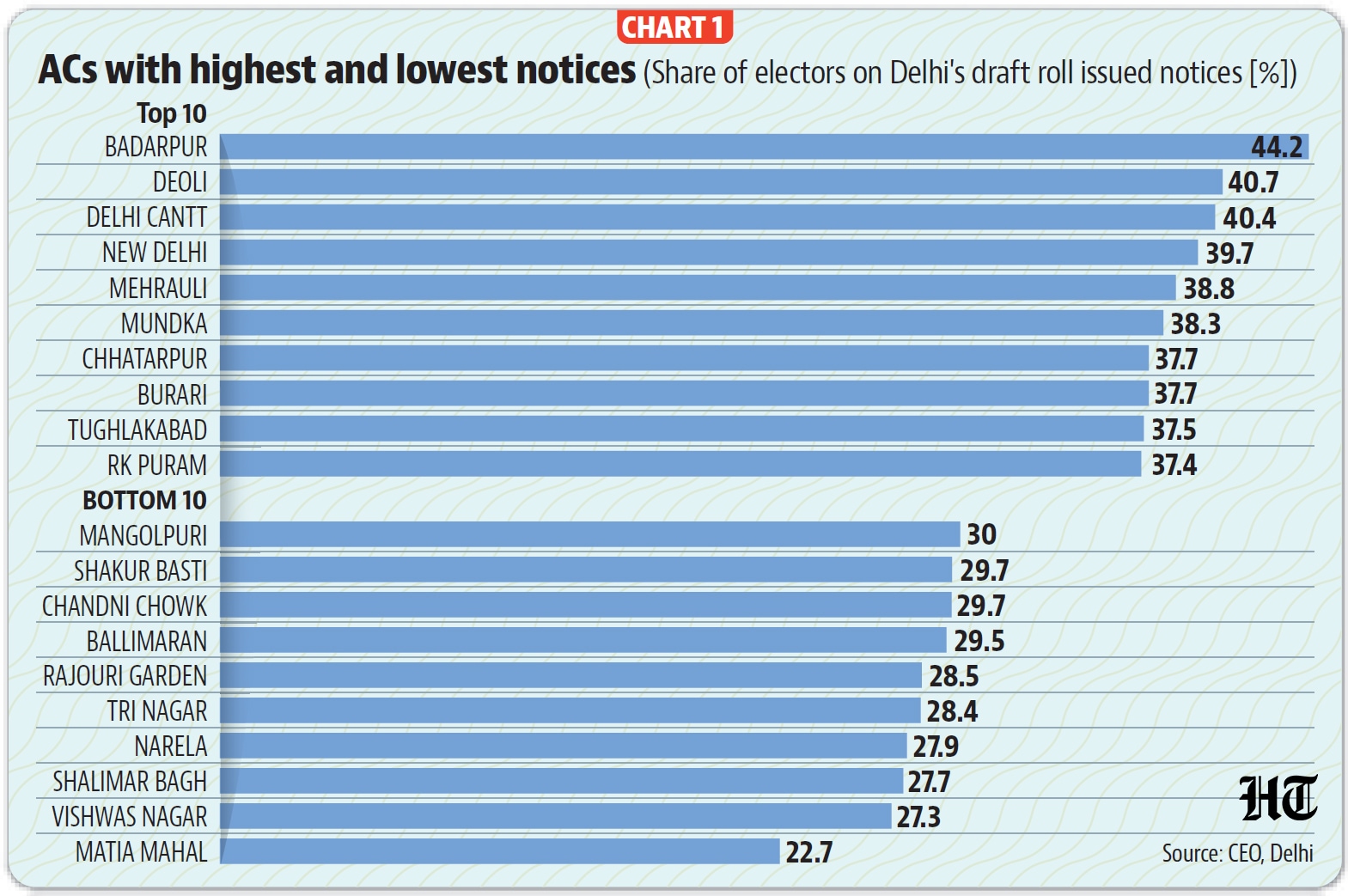
Of the 3.31 million people who have been issued notices, 3.11 million (94%) have just a single reason listed against them.
The 1.38 million who have been issued notices because they are not mapped to the previous SIR are among these 3.11 million people with a single reason listed against them.
However, those with logical discrepancies sometimes have multiple reasons listed against them. For example, around 128,000 notices have two reasons listed against them, around 9,000 have three reasons, and over 400 have four reasons listed. On the other hand, a significant 59,791 people have no reason listed.
Since some logical discrepancy reasons occur multiple times, HT has counted them as many times they occur to rank reasons by their importance. This shows name mismatches – either with one’s own name or that of parent’s – with the previous roll is the second biggest reason for notices. They account for 41% of notices issued, with “Parent Name Mismatch” accounting for 24% and “Self Name Mismatch” accounting for 17%.
A discrepancy in age difference accounts for 16% of notices. These include “Progeny Age Gap<9 Month”, “Parent Age Difference <15”, “Parent Age difference >50”, and “Grandparent Age difference <40”, which account for 6.4%, 5%, 2.5%, and 2.3% of notices. Close to 140,000 people (4.2% of notices) are also marked for having six or more children while 182 people have been marked for their parents being ineligible in last SIR.

The list also shows the age of people who have been issued notices. This shows that the median age – it is the middle value when a set of numbers is arranged in ascending or descending order – of the person issued a notice is 40 years. The oldest 20% of the people issued notices are of age 54 or above and the oldest 10% are of age 62 or above.
The oldest person served a notice is of age 125 years: Shyam Mukhija from Sadar Bazar AC of Old Delhi has been issued a notice for self-name mismatch. To be sure, Delhi’s population is somewhat older than India’s. According to population projections for 2026 made by the National Commission on Population, India’s median age in March 2026 is expected to be 30.27 years and Delhi’s 31.91 years.
A gender break-up shows that 34.5% of men on the draft roll have been issued notices compared to 33.4% of women. On the other hand, half of the 447 transgender people on the draft roll have been issued notices.
To be sure, these numbers must be read with the fact that four booths out of 14,947 in the Capital did not have a list uploaded as of 6pm on September 20, with their respective PDFs saying “No Notices generated for this Part No”.
To be sure, this should not change the major trends or the finding that a significant number of names on the list have no reason listed against them. The latter number was calculated using PDFs that have a table and where a person’s name, age, EPIC number and other details appear. Moreover, PDFs for nearly 400 booths said “No Notices generated for this Part No” on September 19, when the CEO’s website started uploading the list, most of which were updated with a table by September 20.

Abhishek Jha is Assistant Editor-Data at Hindustan Times. He uses statistical programming to generate newsworthy insights from large datasets. He is part of the team that produces Number Theory, a daily data story feature of the paper’s print edition. Since March 2024, he has been writing Weather Bee, a weekly column for the Hindustan Times website. He is a chemical engineer by training, who specialises in stories related to weather, climate, and the environment. Jha has been at HT since 2018, where he offers data-driven perspective and analysis on politics, environment, weather, climate, economy and society. His work includes data coverage of elections in India and abroad, including the 2019 and 2024 Lok Sabha elections; the disasters and extreme weather resulting from changing climate, such as floods, droughts, heat waves, cold waves, and dwindling snow cap in the Himalayas; the factors that drive poor air quality in northern India; the changing patterns of land use; the Covid-19 pandemic and its impact on labour market conditions; the changing pattern of consumer spending seen in the new consumer spending surveys; and social norms seen in the surveys such as the National Family Health Survey.Read More
KioskNews shows a cleaned-up reading view extracted from the publisher’s page — the original always lives on their site, not ours.