'A bullying atmosphere': UN's Israel obsession sidelines atrocities elsewhere, ex-UN official says
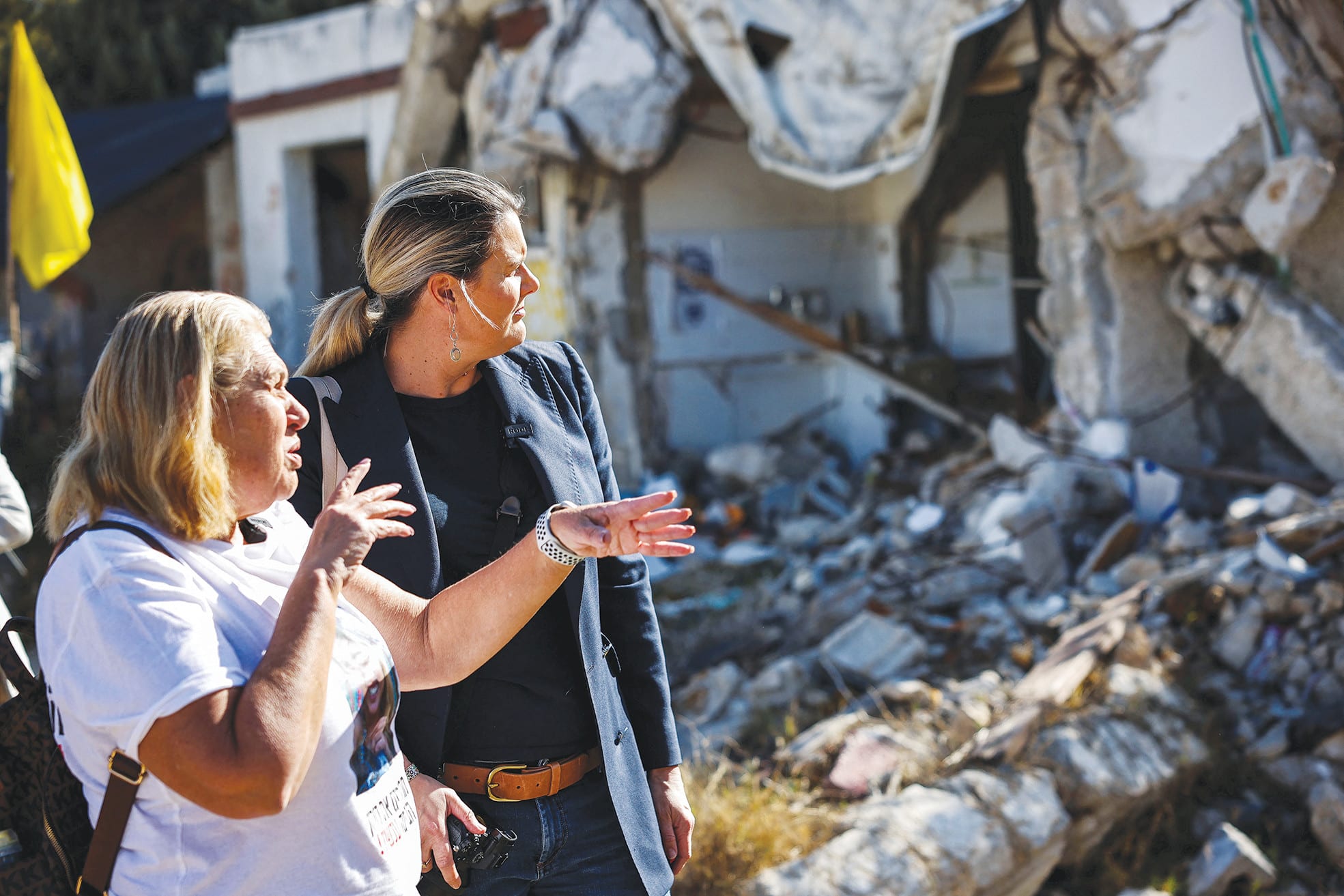
In December 2024, More than a year after Hamas terrorists stormed the Gaza border area, killing civilians in their homes, Dr. Alice Jill Edwards, who then served as the UN special rapporteur on torture, toured the kibbutzim where the massacre occurred.
“It was a very eerie experience,” Edwards recalls.
“It was more than a year after that great suffering. And yet some of the flowers had started to emerge out of the rubble. That is one of the images that stays with me very profoundly.
“The other thing that I can’t forget was the amount of bullet holes in ordinary people’s houses,” she says. “I walked into houses where the microwave oven had been shot to pieces or the fridge. These were civilians.”
Her conclusion is blunt: “I think if you can’t have empathy for this, then I worry about people’s general humanity.”

For Edwards, who served as the UN special rapporteur on torture and other cruel, inhuman or degrading treatment or punishment from 2022 to 2026, the visit was an opportunity to see the consequences of the October 7, 2023, massacre for herself. It also reinforced a conviction that would increasingly put her at odds with colleagues within the international organization.
“This is entirely unlawful under international law,” she says of attacks against civilians. “There are no excuses or exceptions. There are no rights under international law for this type of attack against civilians.”
Edwards is no longer serving as the UN’s torture rapporteur. That distance from the institution, she says, has allowed her to speak more openly about what she considers a deeply troubling failure in the international response to October 7.
“Look, we just had the third anniversary of the attacks, and there was still no investigation or documentation or report on those events by two of my colleagues, yet we have also quite a number of reports, rightly, in relation to Israel’s actions,” she says.
Her accusation is not that Israel should be exempt from scrutiny. On the contrary, Edwards insists that alleged violations by Israeli forces must be investigated. Her objection is that the same standards should apply when the victims are Israeli, and the perpetrators are Hamas or other Palestinian armed groups.
Edwards did produce a report in the months after October 7, as did UN Special Representative on Sexual Violence in Conflict Pramila Patten. But what followed, in Edwards’s assessment, was a prolonged period in which the issue received insufficient attention.
“After that time, there’s been a very long lag,” she says. “There have been occasional references to Hamas activities in Gaza, but very few and often buried within reports about Israel’s activities.”
'No real excuses'
She identifies two colleagues in particular: the UN special rapporteur on violence against women and the special rapporteur on the occupied Palestinian territories. In her view, both failed to engage adequately with the October 7 atrocities despite opportunities to do so.
“And I think that was deliberate,” Edwards says. “And I still think it is deliberate. There’s no real excuses for not having done so.”
Asked whether she had seen her colleagues attempt to interview survivors of sexual violence or other people who experienced the October 7 atrocities, Edwards answers simply: No.
“They had all the opportunities,” Edwards says of her colleagues’ responsibilities. “They are required to produce reports. They are required to engage in communications.”
One explanation offered for the lack of engagement, she says, was that Israel had not provided access. Edwards disputes that argument, noting that she herself was criticized for relying on Israeli information, even though she says her findings were based on independent sources rather than Israeli government material.
“It’s kind of a contradictory statement to say the reason we haven’t done it is because Israel wouldn’t give us the information and then to criticize me for relying on Israeli information,” she says.
For Edwards, the consequences of October 7 extend beyond the people murdered, wounded, or taken captive during the attack. They also include the families who were left wondering whether their loved ones were alive, where they were being held, and whether they would ever return home.
“Across all the many circumstances, including the very large-scale taking of 251 hostages on October the 7th, the family members themselves suddenly are launched into a situation of not knowing where their loved ones are, not having information about them,” she says. “That torment and distress is exactly what torture also is, psychological torture.”
'Obsession'
Her meetings with hostage families in Tel Aviv made that argument especially personal.
“It was very compelling to me when I was in Tel Aviv and met with some of the hostage families and the children of these hostages... four-year-olds who don’t know where their father is or their mother is, when they’re coming home, if they’re dead or alive; they can’t sleep at night.
“These are very traumatic experiences which can rise to the level of psychological torture,” she adds.
Her criticism of the UN extends beyond the handling of October 7. She believes the organization devotes disproportionate attention to Israel while failing to give comparable scrutiny to other conflicts in which civilians experience mass violence and abuse.
Asked about her use of the word “obsession” to describe the pattern, she defends the term.
“Yes, and I say it like this because every time Israel takes a step, does anything, there is a response,” she says.
She points to conflicts in Sudan, Yemen, and the Democratic Republic of Congo, arguing that grave violations elsewhere deserve much greater international attention.
“Do you know that there were 90,000 rapes in the DRC last year alone, documented and verified by the United Nations?” she asks.
According to the numbers she provides, there had been approximately 50 communications concerning Israel since October 7, compared with around 10 concerning Sudan. She says communications related to the war itself between Russia and Ukraine numbered in the mid-teens.
For Edwards, the figures raise a question about how international attention is distributed.
“Yes, we should be calling out governments; we should be calling out Israel for violations,” she says. “But we should also be making sure that we are being independent and impartial.”
The most troubling aspect, Edwards says, may be the atmosphere in which international human rights officials carry out their work.
She describes efforts by colleagues to soften the language of communications concerning October 7, followed by further attempts to prevent others from endorsing them.
“There were times when my colleagues, especially in the investigation on October the 7th, attempted to water down the language,” she says. “There were many, many efforts to change the language.”
Even after adjustments had been made, she says, there were efforts to ensure that other officials would not sign on.
“There was, and there is still, I think, an atmosphere of bullying and intimidation that you have one view only, and you cannot and should not be seeing the other side in the Israel-Palestine conflict,” Edwards says.
She believes that kind of environment undermines the very principles the UN is supposed to uphold.
“We should be able to do our work without feeling like if we speak out, there will be repercussions, there will be retaliation, that there will be consequences,” she says. “The atmosphere is such that it is very frightening to speak out.”
She describes a situation in which professionals may be excluded from events or sidelined in their work if they are perceived as holding the wrong position.
“Since I put out the article, I’ve had many lovely emails from people thanking me for speaking out,” Edwards says.
Some people, she adds, told her they had left the United Nations because they felt unable to perform their work in an atmosphere they believed should be grounded in human rights.
“We are in a dark space, I think,” she says.
A line of integrity
Edwards does not place primary responsibility for the situation on Secretary-General António Guterres. She says his influence over the conduct of individual rapporteurs was limited, although she believes stronger leadership would have been welcome.
“He’s also said it’s not his call. It would have been good to have more leadership,” she says.
She argues that the next secretary-general should make peacemaking and conflict prevention central priorities, alongside efforts to ensure that ceasefires and political settlements lead to a more secure future for people living through war.
The consequences of the dispute go beyond the UN’s human rights machinery. If Israel and other countries lose confidence in the organization’s impartiality, its ability to serve as a credible mediator in international conflicts may suffer.
“It’s regrettable the United Nations has been sidelined in the Middle East and in the Russia-Ukraine war,” she says. “That needs to be repaired with the new secretary-general.”
Yet Edwards also believes Israel has a role to play in restoring international confidence. She expresses disappointment at the lack of international observers in Gaza and at the absence of international access to prisons. She also suggests that Israel consider allowing international judges to participate in relevant judicial proceedings, without transferring the cases to an international court.
“It would be even better if that could be somehow adjusted to allow for international judges,” she says, suggesting that two international judges could participate.
“I think the reputation of Israel is also at an all-time low, and that needs to be improved so that they have the opening to be able to engage in a peace process,” she says.
She rejects the idea that her criticism of the UN should be understood as support for one side against another. Her work, she says, has involved investigating allegations against Israeli authorities over their treatment of Palestinian prisoners as well as examining abuses in other conflicts.
“In all the conflicts I deal with, we’re dealing with people, human beings who have families, who are living in communities,” she says.
“We must walk what I call a line of integrity, that when we see something, we investigate, we call it out when we can, we engage in quiet diplomacy or other strategies, and likewise if we see other violations.”
Her message is not that the organization should abandon its scrutiny of Israel. It is that the same commitment to evidence, empathy, and accountability must extend to every victim.
“I’m not biased towards one side or another side,” she says. “I want things to be fair.”
KioskNews shows a cleaned-up reading view extracted from the publisher’s page — the original always lives on their site, not ours.