Cambridge Dictionary pushes back on AI with ‘human’ as 2026 Word of the Year
Already have Rappler+?
to listen to groundbreaking journalism.
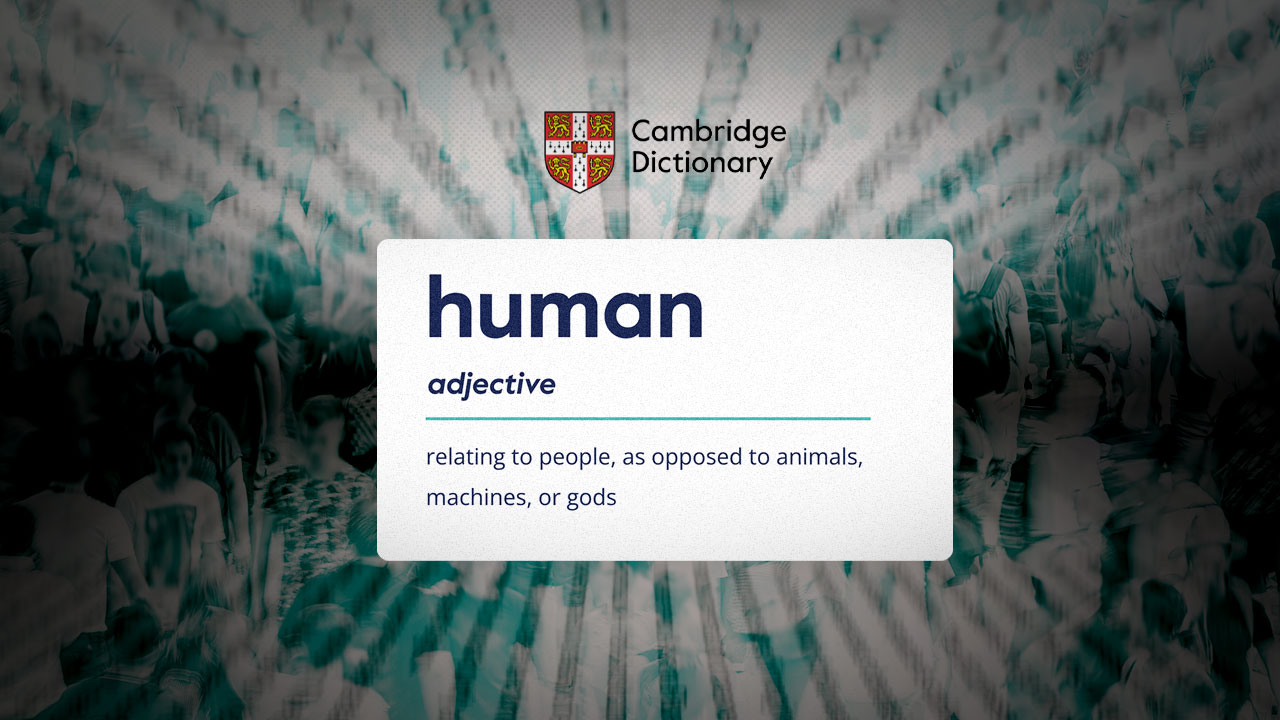
'In a marketplace saturated with AI content, humans have started to become a premium that is code for intention, care, judgment, and the imperfections that make something feel real,' Cambridge Dictionary says
AT A GLANCE
- Cambridge Dictionary has chosen 'human' as its 2026 Word of the Year, defining it as relating to people as opposed to animals, machines, or gods.
- The term 'human' is increasingly used in contexts that highlight the value of human creation in contrast to AI-generated content, emphasizing intention and imperfections.
- The choice reflects a societal re-evaluation of the human factor in various aspects of life, driven by the growing presence of artificial intelligence.
This is AI-generated. Read the article for full context. Report any errors.
MANILA, Philippines – As artificial intelligence technologies grow more ubiquitous, Cambridge Dictionary designated “human” as its 2026 Word of the Year.
In a statement announcing their pick, the organization defined “human” in the Cambridge Dictionary as an adjective “relating to people, as opposed to animals, machines, or gods.”
“Throughout history, the adjective human has signified people, as opposed to animals and gods (and, more recently, machines). Increasingly seen in compounds such as human-written, human-generated, and human-made, it now also denotes that something is created by or typical of people as opposed to AI,” Cambridge Dictionary writes.
Cambridge Dictionary added that as AI-generated context becomes more commonplace, “simply saying that something was made by a person has started to gain new meaning.” The involvement of the human being becomes part of the value and is expressly more notable in a time when generative AI can produce things at speed and scale.
“In a marketplace saturated with AI content, humans have started to become a premium that is code for intention, care, judgment, and the imperfections that make something feel real,” Cambridge Dictionary said.
Colin McIntosh, Cambridge Dictionary chief editor, said of the choice: “Artificial intelligence has been a growing presence in society for years now, but this year it seemed to be everywhere. In many areas of life this has led to a re-evaluation of what it means to be human, as a counterbalance to AI.”
“2026 has been all about a refound appreciation of the human factor in what we consume (with a consequent human premium), and a new value is being placed on the human element in our lives in general: all confirmed by our analysis of the language data, internet trends, and search habits. With that background, human was the perfect choice for our Word of the Year,” McIntosh added. – Rappler.com
KioskNews shows a cleaned-up reading view extracted from the publisher’s page — the original always lives on their site, not ours.