The ‘loneliest place on Earth’ is a spectacular NZ spot most Australians miss
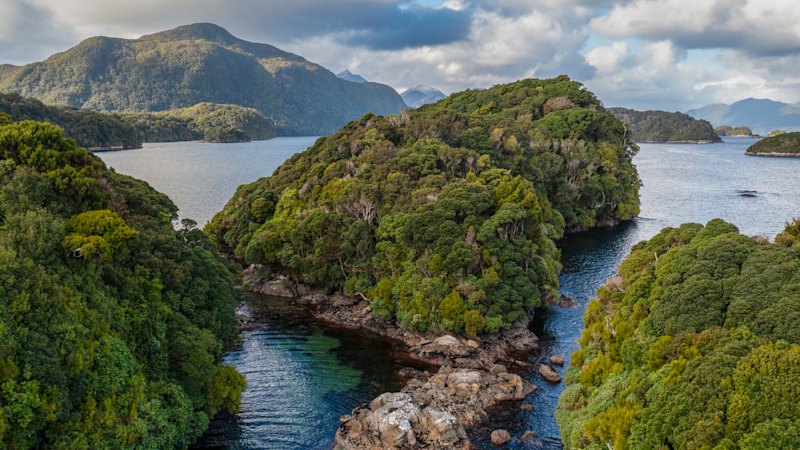
In 2025, 1.6 million cruise ship passengers visited Norway’s fjords, a record for that country. In the southern hemisphere’s version, New Zealand’s Fiordland, only its northern-most fjord, Milford Sound, garners real interest.
Fiordland is made up of 14 fjords in the south-west of the South Island, spread across 12,000 square kilometres of a World Heritage-listed national park and is serviced by a handful of expedition boats.
Mine is an 18-passenger, 24-metre-long cruising catamaran built for these fjords, and it’s not until day six of a six-night expedition that we actually see any other vessel at all – a lobster boat, with a crew of three.
Captain James Cook was the first non-indigenous visitor here. On Cook’s second expedition in 1773, his naturalist, Johann Forster, described Fiordland’s isolation: “Here, was the deepest silence. Nature was hushed, not a breath of wind penetrated to this sheet of water enclosed by high mountains and great forests.”
In the 250 years since, nothing appears to have changed: there are no roads in, no towns, no indication humans were ever here at all. “Fiordland has to be the loneliest place on Earth,” our skipper, Francis Brundell, says. “It’s a beast. God, I love it.”
Sign up for the Traveller Deals newsletter
Get exclusive travel deals delivered straight to your inbox. Sign up now.
Why Fiordland has been overlooked by Australian cruisers is anyone’s guess. Of the 1.48 million Australians who visited New Zealand last year, fewer than 1000 came here on expedition boats.
Meanwhile, many visited Milford Sound – in 2025 about 800,000, three-quarters of that number from overseas – but there’s a paved road in.
Yet, it’s easier than you’d think to get this remote. Norway might be on the other side of the world, but I fly to Queenstown in less than three hours. It’s then a two-hour drive to the village of Te Anau, where a 45-minute helicopter ride gets me to Preservation Inlet on New Zealand’s south-western-most point. Total travel time: less than six hours.
Not only is the helicopter flight convenient – as the pilot threads a path through tall snow-capped mountains, it provides a sense of scale to this wilderness. We emerge a couple of hundred metres above Preservation Inlet where our boat, Fiordland Jewel, sits at anchor, a helipad on its top deck.
We will travel north from here through Chalky Inlet, Dusky Sound and Breaksea Sound, finishing in Doubtful Sound.
Though exactly where we go is anyone’s guess, even the skipper’s. “I know the beginning and the end point,” Brundell explains. “Then the rest is set by the weather. You can’t plan a trip in Fiordland, no two trips are the same.”
As we set off, bottlenose dolphins zero in on our bow, riding the waves we generate. These dolphins grow up to four metres long and weigh as much as a horse. I watch them surf from a small deck at the very front of the boat, their faces turn up to gawk at me. There are Fiordland crested penguins here too, and New Zealand fur seals. Both seem curious as we pass.
When we anchor for the night, the silence is claustrophobic. Rain, a constant in these fjords, turns the steep slopes of the heavily forested mountains around us into waterfalls as far as I can see.
In the frigid evening air, the best place to observe Fiordland’s cascades (you won’t be able to count them all) is from the hot tub on the top deck.
Visiting Fiordland, with its vegetation almost completely untouched over time, is one of the best ways to time travel to the ancient supercontinent Gondwanaland. In this twilight, it’s other-worldly.
This part of New Zealand has the longest European history of anywhere in the country. Once, more people lived here than anywhere else in New Zealand.
In 1773, Captain Cook spent five weeks repairing his ship in Dusky Sound, which we reach after a bumpy ride on the Tasman Sea beside migrating humpback whales (the characteristics of fjords are such that they are separated by sea, so pack your sea legs).
We retrace Cook’s crew’s foot expeditions. The forest paths take me beneath 1000-year-old beech trees and through thick green rainforest, where the sound of water cascading and running along swollen creeks is deafening. Here there are birds thought extinct; others such as the kakapo, the world’s heaviest parrot, are on the brink of extinction.
One afternoon, we hike along and up a steep forest trail for two hours and are rewarded with the sound of two kakapo squawking in the canopy.
A fellow guest – who says he’s hiked practically every square inch of New Zealand except here – has tears in his eyes when he tells me that these are the first kakapo cries he’s ever heard. Another morning, I kayak across the fjords as inquisitive fur seal pups in the shallows, and dolphins in the deep, pass close by.
After inspecting Cook’s maps of Dusky Sound, sealers and whalers arrived and established the first European settlements in New Zealand. In Preservation Inlet, gold was discovered resulting in a mini-boom and a township called Cromarty. Only the skeletons of these mines and buildings remain.
Some days we help the crew drop lobster pots into the water and return the next to haul the pots, full of southern rock lobsters, up. Our chef serves the crustaceans, which can weigh up to nine kilograms, alongside blue cod and hapuku (groper) caught at sea between fjords. With such a small passenger load, meals are communal.
Every day brings a new hike, or paddle, or a fishing session off the bottom deck. Though some days I prefer to simply stare at the surroundings, imagining Cook and his men battling their way through these dark tannin-stained waters, where deep-water marine species are tricked into living close to the surface.
It comes as a shock when, on day seven, we reach Doubtful Sound and see two small passenger boats. Apart from the lobster boat, we haven’t seen another person, or a building (which wasn’t a wreck), or even a single power line or communication tower.
We take a dirt road to Manapouri where a ferry waits to take us across a lake and then we drive back to Queenstown.
We mightn’t be far from civilisation as the crow (or helicopter) flies, but as soon as I leave this place it’s difficult to remember it in any detail. Why? That’s likely to be because nothing in the rest of my world is remotely like it.
THE DETAILS
FLY
Fly to Queenstown with Virgin Australia, Jetstar or Qantas. See virginaustralia.com; jetstar.com; qantas.com
CRUISE
Fiordland Discovery’s six-night Southern Fiords tour includes meals, activities, helicopter ride in and coach out, $NZ8500 ($6893) a person in a Captain Cook cabin that sleeps two. The season runs from May to September. See fiordlanddiscovery.co.nz
MORE
fiordland.org.nz
The writer travelled courtesy of Fiordland Discovery.

KioskNews shows a cleaned-up reading view extracted from the publisher’s page — the original always lives on their site, not ours.