Asian Games put regional sports in limelight
One of the joys of the Asian Games is stumbling onto sports that do not get wide attention beyond the continent. There are many regional sports being played — sepak takraw or wushu or kurash, for instance — but the curiosity champion is probably kabaddi.
The Games offer all the Olympic regulars, but they share the stage with the regional offerings that are not dominated by powerhouse countries such as China and Japan.
Kabaddi origins are believed to be on the Indian subcontinent, and it is so popular that professional leagues there draw millions of viewers. It is a contact team sport, and early history says it was played to enhance strength, agility, breath control and self-defense skills.
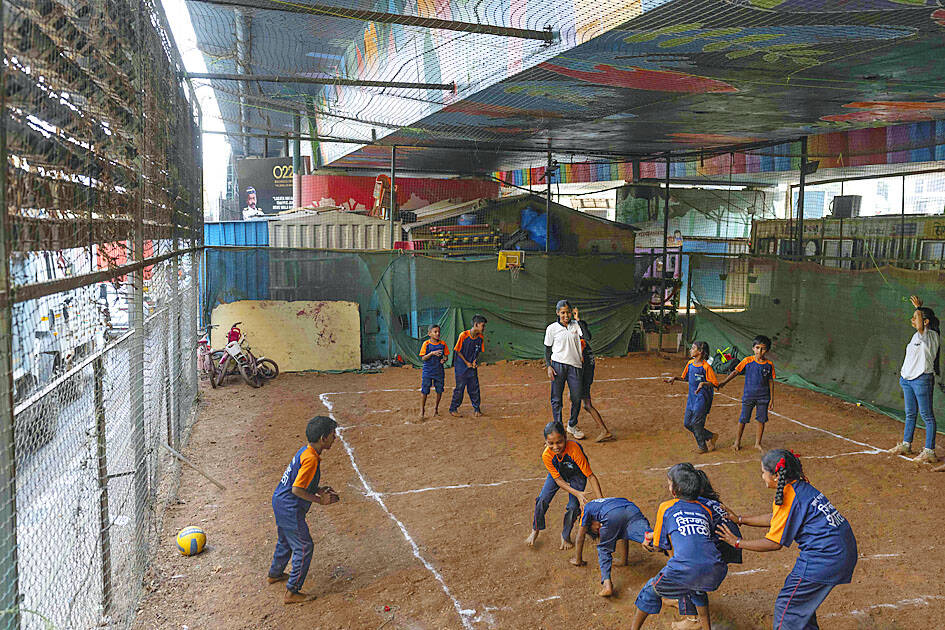
Students play kabaddi at the Signal Shala school in Thane, India, on April 3 last year.
Photo: AP
India won both finals in these Asian Games, defeating Iran on the women’s side 37-34. The Indian men defeated Iran 40-34.
Pawan Kumar, a top Indian player, talked after the victory the same way any winning team player would, explaining strategy, in-game adjustments and delving into the nuances of the game.
“Once we had the lead, we wanted to protect it,” Kumar said. “So we played [it] safe ... and used the time available to us. That helped us maintain our advantage until the end.”
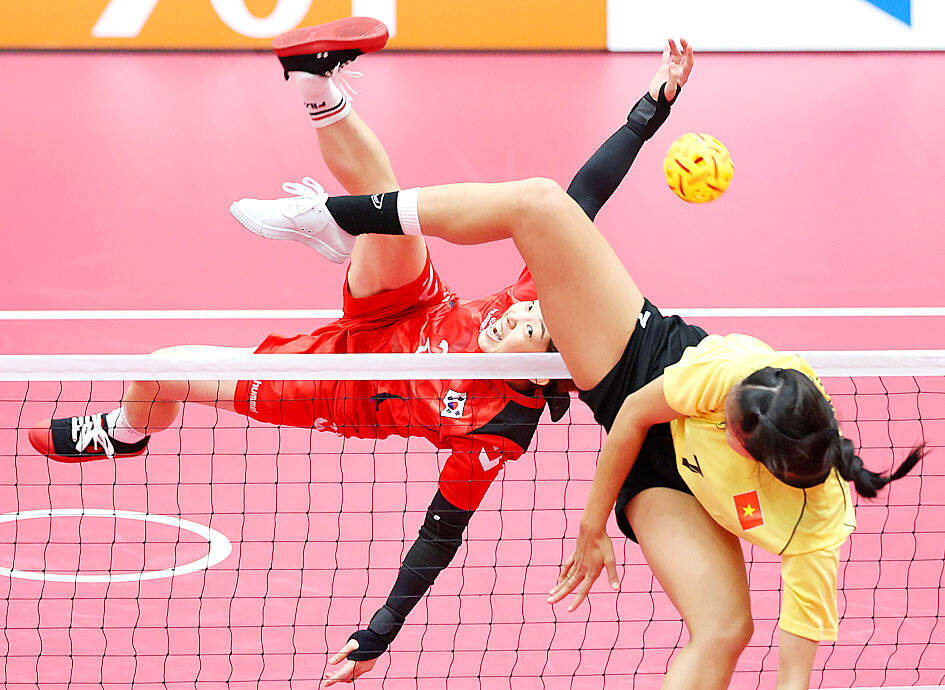
Han Ye-ji, left, of South Korea kicks the ball during their sepak takraw women’s doubles semi-final against Vietnam in Nagoya, Japan, yesterday.
Photo: EPA
The sport involves no ball, no bat, no goals, no rackets. It showcases tags, tackles and wrestling moves, and was played in the 1936 Berlin Olympics as a demonstration sport, but did not gain a global following,
The sport bears a rough resemblance to the schoolyard game known in the US as “red rover,” or a game known in England as “British bulldog.”
In the format used at the Asian Games, two teams with seven players each compete on a small court. The court is rectangular, but another version is played on a circular surface.
A single player on the offense — called a “raider” — crosses the centerline and tries in 30 seconds to touch as many players as possible on the other side and return across the centerline without being tackled.
It is played in a pair of 20-minute halves. Points are earned by tagging opponents, or by stopping the raider.
Meanwhile, sepak takraw is essentially volleyball, with a few big differences: Players cannot use their hands — they can use anything else — and the ball is primarily kicked over a 1.55m high net. There are two, three or four players on each side. In the US, the sport is often known as “kick volleyball.”
Like volleyball, the goal is to get the ball to hit the ground on the opponent’s side of the net. The ball is smaller than a volleyball or soccer ball — about the size of a cantaloupe or a large grapefruit . The game has its roots in Southeast Asia.
Wushu, also known as kung fu, is the Chinese term for “martial arts.” It has had a presence in the Asian Games since 1990 when it was introduced at the games in Beijing. It has also been proposed as an Olympic sport, but has never been voted in.
Competition in taolu involves performing sets and choreographed routines that show off principles of attack and defense. Sanda is the full-contact version of the sport and is often known as Chinese kickboxing.
Kurash involves a range of folk wrestling styles that are popular in Central Asia. It was first introduced into the Asian Games in 2018 in Indonesia when Uzbekistan topped the medal table in the sport. Historians say the sport dates back thousands of years. Taiwan, Iran, Mongolia and India also won multiple medals in 2018.
KioskNews shows a cleaned-up reading view extracted from the publisher’s page — the original always lives on their site, not ours.