Bilic is back: bravery and belief underpin second coming as Croatia manager

“I don’t believe in comebacks.” Slaven Bilic sat in the lobby of a hotel in Canary Wharf wearing a black Soundgarden T-shirt and dark denim, confidently discussing a wide variety of topics ranging from Sir Alex Ferguson’s autobiography to historical epics of Yugoslav cinematography and Nikola Tesla’s celibacy. He was living the good life in London, just before his third Premier League season as West Ham’s manager, and a rare interview for Croatian media was a chance for him to catch up with domestic intrigues.
“I’m now distanced by default, geographically,” he said, breathing a sigh of relief, before continuing to jump from subject to subject; a bit about a Metallica concert, then a bit about steaks at an Argentinian restaurant, followed by some off-record anecdotes. He was clearly enjoying himself and didn’t hesitate to show it; his time as Croatia’s manager seemed long gone, although he always left a bitter-sweet aftertaste when talking about them.
“I have nice memories and wouldn’t want to spoil them,” he said. “I don’t like coming back. It’s not the fear of failure, just the feeling that something has run its course.”
And yet, here we are now. Nine years after that interview – and 14 since his first spell as Croatia’s manager ended – Bilic is back at the helm and preparing to face England in Rijeka in the Nations League on Saturday. Between times there was the Saudi Pro League and Chinese Super League, as well as West Brom and Watford, and no work for 23 months from August 2024.
Age has added some sophistication to Bilic’s appearance, his styling resembling a patchwork of homages to great football managers of our time (the Klopp/Guardiola salt and pepper beard, the Bielsa glasses on a string, the Simeone all-black wardrobe), but he is still unmistakably himself: direct, eloquent and above all passionate, so different from his predecessor Zlatko Dalic’s restrained and humble, almost priest-like, persona.
In July, on Bilic’s first public appearance back in the job, it was as if somebody had opened the windows and let in fresh air. The 58-year-old remains the man; he knows how to charm and capture attention.
No coach would find it easy to succeed Dalic, who made history with Croatia, leading them to second and third at the World Cup, but Bilic was always the best choice: not only because he knows full well what he is dealing with but also because there is a lingering sense he laid the foundation for the success.
The sense is that he started to plant what blossomed into Luka Modric’s and Dalic’s team; that he made Croatia dream big for the first time since his generation of 1998 as a player, a cornerstone being the famous 3-2 victory at Wembley in 2007, when Croatia won not because they needed to but because they could and felt fully confident in their strength.
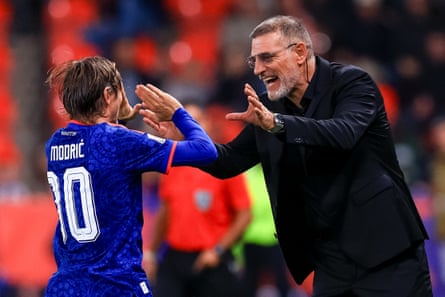
Bilic is also probably the only one who could have convinced Modric to stick around for a while. Fittingly, the 41-year-old Modric scored the first goal of the second Bilic era, in a 2-1 win in Prague against Czechia last Saturday, and rushed to embrace his manager. “Luka is everything to us, he’s just incredible” Bilic said.
after newsletter promotion
When it comes to his managerial work, Bilic needs to prove himself again. He is inevitably no longer the manager he was during his first reign and it remains to be seen how he can apply his experience. It is too early to tell after two games – the second a 4-1 away defeat by a vastly superior Spain, for which he rotated heavily – but there are clues.
Under Dalic the team often waited and relished their underdog role, then were deadly on the counter, despite not having many quick players and despite a creative midfield being their main strength. Bilic wants to dominate; he wants his players to press high, take more risks and for more players to arrive in the opposition area. He wants his centre-backs to step up with the ball rather than wait for Modric or Mateo Kovacic to drop back to the edge of the box and take possession. He wants his team to be brave, attacking and as passionate as he is.
Can he do it with a squad that, despite significant infusion of fresh blood over the years, is still dominated by veterans such as Modric, Kovacic and Ivan Perisic? He believes he can.
Bilic always believed. In 2012 he believed his Croatia could win the Euros (they went out in the group stage) and now he says he can match Dalic’s success. Maybe he really didn’t believe in comebacks nine years ago, but that didn’t stop him keeping faith in bigger things.
KioskNews shows a cleaned-up reading view extracted from the publisher’s page — the original always lives on their site, not ours.