Australia war-gaming use of nuclear-powered subs in conflict with China
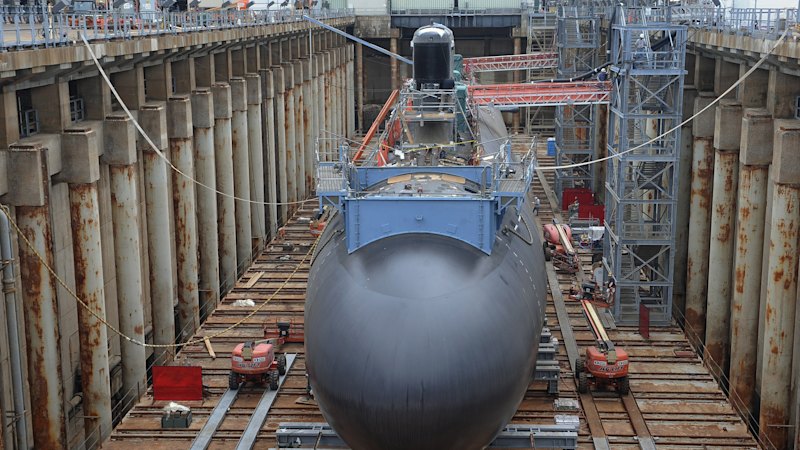
Washington: The Australian Defence Force is participating in war games this week that simulate a regional conflict with China and how US submarines, as well as those to be acquired under AUKUS, would be utilised.
The war games are being run in Canberra over three days by the Washington-based Hudson Institute, a conservative think tank that regularly models the likely permutations of military conflicts and contingencies, along with the United States Studies Centre.
Bryan Clark, director of the Centre for Defence Concepts and Technology at the Hudson Institute, said half the participants came from the ADF, while US and Japanese military personnel made up a quarter, and the rest were civilian experts.
“We’re paying for it, we’re sponsoring it, they’re participating,” Clark said. “We give them the entire ADF to play with”, as well as the US nuclear-powered submarines that are due to rotate through Submarine Rotational Force (West) near Perth from next year.
“If Australia comes under attack, these SRF submarines are going to be pressed into service to defend Australia because they’re already there, and we have an alliance relationship, obviously,” he said.
“What we want to see is how do the teams use these submarines along with the rest of the resource, and what’s the most valuable mission they could be doing.”
Countries routinely conduct or participate in war-gaming exercises, and in the United States, it is common for think tanks to lead them. The Hudson Institute has run war games in Canberra previously, such as a 2024 activity focused on uncrewed systems, held at the government’s Joint Experimentation and Wargaming Laboratory.
But the new focus on nuclear-powered submarines, which will soon be based in Western Australia, demonstrates the AUKUS agreement progressing from theory into military practice, and underlines the seriousness with which the militaries regard a potential conflict.
Clark, speaking in Washington this month, worried Australia was yet to convince the public of the utility of AUKUS and the nuclear-powered submarines it will spend tens of billions acquiring.
“I feel like the ADF, the Australian government, hasn’t made the case for how they would use them and why it’s important to buy them,” Clark said.
“I think that will be important as we get further down the line, and it actually gets to the point where you are actually spending the money on buying them.”
Under AUKUS, Australia is due to acquire three nuclear-powered submarines from the US, starting in the year 2032, before building a new AUKUS-class nuclear-powered submarine with the United Kingdom.
Defence and security expert Jennifer Parker, an adjunct professor at the University of Western Australia, noted the Defence Force always conducted war games. “They would be regularly war-gaming the most dangerous scenario for our region ... this would likely include the prospect of regional conflict,” she said.
Parker shared Clark’s concerns about the likelihood of a conflict in the near term.
“My impression is that the ADF senior leadership is deeply concerned about the prospect of a major conflict in the coming years.
“There is a deep disconnect between the thinking in the ADF, I would say, and the public understanding of the risk.”
A Department of Defence spokesperson said a small cohort of ADF personnel were taking part in the tabletop exercise, titled Defending Australia in a Post-Dominance World.
“Defence routinely engages in simulated tabletop exercises, aiming to enhance operational understanding and capabilities with our partners,” they said.
The war games come exactly a year after US President Donald Trump affirmed AUKUS was “full steam ahead” during Prime Minister Anthony Albanese’s official visit to the White House.
Get a note directly from our foreign correspondents on what’s making headlines around the world. Sign up for our weekly What in the World newsletter.
KioskNews shows a cleaned-up reading view extracted from the publisher’s page — the original always lives on their site, not ours.