Malaysian Indian youths see education system as source of discrimination, Iman Research report finds
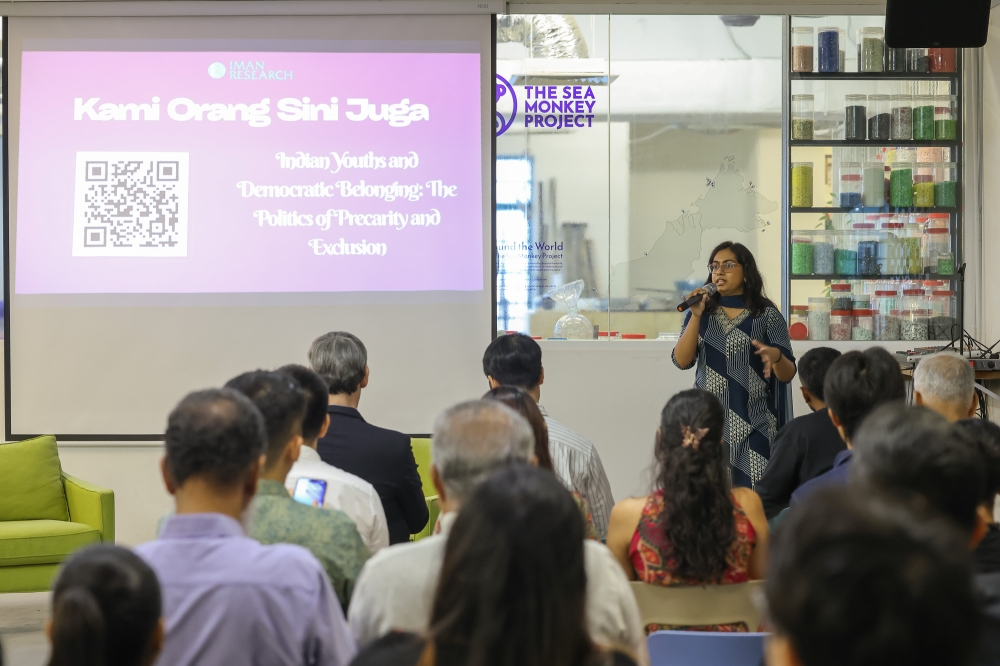

Researcher at Iman Research Shaleen Surendra speaks during the Indian Youth Report launch in Kuala Lumpur, November 12, 2026. — Picture by Yusof Isa
By Milad Hassandarvish
First Published: Thursday, 12 Nov 2026 6:03 PM MYT
KUALA LUMPUR, Nov 12 — Indian youths in Malaysia see the national education system as a significant source of discrimination rather than a pathway to social mobility, according to a report released today by Iman Research.
The study, titled The Kita Orang Sini Juga – Indian Youth Report, found that students experienced social alienation and institutional bias throughout their schooling, sometimes at the hands of those responsible for guiding their development.
The report cited a 2021 survey by youth movement Sekolah Semua, which found that nine in 10 Indian students felt they had experienced discrimination because of their ethnicity; based on 2,441 responses nationwide, 73 per cent said they faced discrimination from their peers, while 74 per cent reported similar experiences involving teachers.
Discrimination in schools
Drawing on interviews with 111 Indian youths nationwide, Iman Research documented instances in which educators, who were expected to act as mentors, allegedly reinforced negative stereotypes and made students feel unwelcome.
One respondent described being denied leadership opportunities at a semi-urban school and repeatedly made to feel inadequate by teachers.
“The teachers would directly tell me, you can come from this interview, but I’ll tell you now itself, I will not give you this position... It really made me feel so inferior in that school.
I’m really such a nobody here. I cannot do anything. I cannot grow,” the report quoted the youth as saying.
Another respondent recalled an incident in which a Bahasa Melayu teacher allegedly used derogatory language to distinguish between Indian students based on their perceived behaviour.
“[The] BM teacher came into my class one day, straight up used ‘keling’. He said, ‘you budak India ke budak keling?’ Yeah, then he pointed at me and said ‘kalau you India you baik, kalau keling macam-’ then he pointed at other [Indian] students,” the youth recalled.
The report said such experiences could leave students feeling isolated and pressured to navigate “respectability politics”, whereby they felt compelled to behave exceptionally well to avoid negative generalisations about their community.
Structural barriers
Beyond individual experiences in classrooms, the report identified the matriculation quota system as a structural obstacle for Indian youths seeking access to higher education, with limited places and inadequate educational resources contributing to frustration among respondents from different states.
It also highlighted concerns over access to mother-tongue education and challenged the assumption that national schools automatically foster unity, noting that Indian students continued to encounter segregation and “ingroup-outgroup” dynamics, which could be learned from their surroundings, including parents and teachers, from as early as kindergarten.
The report further found that socio-economic status did not necessarily shield Indian students from discrimination, citing the experience of a middle-class student who was initially blamed by teachers after being physically attacked by a group of peers.
“It was five or six versus one. It was a physical fight. I got scolded once the fight ended and blamed, and when the teachers found out they didn’t realise at that point that my mum was a teacher, but when they found out then they were like, I remember the teacher apologised for scolding me,” the report quoted the youth as saying.
The report concluded that failing to protect students from discriminatory behaviour risks normalising racism and weakening young people’s confidence in institutional fairness, ultimately shaping how they view their political influence and place in Malaysian society.
KioskNews shows a cleaned-up reading view extracted from the publisher’s page — the original always lives on their site, not ours.