Milei could benefit Peronists by scrapping PASO primaries
President Javier Milei’s government is trying, but struggling, to change next year’s electoral rules by once again suspending the compulsory PASO primaries, an electoral artifact created 15 years ago.
The primaries were also suspended for the 2025 midterm elections. The official argument is that they are expensive in a context of strict fiscal austerity. The unofficial reason is that without primaries, the Peronist opposition would find it more difficult to sort out its leadership problem.
This latter argument is debatable and reality might challenge that assumption. Without primaries, the Peronists might find an incentive to unite early in the electoral year, rather than splitting into as many candidates as there are factions.
President Milei said confidently this week that he will win re-election in the first round in October 2027. For now, polls do not support that claim, although they are more often off than on target and there are still 11 long months to go until the vote. Yet Milei and his sister, presidential chief-staff and ruling party political orchestrator Karina Milei, are pinning too much hope on electoral reform – a push which also includes the scrapping of compulsory presidential debates – being part of the administration’s winning hand.
The primaries are a double-edged sword: arguably, Milei would not be president without them. Since they were introduced in 2011, no ruling party has used them meaningfully to pick its presidential candidate, but there have been two meaningful opposition primaries: one resulted in victory for the opposition and the other in defeat.
In 2015, Mauricio Macri used the primaries to give his candidacy more political muscle, competing with the centrists Elisa Carrió of the Coalición Cívica and Ernesto Sanz of the Unión Cívica Radical. Macri bagged 80 percent of the votes in the primary and emerged stronger as the leader of the Cambiemos alliance, going on to defeat the Peronists in the second round.
But in 2023, the PASO primaries ruined the chances of Cambiemos’ successor, the centre-right Juntos por el Cambio coalition, which was the favourite to beat the struggling ruling Peronists, then led by the dysfunctional presidential couple Alberto Fernández and Cristina Fernández de Kirchner. Without the compulsory primaries, Juntos por el Cambio would likely have settled on its top candidate, then-Buenos Aires City mayor Horacio Rodríguez Larreta. The PASO primaries, however, gave Patricia Bullrich the incentive to run against him. The competition was so sour that it cracked open an opportunity for the disruptive Milei, who was a much clearer voice, to take the top opposition spot.
Without realising it, the Milei siblings might do the Peronists a favour by eliminating the PASO primaries. The internal vibes within the Peronist party are so viscerally rotten that six months of public struggle to clinch the nomination could open unhealable wounds. Conversely, if there is no PASO, the Peronist leadership will do what it does best: backroom dealing that usually leads to a mafia pact, unity for the sake of power-grabbing.
If Milei’s approval ratings do not pick up from their current stagnation (around 35 percent), a united Peronist party – even if united around the same old faces like Fernández de Kirchner, Sergio Massa or Axel Kicillof – will be a strong contender. Massa got 37 percent of the votes in the first round and 44 percent in the second round in 2023, while inflation under his watch as economy minister climbed to a staggering annual rate of almost 150 percent.
In that case, Argentines will settle the election in a second-round penalty shoot-out, in which most voters will pick the lesser evil rather than a saviour. If, on the other hand, the Peronists came up with a new face, an instant candidate nobody can see coming right now, the election could easily go their way.
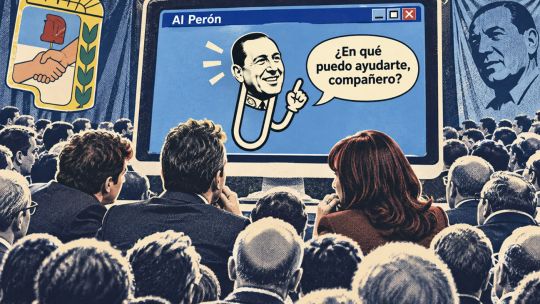
Milei can be thankful they are not so creative: if they keep choosing to talk to an AI version of Juan Perón, as they did on Peronist Militancy Day this week, next year’s election will be a coin toss.
KioskNews shows a cleaned-up reading view extracted from the publisher’s page — the original always lives on their site, not ours.