Trump, Xi, Putin to meet in Shenzhen: Beijing’s bargain, big optics and what it means for India
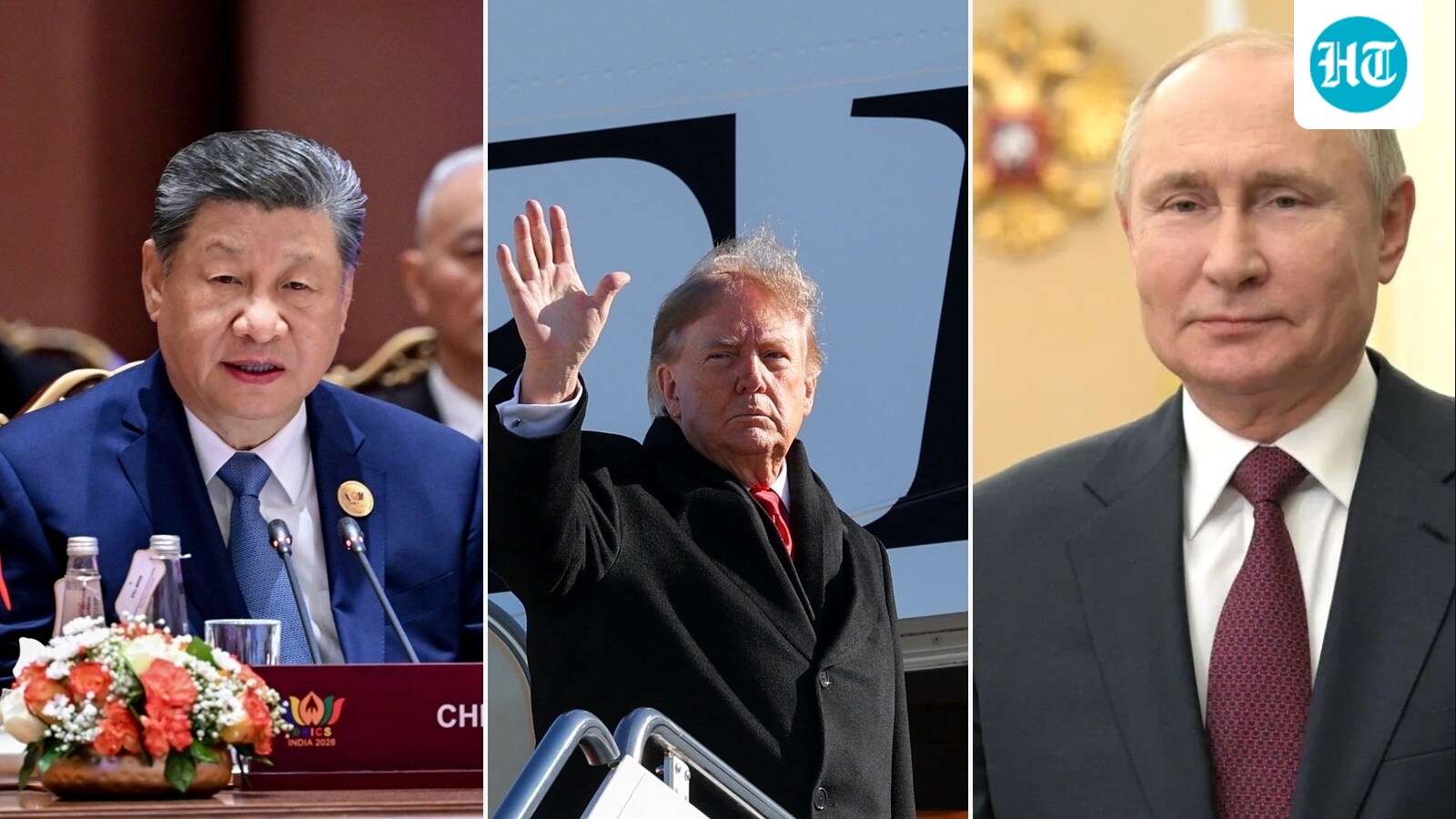
A trilateral summit outcome looks unlikely, as Trump, Putin and Xi seek to project power at home without making concessions.

 Prefer HTon Google

The US-China-Russia trilateral summit on November 19 at Shenzhen is all about three big leaders of past-present-future superpowers with Beijing seeking recognition of its sphere of influence in Asia as a first step from Washington and Moscow without conceding on denuclearization. President Putin, President Trump and President Xi will all talk about global peace with Russia and US seeking different objectives from Ukraine, Iran while telling Beijing to cut the drone manufacturing material supply chain to Kiev and Tehran.
Given that both Russia and US are facing never ending wars with Ukraine, Iran and its lethal proxies, the moment will belong to President Xi who will seek assurances from both Russia and US on Taiwan and its sphere of influence in the Indo-Pacific. While Russia and US seek to involve China in a trilateral nuclear dialogue to put a bar on Beijing's rapidly expanding intermediate range nuclear ballistic missile arsenal and nuclear proliferation to suspect countries like Pakistan, Beijing will resist this move as it has a huge nuclear weapon gap with both Russia and US.
However, the possibility of any significant outcome from the trilateral summit is limited as all President Trump, President Putin and President Xi have huge egos and want to project power to their domestic audiences without conceding anything. And all have different objectives.
Russia has come closer to the US with the objective of redrawing European security and removing the Chinese chokehold. The US views China as the most powerful adversary, seeks alternative supply chains and wants Russia to end the Ukraine war. China wants the two powers to recognize Beijing as heir apparent on the global stage, which will be detrimental to both India, ASEAN countries and Japan.
With China dominating the South China Sea and its ally Iran playing hardball on the Straits of Hormuz and Suez Canal route, the US and Russia would be looking towards some understanding on freedom of navigation on these three strategic axis.
From the Indian perspective, détente between Russia and US will be beneficial but recognition of the Chinese leader by the other two Presidents will be counter-productive and will put more pressure on India’s unresolved borders with China. Already China has expanded its influence in the Indian sub-continent with a strong footprint in Pakistan, Bangladesh, Maldives, Nepal, Sri Lanka and Myanmar as these countries have been reduced to tributary states given Beijing’s power and pelf.
The Shenzhen summit will produce dramatic TV footage but the possibility of any dramatic outcome is minimal. It is not in the interest of China to let both Russia (in Ukraine) and US (in Iran) off the hook.

Shishir Gupta is Executive Editor at Hindustan Times and one of India's top journalists covering national security, strategic affairs, foreign policy and geopolitics. Over the past three decades, he has extensively reported on India's military, diplomatic and security landscape, covering every major conflict and national security challenge, from the 1999 Kargil War and the 2020 East Ladakh standoff to Operation Sindoor in 2025. He has also covered major terror attacks, including the IC-814 hijacking, the 26/11 Mumbai attacks and the 2025 Pahalgam terror strike, along with numerous Pakistan-backed terrorist incidents in the Kashmir Valley and across India. He has reported on national and state elections for more than three decades. A recognised authority on strategic affairs, Gupta has covered India's nuclear programme since the Pokhran-II (Shakti series) tests in May 1998 and has written extensively on global nuclear issues, Indian diplomacy and the country's expanding global outreach. He has also reported widely on international conflicts and terrorism, with a special focus on the Indian subcontinent. Gupta has interviewed Prime Minister Narendra Modi more than four times, including Modi's first interview with the print media after becoming Prime Minister in May 2014. His other interviews include three with the Dalai Lama, as well as conversations with Benjamin Netanyahu, Amit Shah, Yogi Adityanath, S. Jaishankar, Nirmala Sitharaman and Piyush Goyal. He is the author of Indian Mujahideen: The Enemy Within (Hachette, 2011) and Himalayan Face-off: Chinese Assertion and Indian Riposte (Hachette, 2014). He was awarded the Chevening-Wolfson Joint Scholarship at Wolfson College, University of Cambridge, UK, in 1998 and participated in the International Visitor Leadership Program (IVLP) of the US State Department in 2006. He received the Ben Gurion Prize from Israel in 2011 and the K. Subrahmanyam Prize for Strategic Studies in 2015 from the Manohar Parrikar Institute for Defence Studies and Analyses (MP-IDSA). Since 2024, he has hosted Point Blank, Hindustan Times' weekly YouTube show on global geopolitics.Read More

KioskNews shows a cleaned-up reading view extracted from the publisher’s page — the original always lives on their site, not ours.