IMF slashes Argentina’s 2026 growth forecast to 2.1%
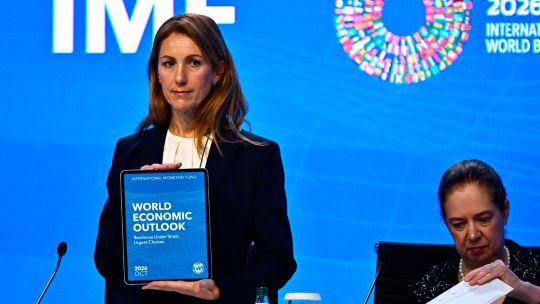
The International Monetary Fund (IMF) has almost halved its 2026 growth forecast for Argentina, slashing its projection to 2.1 percent from an initial four percent projection issued, while also raising its estimates for inflation and unemployment.
The revised outlook, published on Monday in the October edition of the IMF’s World Economic Outlook (WEO) report, is a further downgrade from the 3.5 percent growth forecast issued back in April and that was maintained in July.
Further dampening the horizon for President Javier Milei’s government, Fund technicians also lowered their projection for 2027 from four percent to 3.5 percent – half a percentage point down.
The revision reflects weaker-than-expected economic activity, subdued domestic demand and financial conditions that continue to constrain the recovery, said Petya Koeva Brooks, deputy director of the IMF’s Research Department.
The new forecast remains above the 1.5-percent growth projection forecast by analysts and economists surveyed by the Central Bank in its latest REM monthly expectations survey issued in September.
Notably, it is almost a point below the three-percent expansion envisaged by Milei’s government in its draft 2027 Budget bill.
Data from the INDEC national statistics bureau earlier this month showed that economic activity contracted by 2.9 percent in July compared with June and by 1.4 percent year-on-year. Experts surveyed by the Central Bank predict a poor third quarter and a recovery in the final three months of the year.
On inflation, the IMF raised its forecast for 2026 from 30.4 percent to 32.5 percent. Its estimate for the following year was adjusted more substantially, from 15.7 percent to 21.2 percent.
Although the Fund expects price increases to slow next year, the projected pace of disinflation is now considerably more gradual than previously anticipated.
The figures refer to annual average inflation rather than the change in prices between December and December.
Unemployment, which INDEC measured at 7.9 percent in the second quarter of this year, is also expected to rise. The IMF now predicts 7.6 percent in 2026 (up from 7.2 percent previously) and 7.1 percent in 2027 (previously 6.9 percent).
Argentina’s economy will grow more slowly than the wider region, said the Fund in its report, predicting an average of 2.3 percent for Latin America and the Caribbean in 2026.
IMF chief economist Silvana Tenreyro said at a press conference on Tuesday Argentina’s economy should start to recover in the final quarter of this year and to "strengthen further in 2027 and 2028.”
“Part of that recovery is due to favourable terms of trade, as well as the easing of financial conditions and the rebound of investment” in Argentina, she added.
The economies of Brazil and Colombia are projected to expand by 2.2 percent, while Peru is expected to grow by three percent. Neighbouring Uruguay and Chile are forecast to record weaker growth, at 1.3 percent and 0.6 percent, respectively, with the economy of Paraguay expected to expand by a much larger 4.5 percent.
Tenreyro said that leaders should “keep a close eye on inflation” at a press conference, predicting an average rate of 4.2 percent across Latin America and the Caribbean.
Globally, the IMF projects growth of 3.1 percent in 2026, one-tenth of a percentage point above its July estimate, followed by 3.4 percent in 2027.
The Fund’s report warns that higher energy and food prices linked to the war in the Middle East are likely to sustain inflationary pressures and cites additional concerns, such as high public debt and the risk of financial market corrections.
The downgrade comes as a delegation of Argentine officials, including Economy Minister Luis Caputo, attends the annual meetings of the IMF and World Bank in Bangkok.
Caputo is scheduled to meet IMF Managing Director Kristalina Georgieva while in Thailand, for talks that will likely address the ongoing third review of the country’s US$20-billion financing programme, agreed in April 2025.
Argentina’s programme includes commitments to fiscal discipline and the accumulation of foreign currency reserves and Fund technicians recently carried out a visit to Buenos Aires.
Technical assessment of the nation’s compliance with the programme’s targets remains pending. If the third review receives approval from the IMF’s Executive Board, Argentina is set to receive a disbursement of around US$860 million in fresh funds.
Argentina remains the IMF’s largest debtor, owing the institution approximately US$56.7 billion in total.
KioskNews shows a cleaned-up reading view extracted from the publisher’s page — the original always lives on their site, not ours.