‘Our town is making jeans again’: meet the firm reviving jobs and skills in Wales
Worn on the streets of London’s Soho, San Francisco or Sydney, every pair of high-end jeans made by Hiut Denim comes from the rather unlikely location of a small coastal town in west Wales.
Cardigan, with a population of just 4,200, has a proud history of denim production and was once home to Britain’s largest jeans factory, even if the town’s name recalls a different garment entirely.
When jeans manufacturing in Wales was moved abroad at the start of the century, hundreds of local people lost their jobs and were forced to find work elsewhere.
Hiut Denim was founded by David and Clare Hieatt in Cardigan in 2011. The couple, both originally from Wales, previously ran the ethical fashion brand Howies. They set up Hiut – the brand name blends their surname with the word utility – with the goal of reviving denim-making skills in the town and training up the next generation of skilled craftspeople.
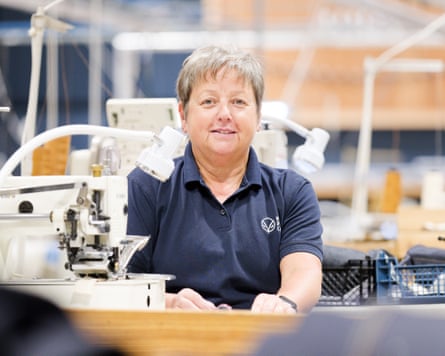
Elin Evans was one of those “grand masters”, as they are known in the company, with a lifetime’s experience of making jeans. Now 59, Evans is Hiut’s factory manager and has been in the trade since 1983, when she was 16.
“I’ve done a full loop, because this is where I started,” she says, from her seat behind a sewing machine on the factory floor. Deftly handling the indigo fabric, she moves individual pieces through the machine and a pair of jeans begins to take shape.
In its heyday, the Dewhirst factory in Cardigan where Evans once worked employed about 400 people, representing about 10% of the town’s population, and cranked out 35,000 pairs of jeans each week for Marks & Spencer.
When Dewhirst decided to outsource production to Morocco, Evans was given the opportunity to move to Tangier. But the founding of Hiut led to her returning home to Wales and to a sewing machine. “I hoped it was like riding a bike,” she says, “but you never forget and the rest is history”.
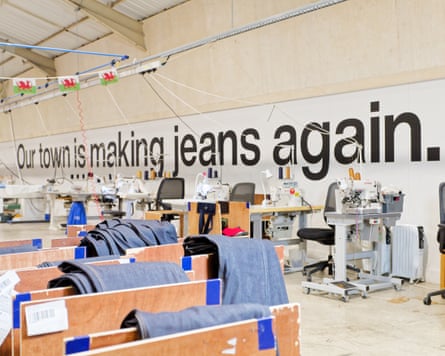
As Hiut took off, the company moved into what was once part of the Dewhirst factory, taking Evans back to the place she began her career. A slogan painted on the factory wall proclaims “Our town is making jeans again” and Welsh flag bunting flutters above the sewing machines, in celebration of the annual cultural festival, held this year in early August just a miles south of Cardigan.
Evans and the other grand masters who joined Hiut have spent decades cutting pieces of fabric, creating pockets and stitching denim.
The brand’s production levels are far removed from the mass manufacturing which previously took place in Cardigan – Hiut employs 20 people, who make 120 pairs a week.
The company insists its product is no ordinary wardrobe staple. Each pair is made by hand from 17 pieces of fabric, with a “made in Wales” label inside the waistband and another label signed by the member of staff who stitched the jeans. Hiut also offers lifetime repairs.
“The majority of the time, you know the name of the person that’s bought your jeans. You know your customer and the customer gets to know us as well,” says Evans. “We’re very proud of what we’re doing and the quality is top notch.”
Indeed, online fashion reviews praise Hiut’s attention to detail, such as neat seams and how all of the rivets featuring the brand’s name or owl logo are added by hand to ensure they face the same way.
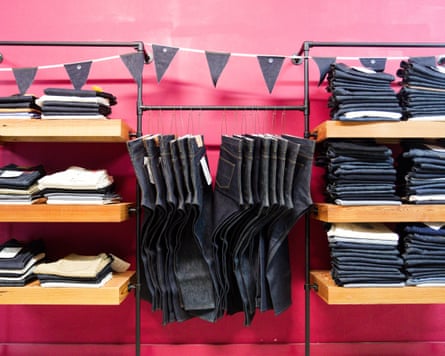
Such premium jeans come with a suitably premium price tag – about 10 times higher than the cost of a high-street pair – starting at £245 for men’s and women’s slim-fit styles, made from organic cotton from Turkey, and rising to £350 for pairs made from premium Japanese selvedge.
Hiut customers includes TV personalities Ant and Dec and the brand got a big boost when the Duchess of Sussex wore a pair during her first official visit to Wales in 2018, resulting in a three-month backlog of orders.
Despite such endorsements, the company hit financial difficulties in the wake of the Covid pandemic, when the founders approached some of their top customers to ask if they wanted to invest in the company.
One of these was the German von Loeper family. They initially became minority shareholders in late 2024, before taking over the company in September 2025. Johann von Loeper, 26, became the company’s chief executive, leaving a career in finance in London to move to Cardigan.
after newsletter promotion
He says his father, Philipp, was a loyal customer first, which prompted the family-owned investment group to take a stake in a firm beyond its usual investments in life sciences or agricultural companies.
“We don’t do anything in retail or fashion really, this is more of a passion project,” von Loeper says. “My father sort of became obsessed with the product … I think he bought more than 30 pairs.”
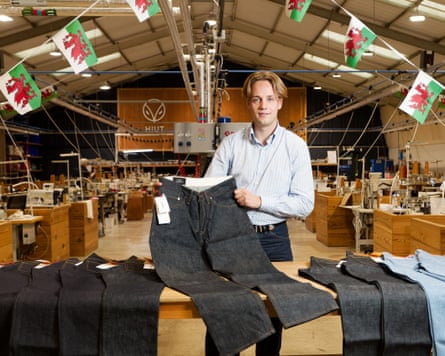
The family has committed to keeping the manufacturing in Cardigan, although von Loeper adds that the factory’s west Wales location creates logistical challenges when moving finished garments or bringing in photographers and models for photoshoots.
He adds: “The thing that attracted all of us to Hiut was the purpose of making jeans again, and not just for the sake of making jeans, but to have the jobs, to have to craft, to have skills remain here.”
Some high-profile visitors have tried out the craft. A framed photo and letter from Kensington palace hangs on the factory wall, commemorating the March visit of Catherine, the Princess of Wales, where she had a go on a sewing machine.
Walking past huge rolls of fabric from some of the most prestigious denim mills in the world – in Japan, Italy and Turkey – von Loeper says he faced a big decision shortly after taking over running the company. A key Japanese denim supplier warned Hiut and other long-term customers that operational pressures meant it was about to close its order books until 2027.
“We bought £100,000 worth of selvedge in my first few weeks here because I said ‘let’s get it now before we run out’ and that was one of the better things I did,” he says.
When the von Loeper family took over, they said Hiut was “losing a lot of money every month”, but they believed that with investment and a new strategy, the brand could become profitable again.
The new owners soon got to work updating the entire jeans collection, and are hoping to take on more staff so they can increase production. Von Loeper is aware that Evans and other grand masters are fast approaching retirement age and believes the company has a “five-year window” to hire and adequately train new employees. He also wants to broaden Hiut’s appeal, and as part of that has secured new stockists, including Liberty department store in London.
“Our customer age group has always been 35-55,” says von Loeper. “Our jeans were worn to the office even before Covid, but we can definitely see that customers and what they are buying for has changed and we are trying to adapt to that.”
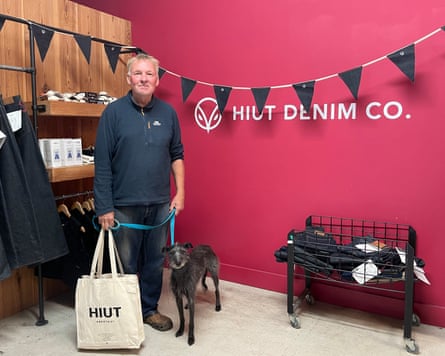
At the shop located just metres away from where jeans are being made, customers come to try on different denims. One customer, Paul Tomlin, has made a purpose journey to Hiut during a visit to Wales to buy more of his favourite jeans.
“I came to make sure I got the right fit. I tried on three pairs and found a style that suits me,” says Tomlin, holding a branded bag containing two new pairs. He says he likes the firm’s ethos as well as its clothing: “It’s a good story and has a good feel as a company”
KioskNews shows a cleaned-up reading view extracted from the publisher’s page — the original always lives on their site, not ours.