AI revenue to reach US$300m this year, UMC says
By Lisa Wang / Staff reporter


United Microelectronics Corp (UMC, 聯電), the world’s fourth-largest contract chipmaker, yesterday said it expects artificial intelligence (AI)-related chips to account for 25 percent of its revenue by 2029, adding that AI revenue is set to meet its US$300 million target this year.
To meet surging demand for a wide range of its technologies from silicon photonics to advanced packaging and AI-related business, the company is allocating an additional US$3.2 billion to accelerate capacity expansion, UMC chief executive officer Jason Wang (王石) said at an earnings conference.
Silicon photonics and advanced packaging are emerging as new growth engines for UMC, as the company aims to address next-generation optical connectivity, power delivery and memory bandwidth requirements for AI infrastructure, Wang said.
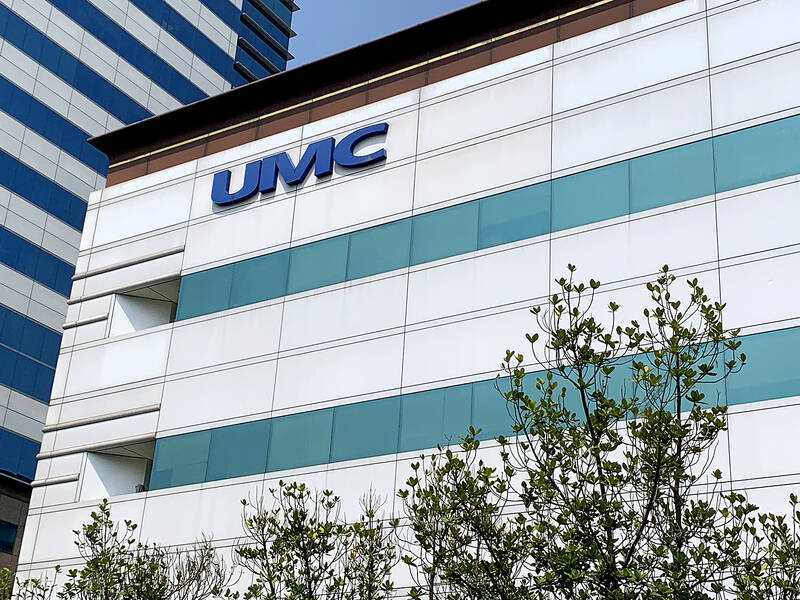
United Microelectronics Corp’s logo is pictured on the company’s building at the Hsinchu Science Park on Sept. 26, 2024.
Photo: Grace Hung, Taipei Times
In July, the company said it would spend US$5 billion in the next two to three years to expand silicon photonics and advanced packaging capacity.
Most of the new capacity is expected to come online in late 2028 and through 2029, and reach large scale production by 2030, Wang said.
Based on UMC’s expansion plans, it aims to reach a monthly capacity of 18,000 wafers for silicon photonics, 22,000 for deep-trench capacitors and 20,000 for thin-film lithium niobate modulators.
Overall, UMC is upbeat about next year’s revenue growth, as it is negotiating with customers to hike average selling prices by 10 percent to reflect rising raw material costs, persistent capacity constraints and a “richer product and technology mix,” Wang said.
“We expect next year to mark a turning point in our blended average selling prices trajectory, moving from an environment of price erosion toward a meaningful positive uplift,” he said.
This year’s growth momentum is expected to extend into next year, fueled by higher wafer value rather than increased shipment volumes or factory utilization, Wang said.
“We expect the growth momentum to be supported by the healthy demand across our core business and growing opportunity in the flagship technology and high-value applications,” he said.
This quarter, UMC expects wafer shipments to grow by a low-single-digit percentage from last quarter, Wang said.
Average selling prices would remain firm, while gross margin is expected to be comparable to the preceding quarter’s 34 percent, he said.
Factory utilization would remain in the low 90s this quarter, he said.
UMC yesterday reported that third-quarter net profit fell 61 percent to NT$16.43 billion (US$506.8 million) from NT$42.26 billion in the second quarter. The company attributed the decline to a 95.8 percent drop in non-operating income to NT$1.27 billion from NT$30.24 billion in the previous quarter.
On an annual basis, net profit rose 9.7 percent from NT$14.98 billion, it said.
Earnings per share dropped to NT$1.32 from NT$3.39 a quarter earlier, but improved from NT$1.2 a year ago, it added.
KioskNews shows a cleaned-up reading view extracted from the publisher’s page — the original always lives on their site, not ours.