Twelfth Night review – Mathew Horne oozes arrogance as a brilliantly buttoned-up Malvolio
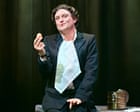
You can picture Mathew Horne’s Malvolio as a guest on an early 1970s BBC Two arts show. With his buttoned-up collar, tight black suit and supercilious delivery, he oozes self-satisfaction. Trusting in his superior taste, he has the pose to prove it: stiff, studied and haughty.
His fall from grace, tricked into dressing up as a yellow-stockinged morris dancer, is as funny as it ever is in Shakespeare’s comedy. It is the comeuppance of the arriviste. Brought down to size, he is no less indignant for it. In a smart, unyielding performance, he goes from pompous to bruised – and ever unrepentant.
Where Malvolio is urbane, Genevieve Dawson’s live score has a folk-club earthiness. Played on clarinet, guitar and violin, it is haunting and whimsical, with a similarly 1970s vibe, like something from The Wicker Man.
Calling the musicians to order, David Birrell plays Feste less as the fool than the troubadour, one blessed with expensive dress and surprising wisdom, as well as a voice correctly identified by Sir Andrew Aguecheek (James Chetwood) as “mellifluous”. His plangent songs cast a note of uncertainty over the comic romance of Jamie Glover’s swift, concise and controlled production.
Fielding much the same ensemble that appeared in last month’s King Lear, with a blood-orange sun presiding over Amanda Stoodley’s stony circular set, Glover brings energy and clarity to the language. Going at a fair clip, the actors wind up the narrative coil in the first half, playing it straight and focused, in order to release the comedic spring in the second.
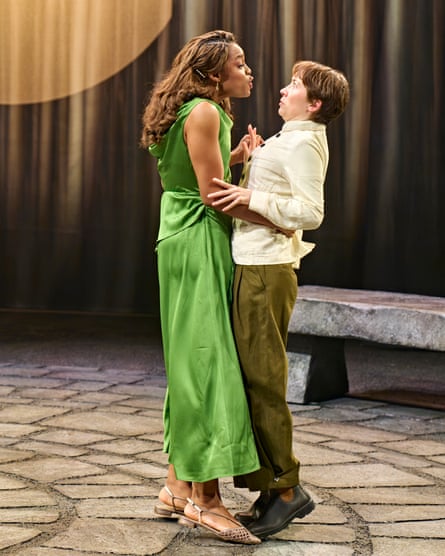
In a play about status, appearance and falsity, the shipwrecked Viola (Bebe Sanders), going undercover as Cesario, is winningly plain-speaking as she inadvertently arouses the passions of Olivia (Justina Kehinde). She is too poetically lovely to resist. Switching from the magisterial to the lusty, Olivia has a tough time reconciling courtly expectations with her desires. For his part, Orsino (Fode Simbo) is plain deluded until Viola’s brother Sebastian (Harry Redding) shows up and he can see the beauty of what is right in front of him.
There is merriment in the confusion and its untangling, but also a dream-like instability in a punchy, satisfying show.
KioskNews shows a cleaned-up reading view extracted from the publisher’s page — the original always lives on their site, not ours.