Taichung candidates present policies
RACE ON: Ho Hsin-chun pledged to improve transportation, while Johnny Chiang focused on public safety and Hung Li-hua promised to support families with children
Democratic Progressive Party (DPP) Taichung mayoral candidate Ho Hsin-chun (何欣純) focused on transportation improvements, while Deputy Legislative Speaker and Chinese Nationalist Party (KMT) candidate Johnny Chiang (江啟臣) prioritized public safety on Tuesday evening at a televised policy presentation for the Taichung mayoral election.
Organized by the Taichung Election Commission, the event gave three candidates — Ho, Chiang and the Law Justice Party’s Hung Li-hua (洪麗華) — an opportunity to present policies, answer questions from two academics and deliver closing statements, without directly questioning one another.
Ho, a fourth-term legislator, accused the administration of outgoing KMT Mayor Lu Shiow-yen (盧秀燕) of moving too slowly on infrastructure projects over the past eight years.
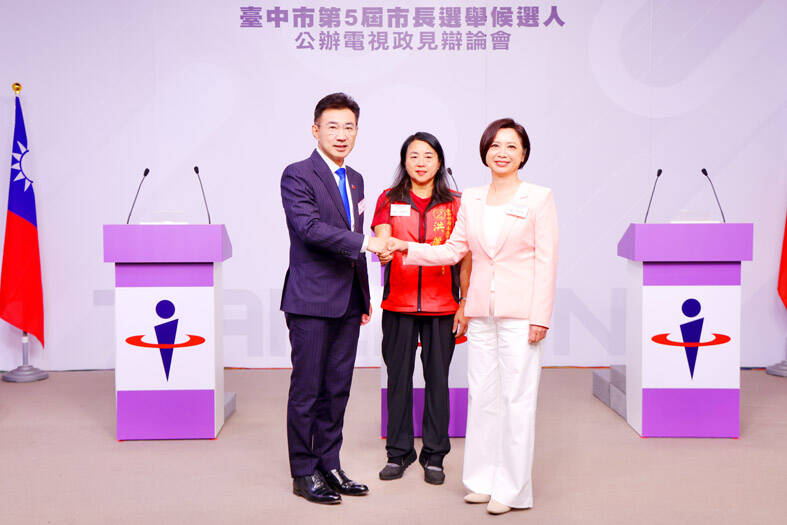
Democratic Progressive Party Taichung mayoral candidate Ho Hsin-chun, right, shakes hands with Chinese Nationalist Party candidate Johnny Chiang in a televised policy presentation in Taichung on Tuesday.
Photo courtesy of Taichung Election Committee
Lu has governed Taichung, one of Taiwan’s six special municipalities and home to about 2.9 million residents, since 2018 and is barred from seeking a third term under a two-term limit.
Even the city government’s “thinking seems stuck,” Ho said, criticizing persistent congestion along Taiwan Boulevard and Provincial Highway 74, and slow progress on transportation projects.
Ho, 52, said residents in Taichung’s coastal districts were still waiting for the MRT Blue Line, which is planned to connect Taichung Port with the city center, while children “could not even get a bus to and from school.”
She pledged to accelerate construction of the MRT Blue Line, advance other rail projects, introduce smarter traffic management, and improve bus frequency and punctuality.
Asked how she would fund the projects, Ho said she would seek additional central government support and explore cooperation with private developers, adding that construction delays could drive up costs.
She also promised to maintain subsidies for elderly people’s National Health Insurance premiums, saying that KMT politicians mislead older people by suggesting she would abolish the benefit.
She proposed a one-time cash payment to residents, subject to a review of municipal finances and without additional borrowing.
Chiang praised Lu’s investments in education, parks and major public facilities, pledging to build on what he called her administration’s achievements.
The 54-year-old said public safety would be his top priority, proposing to integrate existing networks for crime prevention, workplace safety, firefighting and disaster response into an early-warning system.
“Even if we have to borrow money or take on debt, we must do it,” Chiang said of measures needed to protect lives.
He named preventive healthcare, including potential subsidies for shingles vaccinations, as his second priority, followed by measures to improve employment and transportation.
Chiang also advocated free bus rides, estimating that they would require an additional NT$60 million to NT$70 million (US$1.8 million to US$2.1 million) annually.
He said that improving bus services was more important than making them free, urging more frequent short-distance services, faster long-distance routes and convenient transfers so residents could meet their daily needs within their own communities.
Chiang proposed establishing a committee to coordinate international relations, industrial cooperation and trade exhibitions, while transforming Taichung from a precision machinery manufacturing center into a robotics manufacturing hub.
He also pledged to continue building social housing, with a target of 18,000 units, and proposed a committee on women’s and children’s development to coordinate policies on healthcare, childcare, education and housing for young families.
On two major sports and entertainment venues being developed under Lu, Ho expressed support for the Taichung Arena, currently under construction, and the planned “Taiwan Dome,” but said she would review their planned operations and transportation links.
Meanwhile, Chiang highlighted the venues’ potential to attract major sporting events and concerts, helping transform Taichung into an international sports and entertainment destination.
Hung called for greater support for families with second and subsequent children through junior-high school to address declining birthrates.
KioskNews shows a cleaned-up reading view extracted from the publisher’s page — the original always lives on their site, not ours.