S Korea’s Lee strips prosecutors of power
JUDICIAL REFORM Prosecutors have long been accused of exercising excessive power, but the move has raised concerns that it might create gaps and leave victims worse off
South Korean President Lee Jae-myung has pushed through a sweeping overhaul of the criminal justice system, stripping investigative powers from prosecutors he accuses of abusing their authority, including criminal cases against him before he took office.
A revised law that came into force yesterday focuses on shifting power to police from prosecutors, leaving the latter primarily to decide whether cases should go to trial.
“The purpose of prosecution reform is to ensure that the powers and responsibilities entrusted to investigative and prosecutorial authorities to protect victims, human rights and the social order are not abused for politically motivated investigations and prosecutions,” Lee said last month, vowing to make the reform irreversible.
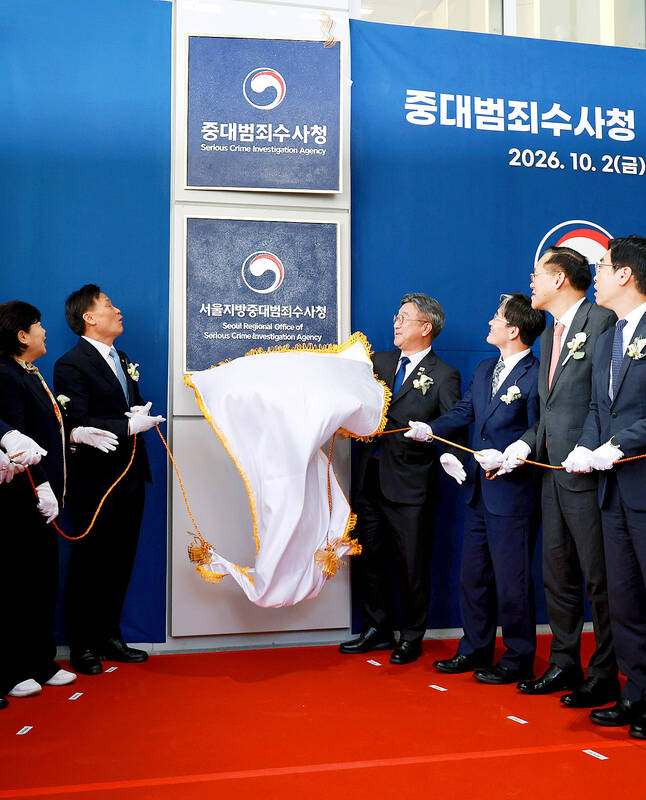
South Korean Minister of the Interior and Safety Yun Ho-jung, fourth right, and others take part in a ceremony at the newly established Serious Crimes Investigation Agency in Seoul yesterday.
Photo: EPA
South Korea’s prosecutors have long been accused of exercising excessive power, but the move has raised concerns that it might create gaps that leave crime victims worse off. The optics of the reform, led by a president who faces pending cases launched by prosecutors, are also feeding into a drop in Lee’s public support.
Supporters of the move claim it would help break up an institution that has contributed to political instability over the years. Of the eight presidents who served before Lee since the country embraced direct democratic elections in 1987, four have been imprisoned, ousted or both after investigations by prosecutors. Another, Roh Moo-hyun, died by suicide while facing an investigation into allegations of bribery involving his family a year after his term ended.
Lee’s own ascent to the country’s top job last year followed a martial law fiasco triggered by his predecessor and top prosecutor-turned-president, Yoon Suk-yeol.
The overhaul scraps the Supreme Prosecutors’ Office and launches two new agencies to take on some of the office’s functions. A new Prosecution Service is to make decisions on whether to indict suspects and handle prosecutions in court.
The newly formed Serious Crimes Investigation Agency will take responsibility for launching and carrying out probes into seven categories of crimes, including corruption and national security transgressions. The police and the Corruption Investigation Office for High-Ranking Officials are to take the lead on other investigations, though there still might be scope for disagreements over which agency has jurisdiction.
The revision comes as Lee’s own trials have been suspended while he serves as president. Those trials surround accusations over aiding private land developers, misusing public funds and infringing election law. Lee has denied any wrongdoing and called the indictments politically motivated.
“I have been, still am, and will continue to be one of those who have suffered the most from the prosecutors’ abuses,” Lee has said.
The overhaul is seen as one of the factors weighing on Lee’s approval rating, now hovering below 40 percent with nearly four years still remaining in his single, five-year term. A Gallup Korea poll in August showed half of respondents were against the reform, while 27 percent supported the plan.
KioskNews shows a cleaned-up reading view extracted from the publisher’s page — the original always lives on their site, not ours.