Study finds 4 rare DNA variants tied to schizophrenia
By Lee I-chia / Staff reporter


A National Health Research Institutes (NHRI) research team has identified four new loci of rare copy number variants (CNVs) more strongly associated with schizophrenia in East Asian populations, potentially shedding light on the mechanisms behind the disorder.
About 1 percent of the global population have schizophrenia, and while studies have confirmed that genetics plays a key role in the development of the mental health condition, the specific genetic variants that increase the risks of the disorder have not yet been fully identified, NHRI Center for Neuropsychiatric Research postdoctoral fellow Jen Ya-wen (任雅文) said.
Large-scale international genetic studies over the past few decades have predominantly focused on people of European ancestry, leaving Asian and other populations underrepresented, she said.
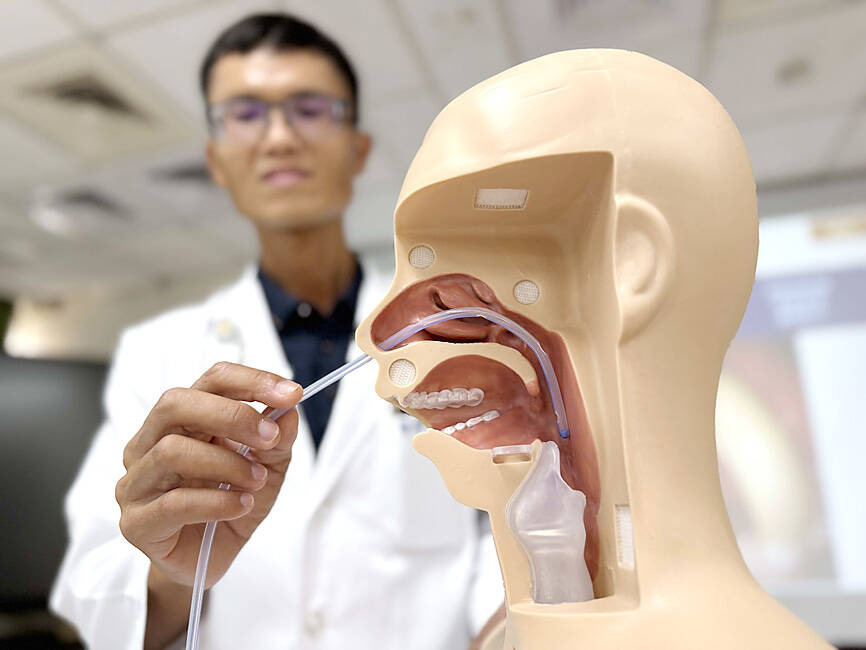
A physician demonstrates a nasogastric tube on May 16 last year.
Photo: Tsai Shu-yuan, Taipei Times
The research team led by NHRI vice president Chen Wei-jen (陳為堅) in collaboration with other international teams focused their study on CNVs — uncommon and large deletions or duplications of DNA, which change the usual two-copy count of genes in a genome, potentially altering gene function.
Previous large-scale genetic studies have established the important role of rare CNVs in schizophrenia etiology, and that some rare genetic variants have a greater impact on the risk of developing schizophrenia, Jen said.
The study gathered data from 44,161 people across Taiwan, China, Japan, Singapore and Indonesia — consisting of 20,903 people with schizophrenia and 23,258 without the disorder — for analysis and also conducted cross-population comparison with the data of 34,257 people of European ancestry, she said.
In the East Asian samples, they identified nine schizophrenia-associated rare CNV loci, and when integrated with samples of European ancestry, a total of 14 significant loci were identified, including eight new ones that reached genome-wide significance for the first time, Jen said.
Among the eight new rare CNV loci associated with schizophrenia, four were primarily detected because they appeared more frequently in East Asian populations, she said.
“Individuals carrying genetic variants at these four loci have a higher likelihood of developing schizophrenia,” Jen said.
Their impact on the risk of developing the disorder is roughly the same as in other ethnic groups, though these variants are more prevalent in East Asian populations, she added.
The study highlights the importance of increasing ancestral diversity in genetic studies to fully capture the genetic underpinnings of complex diseases such as schizophrenia, she said.
The new findings remain at a basic genetic research stage and cannot yet be directly applied to clinical genetic screening, disease diagnosis or treatment, but they can contribute to further exploration of the biological mechanisms affecting neurodevelopment and disease pathogenesis, she added.
Chen said Taiwan contributed data from more than 8,600 participants, providing a vital scientific foundation for this study.
By establishing research cohorts, accumulating local genetic data and engaging in international collaborative studies, the NHRI can help clarify disease characteristics of the Taiwanese population, he said.
The team’s findings were published in the international genetics journal Nature Genetics in September, the NHRI said.
KioskNews shows a cleaned-up reading view extracted from the publisher’s page — the original always lives on their site, not ours.