Our place in the sun: Australia’s uptake of solar panels is already through the roof. How much higher could it get?
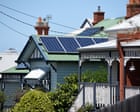
Zoom in on satellite pictures of the Melbourne postcode 3029 and one feature becomes glaringly obvious – there are lots and lots of solar panels on lots and lots of roofs.
“If you walk along the streets, it’s actually hard to see a house without solar panels,” says Saajidh Nizam, a software engineer who lives in Tarneit with his wife, two children and a 6.6kWh solar system on the roof.
This western Melbourne postcode has more rooftop solar than anywhere else in Australia. More than 28,000 systems have been installed there since 2001, according to Australia’s Clean Energy Regulator.
Australia generates more electricity per person from solar panels than anywhere else in the world, making postcode 3029 the poster child for Australia’s residential solar sector.
There are about 4m homes and small businesses with rooftop solar – about 36% of households have a system – and the country’s enthusiasm for the photovoltaic panels is only building with 2026 on track to be a record year of installations.
But the copious amounts of sunshine hitting Australia compared with other countries isn’t the only reason solar is booming.
For more than 20 years, the Australian government has been issuing certificates to homes and businesses that erect rooftop solar, cutting the upfront costs. The scheme has been extended this month to include larger systems on corporate premises.
Tristan Edis, the director of analysis and advisory at research and analytics firm Green Energy Markets, says relatively high electricity prices together with less onerous regulations than other countries, in particular the United States, are two reasons why Australians have adopted solar so enthusiastically.
The other is the types of homes built around the country with “low-density housing and a lot of roof space, making [solar] easier to install,” Edis says.
According to the Clean Energy Council, an industry group representing the renewables sector, in the second quarter of this year, records were broken in every Australian state for installations, with 102,234 systems installed on roofs – the highest quarter on record.
Ten years ago, rooftop solar was generating less than 3% of the country’s electricity while coal supplied 75%. In the last 12 months, electricity from rooftops supplied almost 14%, while coal was down to 50%.
“There are more rooftop solar systems in Australia than there are swimming pools in backyards,” said a spokesperson for the Australian Energy Market Operator.
They said uptake of solar had “fundamentally changed the electricity system” and “given millions of consumers a more active role in how they produce and use electricity, and now store it with the influx of residential batteries”.
Solar had seen demand for grid electricity falling and wholesale electricity prices reaching zero, or even going negative, in the middle of the day, they said. In winter, with less sunshine hours, rooftop solar still covered 10% of the electricity used in the national electricity market, which supplies more than 85% of the population.
In the national market, rooftop solar now routinely supplies more than 40% of the electricity used during the middle of the day; on some days, it peaks above 60%. To cope with all of that solar power, new rules have been introduced requiring electricity retailers in most areas to offer customers three hours of free electricity every day.
A report from the government’s corporate watchdog found households with solar and batteries had bills that were between 20% and 52% lower than regular electricity customers, and households who participated in a virtual power plant – where the battery’s output can be linked with other households and controlled by a retailer – had bills 57% to 63% lower.
Now, with the sudden arrival of home batteries – supported by a federal government program that has seen half a million installed since July last year – Edis says the traditional evening peak for electricity use is being flattened as solar-charged batteries kick into gear.
“That is going to destroy the economics of fossil fuel generators,” says Edis.
How much bigger?
But how much bigger could Australia’s rooftop solar boom get?
The government agency that operates the main electricity market produces a blueprint every two years for the most likely development of the electricity system.
This blueprint forecasts that the capacity of rooftop solar systems will grow from its current level of 20GW to 87GW by 2050 – meaning 56% of homes would have rooftop solar systems, “driven by ever-falling costs”. Two-thirds of those homes would also have batteries. If that change materialised, the energy market operator said rooftop solar alone would be supplying about 27% of the country’s electricity.
The challenge, the operator said, was “not simply accommodating more solar panels but making the most of the electricity they produce.”
after newsletter promotion
Edis’s own projections have suggested even higher amounts of rooftop solar could be possible.
He says a typical 10kW solar system in Australia can produce more than enough electricity for an average household, even if they run an electric car.
“Their demand for electricity is almost entirely taken care of by their solar and their battery. Residential electricity consumption disappears from the grid,” he says.
A rising motivator for Australians buying solar systems, says Edis, is the advent of electric cars.
“There’s a relationship developing between electric cars and solar. For a lot of Australians, charging up their car will be incredibly cheap,” he says.
Some electricity system analysts, including Edis, point to commercial buildings and rental units as a “missing middle” where, with better rules, rooftop solar could grow even further.
‘A billion solar citizens’
This week in Fiji at a preparatory meeting ahead of November’s UN global climate talks in Turkey, Australia became the first country to endorse a global voluntary pledge to double the number of homes with rooftop solar from 150m to 300m by 2030.
“Rooftop solar is the sleeping giant of global climate diplomacy,” says Heidi Lee Douglas, the chief executive of Solar Citizens, an advocacy group representing more than 200,000 rooftop solar owners.
“This is going to create a billion solar citizens,” says Douglas, who was in Fiji for the announcement. “[Rooftop solar] is politically popular, and it appeals to people because of the cost of living benefits and now, with energy security issues, governments are more motivated.
“A lot of energy ministers are going to sit up and take notice of this. Rooftop solar has the potential to do so much good but it has been so underrated. We know it is safe and it is a known quantity, and it is easy to deliver quickly.”
Solar Citizens was set up in Australia 16 years ago to advocate for solar owners and create a new political economy around rooftop systems.
The charity is working with civil society groups in Japan, Taiwan, Pakistan, Vanuatu, Malaysia and Indonesia to set up “solar citizen movements” and build advocacy campaigns, says Douglas.
In Australia, Douglas is pushing to double the amount of rooftop solar that is connected to batteries over the next three years.
Back in Tarneit, Saajidh Nizam says he is doing the sums on adding a battery to the solar system on his roof.
“It’s a good idea,” he says, looking around his record-setting suburb.
“We’re not putting as much pressure on the grid, and we’re trying to be a bit more self-sustaining and a bit less damaging on the environment.
KioskNews shows a cleaned-up reading view extracted from the publisher’s page — the original always lives on their site, not ours.