6 Fantasy Books That Are Unforgettably Bleak

Diego Pineda has been a devout storyteller his whole life. He has self-published a fantasy novel and a book of short stories, and is actively working on publishing his second novel.
A lifelong fan of watching movies and talking about them endlessly, he writes reviews and analyses on his Instagram page dedicated to cinema, and occasionally on his blog. His favorite filmmakers are Andrei Tarkovsky and Charlie Chaplin. He loves modern Mexican cinema and thinks it's tragically underappreciated.
Other interests of Diego's include reading, gaming, roller coasters, writing reviews on his Letterboxd account (username: DPP_reviews), and going down rabbit holes of whatever topic he's interested in at any given point.
Sign in to your Collider account
There are few things that can make a fantasy book more memorable than a dark tone, but throughout the years, history has been treated to some exceptional fantasy masterpieces which aren't just dark: They are unforgivingly and unapologetically bleak through and through. Far from just a dark tone, bleakness when it comes to a fantasy book can involve several different things. We can be talking about a tragic story that finds several different ways to kill the reader's sense of hope, morally complex characters that may not always be easy to follow, or relentless conflict and drama that never gives the reader a chance to breathe. Whatever it is, there are six particular fantasy books from the past which are unforgettable largely because they're so incredibly bleak from top to bottom.
From foundational classics like Titus Groan to modern masterpieces like Between Two Fires, these are some of the bleakest fantasy books the world has ever seen, works which prove just how powerful fantasy literature that doesn't leave much room for optimism can be. They're not pointlessly bleak, either. Their darkness can serve several different purposes, such as exploring deeply yet nihilistically philosophical themes, highlighting contrasts between light and dark, and raising the stakes by sticking true to the realistic desolation of the real world. This way, they prove that dark fantasy can be one of the most potently memorable branches of this truly timeless genre.
1 'Titus Groan' (1946)

British writer, artist, poet, and illustrator Mervyn Peak is best known for the Gormenghast series of Gothic fantasy books, which starts with the foundational '40s classic Titus Groan. It's one of the most perfectly-written fantasy book masterpieces ever, about the birth of the new heir to the decaying fortress of Gormenghast, which coincides with the rise of a ruthless kitchen boy who schemes his way to absolute power. Peake was one of the most acclaimed and influential English-language writers of his generation, his work often compared to the oeuvre of J. R. R. Tolkien; so, for fans of the Legendarium, there are very few books easier to recommend than Titus Groan.
Titus Groan builds its bleakness out of absolute isolation, a total lack of warmth, and strong philosophical meaninglessness.
The book's gloom is masterfully built into virtually every single layer of the narrative, from the detailed world-building to the philosophical depth of the story. Where a lot of dark fantasy and Gothic horror relies on elements like monsters, malevolence, and the supernatural, Titus Groan builds its bleakness out of absolute isolation, a total lack of warmth, and strong philosophical meaninglessness. What makes it such a special kind of dark fantasy masterpiece is that it at times feels more grotesque than it does outright bleak. From the bizarre inhabitants of Gormenghast, to the overwrought prose, to the dark humor, everything about Titus Groan is way ahead of its time in terms of bleakness.
2 'The Court of Broken Knives' (2017)

Anna Smith Spark is a significantly acclaimed voice in modern grimdark fantasy, a subgenre characterized precisely by its bleak settings, stories, and themes. And as far as her work in grimdark fantasy goes, it doesn't get much better or much more important than her Empires of Dust series, which begins with The Court of Broken Knives. In it, a clever and disillusioned politician plots to overthrow the inadequate Emperor and his entire court. People looking for a relatively straightforward introduction to grimdark fantasy are perhaps better off looking elsewhere, because The Court of Broken Knives sits on the extreme edge of the subgenre as far as bleakness goes.
The story deals heavily and rather hopelessly with themes like graphic violence, trauma, drug addiction, genocide, and torture, making for a reading experience that's nothing if not intensely heavy. This was the novel that lead some to nickname Spark as the Queen of Grimdark, and it's easy to see why. The author offers pretty much none of the silver linings or moral redemption arcs that many grimdark writers offer in order to lighten their books' tone. Spark's hypnotic prose is so poetic that it becomes concerningly easy for the extreme darkness of the story to feel potently aestheticized; the decline of the narrative's setting is profoundly fascinating; and the subversion of the Chosen One archetype is one of the most interesting that fantasy has seen in years.
3 'Last Argument of Kings' (2008)

Joe Abercrombie is one of the most pivotal figures in the modern history of dark fantasy, hailed as one of the most prominent masters of grimdark. He's best known for his First Law series, one of the most criminally important cornerstones of the grimdark subgenre. It's composed of two trilogies, two short story collections, and three standalone books, and the best part of the whole thing is arguably the first trilogy, also called the First Law trilogy. Its conclusion is Last Argument of Kings, which follows the political and military collapse of the Union as it faces a dual invasion. This is one of those book series that everyone should read at least once, and the excellence of Last Argument of Kings is a big reason why.
One of the big elements that make the book so special is how it masterfully yet oh so cruelly dismantles the comforting tropes of the fantasy genre. Unlike most fantasy epics, Last Argument of Kings is built on the thesis that change is nothing but an illusion, that power is destined to belong to power-thirsty sadists, and that human nature is inherently dark in many a way. Throughout the first installments in the trilogy, characters appear to undergo classic Hero's Journey arcs, only for Last Argument of Kings to violently pull the rug out from under readers' feet. All the best fantasy books offer some kind of reflection on the real world, and this book's messages are gut-wrenching: that noble intentions are useless, cruelty can be efficient at helping to achieve one's objectives, and that the world rarely rewards true virtue.
4 'Between Two Fires' (2012)
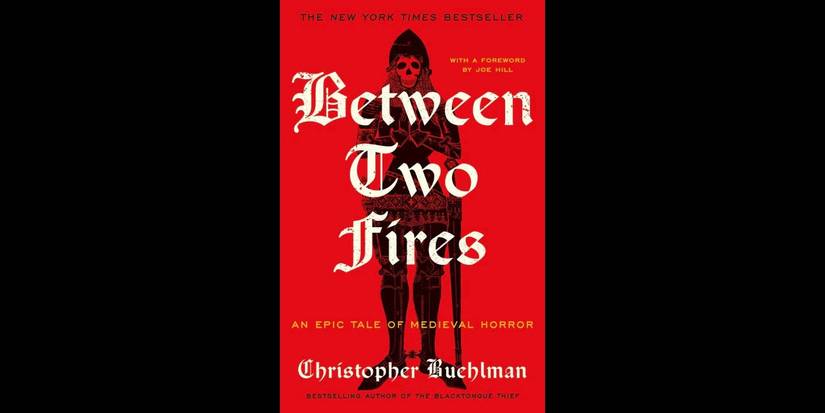
Christopher Buehlman is one of the most prominent modern voices in dark fantasy and horror, whose distinct prose and passion for historical depth—as well as his background as a Renaissance faire insult comedian—make him a constantly exciting voice. There are those who may point to Between Two Fires as his best work to date, and seeing as it's one of those rare dark fantasy books that are perfectly written, it should be abundantly easy to see why. Set in mid-14th-century France during the devastating sweep of the Black Death, it's about an excommunicated knight who has lost everything and embarks on a journey to confront the demonic forces that have infiltrated the world.
It's a powerful, deeply thought-provoking meditation on why God allows events as devastating as the Black Death to occur.
The book is notorious perhaps particularly because it's so exceptionally bleak and gritty. It's a powerful, deeply thought-provoking meditation on why God allows events as devastating as the Black Death to occur, and the apocalyptic horror tone with which it approaches such a premise is absolutely engrossing from cover to cover. By depicting a world where a disaster of this caliber is not just a natural catastrophe, but the fallout of a literal war in Heaven, Buehlman creates a world where the horror feels truly hallucinatory and the provocative subversion of sacred imagery feels like the order of the day.
5 'The Black Company' (1984)

Speculative fiction master Glen Cook's The Black Company is one of the most notoriously dark and gritty book trilogies in the history of fantasy, but it's arguably the inaugural book in the saga, The Black Company, that's the most unforgettably bleak of the bunch. Though it's balanced with some sharp banter and dark humor, even that feels like it's entirely in service of a narrative so dark that it feels like grimdark even though it was written well before the term was even coined. It follows an elite, cynical mercenary unit that takes a contract working for The Lady, a ruthless tyrant ruling the Northern Empire.
The Black Company's undeniable bleakness stems not from any sort of excessive gore or cheap shock value, but rather from a grounded sense of realism whose reflection of the unglamorous nature of military life makes for one of the most engrossing military fantasy books the world has ever seen. The book's protagonists don't fight for justice, freedom, honor, or any other sort of positive value. The book's world is built purely out of complicity in tyranny and desperate economic necessity, and coupled with Cook's clinically unsentimental prose, that makes for one of the most engrossingly dark reading experiences in the whole history of fantasy literature.
6 'The Great Ordeal' (2016)

You'd be hard-pressed to find anyone who has read R. Scott Bakker's iconic The Second Apocalypse series and doesn't think that it's the most aggressively and oppressively bleak book series in the history of perhaps not just fantasy, but speculative fiction as a whole. But though all of the series' installments are immensely dark, none are darker than The Great Ordeal, where Anasûrimbor Kellhus leads his massive crusade northward toward the apocalyptic stronghold of Golgotterath. It's the penultimate entry in the overall saga and the second entry in The Aspect-Emperor subseries, and it's widely regarded by grimdark experts as the absolute zenith of literary despair.
Here, salvation of any sort is literally impossible, morality is but a delusion, and the universe as a whole is endlessly and irreparably hostile. Death, starvation, horror, soul-shattering narrative irony, and cosmic nihilism are the very foundation of everything that The Great Ordeal does and stands for, and that makes for the sort of dark fantasy reading experience that certainly not everyone will have the stomach for. People who love grimdark when it's at its bleakest, however, are pretty likely to find The Great Ordeal and The Second Apocalypse as a whole to be absolutely unforgettable throughout.
Collider Exclusive · 8 Questions · 2 Minutes What Fantasy World Do You Belong To? Middle-earth · Grand Line · The Continent · Camp Half-Blood
Pick your magic, your crew, where you want to wake up and who you would rather be fighting, and we will tell you which world you actually belong in. Four are open to you: an ancient kingdom living through its last good age, an endless sea full of pirates, a continent that pays people to kill monsters, and a summer camp where the Greek gods are extremely real and mostly a nuisance.
💍Middle-earth(Rings of Power)
👒Grand Line(One Piece)
🐺The Continent(The Witcher)
🔱Camp Half-Blood(Percy Jackson)
01
What kind of power do you want? Every one of these worlds runs on a completely different sort of magic.
02
Who is travelling with you? Nobody gets through any of these stories entirely on their own.
03
Where do you want to wake up tomorrow? The best fantasy is usually just somewhere you would genuinely like to live.
04
How are you making a living out there? Even in fantasy somebody has to pay for the horse.
05
There is something in the woods. What do you do about it? All four of these worlds keep something unpleasant out there in the dark.
06
Who is the villain of your story? The enemy tells you far more about a world than the hero ever does.
07
What do you actually believe in out there? Every world hands its heroes one rule and asks them to hold onto it.
08
A thousand years from now, how are you remembered? Eight questions in, this is the one that decides your world.
The Map Is Drawn Your World Is…
Four worlds and four completely different ideas of what a good life looks like. This is where you belong, what it would ask of you, and what you would get back in return.
Middle-earth
You belong somewhere old enough that the mountains have names and somebody can still tell you who gave them. Middle-earth is for people who think the right thing is worth doing even when it will not be finished in their lifetime.
- This is the only world on the list where doing good is understood as a very long defeat, fought anyway, by people who will never see how it ends.
- You are drawn to grandeur, to white cities and deep forges and the sense that almost everything you touch is older than your entire family line.
- The Rings of Power is set in the last good age before it all goes wrong, which gives every quiet scene in it a slightly unbearable weight.
- You would take the hard road, and you would take it on foot.
The Grand Line
You want the sea, a crew, and absolutely nobody telling you where you are allowed to go. The Grand Line is the world for people whose main ambition in life is finding out what is over there.
- One Piece has run for decades on one very simple engine, which is a group of people who each want something impossible and have decided to go and get it together.
- You collect people. Your ideal crew is a set of misfits who were each written off somewhere else before you turned up and offered them a better idea.
- The world is enormous and deliberately ridiculous, and the emotional gut punches land harder because of that rather than in spite of it.
- You would set sail knowing the map runs out, which is more or less the entire point of it.
The Continent
You would rather be feared and useful than liked and useless. The Continent is a world where the monsters are the straightforward part of the job and the people are where it all gets complicated.
- Witchers get paid to do what nobody else will and resented for existing at all, which is a trade most people would refuse and you would probably accept.
- You have no real illusions about which side is the good one, largely because on the Continent that question tends to have a disappointing answer.
- The best of these stories are not about the fighting. They are about somebody with a rigid code being repeatedly cornered into caring about people.
- You would take the coin, finish the job properly, and be out of town before the story got told wrong.
Camp Half-Blood
You want the myths to be real and loose in the actual world, and you want to find out at about thirteen that you were never anywhere near as ordinary as everybody kept telling you.
- Percy Jackson takes the oldest stories we have and drops them into car parks and diners, which makes the gods considerably funnier and a great deal worse.
- You would be the kid every school gave up on, who turns out to have been built for something nobody thought to test for.
- The series is genuinely about friendship rather than destiny, and it says so out loud every time a prophecy tries to get in the way.
- Camp Half-Blood is the real fantasy here: a place where the thing that made you difficult everywhere else is the thing that makes you belong.
KioskNews shows a cleaned-up reading view extracted from the publisher’s page — the original always lives on their site, not ours.