Anger over VIP tents and privileges at Pope Leo's Mass in Argentina
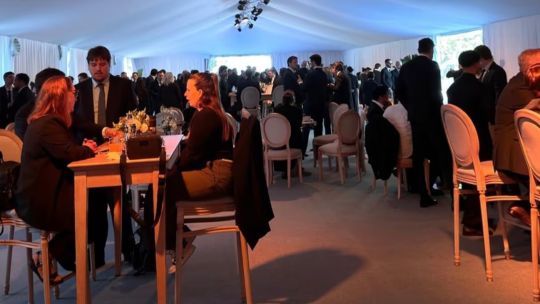
Pope Leo XIV’s historic Mass on Monday in the Palermo neighbourhood of Buenos Aires has triggered a political controversy in Argentina over the exclusive space reserved for the glitterati, politicians and businessmen – a message at odds with thoughts and sentiments offered by the Catholic leader in his speech.
While more than two million of the Catholic faithful endured long waits under the sun to hear the Catholic leader, a select group of guests were given access to exclusive areas with additional comforts and services.
The national government, City Hall and the organisers of the event are all now facing questions, with national lawmakers threatening to lead an investigation into the extravagance.
The papal mass at the Monumento a los Españoles drew multitudes to Buenos Aires. But the so-called ‘VIP tent’ has irritated some in ecclesiastical circles, who admonish the privileges conceded to celebrities, politicians and businessmen over the hundreds of thousands of the faithful who participated in the celebration.
While Argentines coming from all over the country formed long queues and endured high temperatures to form part of the historic encounter with the Pontiff, a group of special guests had access to exclusive sectors with differential comforts and services.
The installation of VIP tents, the presence of celebrities and the allocation of preferential seating provoked criticism over the contrast between the privileges enjoyed by some present and the message of humility, austerity and proximity to the most vulnerable which characterises the pontiff.
The controversy grew as the testimony of participants, volunteers and journalists began to emerge – mostly through social media – revealing the existence of reserved spaces with food, drink and protection against the sun while numerous laypeople, clergy and older people spent hours exposed to high temperatures.
Questions were subsequently raised over the involvement of the Casa Rosada, with official Mara Gorini overseeing the organisation, the Buenos Aires City government and production company DF Entertainment, which was involved in contracting services for the event.
Celebrities, catering and privileged seating
Journalist Eduardo Feinmann confirmed publicly that a VIP area with food was available during the celebration and the presence of entertainment and media personalities.
According to his account, guests included Ana Carolina Ardohain (aka Pampita), Valeria Mazza, Florencia Trinidad (aka Flor de la V), Yanina Latorre and Analía Franchín, among others.
Feinmann attributed the invitations to the Buenos Aires City government, although accounts subsequently circulated suggesting that national government officials had been responsible for distributing some passes.
Yanina Latorre described the conditions of entry into the reserved space, saying that her driver left her directly at the entrance into the VIP sector. She also explained that the invitations included a dress code and certain guidelines for protocol with which those present would have to comply.
According to her account, others present included Zulemita Menem, Zulema Yoma, Gabriela Michetti, Patricia Bullrich, Horacio Rodríguez Larreta and other figures from politics and entertainment.
Model and influencer Angie Landaburu also posted photographs online from the VIP area.
Reports of the catering and comforts provided to guests prompted criticism on social media, where numerous users questioned why a major religious celebration had included a separate arrangement for public figures.
Journalist Nacho Otero voiced one of the most direct criticisms: “What a lack of respect to have assembled a VIP playpen for ‘celebrities,’ with seats and a ‘dress code’, at today's Mass, while leaving nuns, priests and elderly people sitting on the ground.”
Writer Claudia Piñeiro also highlighted the contradiction between the arrangements for special guests and the difficulties experienced by the underprivileged taking part.
The discontent also extended to those who collaborated with the organisation of the mass, dedicating long hours of volunteer work to guarantee the success of the celebration.
Volunteers' anger and guestlist
Discontent also spread among those who had helped organise the Mass and devoted long hours of voluntary work to ensuring the celebration went smoothly.
One volunteer publicly expressed his anger on X, comparing the conditions faced by those helping with the event with those enjoyed by celebrities in the preferential areas.
“Guys, it gets my goat a bit to see Pampita, Yanina Latorre, Analia Franchin and all those hypocrites seated three metres away from the Pope when we volunteers who have been toiling away since 8pm last night [Sunday] had to follow the mass standing behind fencing 2.3 kilometres distant from the altar. Always the same thing,” the volunteer wrote.
The testimony highlighted the contrast at the heart of the controversy: while some guests were given seats close to the altar and access to specially equipped areas, people directly involved in providing assistance and organising the event had to follow the ceremony from much further away.
The argument extended from an exclusive focus on the catering or tents to the criteria used to establish the priorities within a religious celebration drawing over two million people.
It also drifted into the political terrain when contradictory versions as to who had authorised the preferential admissions began to circulate.
Journalist Gonzalo Prado maintained the invitations were handled by national authorities, and that the Presidential Chief-of-Staff’s office and Foreign Ministry sent out lists to the producer entrusted with issuing the QRs.
According to his reconstruction, a quota of 250 invitations was made available to City Hall to send out to officials and representatives of the Executive, Legislative and Judicial Branches, decentralised institutions and communes.
Prado said those lists had to be submitted to the national government and that invitations to certain celebrities were also subject to the involvement of national authorities.
His claims contradicted Feinmann's account, which attributed invitations to entertainment figures to the Buenos Aires City government.
The controversy even involved Vice-President Victoria Villarruel, amid conflicting accounts over whether she had received her accreditation.
While the vice-president said she had not received the QR code required to enter, the Casa Rosada maintained that the relevant invitation had been sent to her.
The VP has long been at odds with her former running-mate, President Javier Milei, and has been deliberately sidelined during the Pope’s visit.
The episode once again exposed political divisions within the governing camp and raised further questions over the criteria used to distribute access to a religious celebration.
Business leaders and financiers
The exclusive sectors were not limited to entertainment and political figures. Several businessmen and Supreme Court justice Ricardo Lorenzetti were also mentioned among those appearing in the preferential areas.
Parallel information concerning the organisation of the visit identified a small group of businessmen who had scheduled a brief private meeting with Leo XIV after the Mass in a tent near the altar. Those named included José Luis Manzano, Daniel Vila, Eduardo Eurnekian and brothers Marcos and Alejandro Bulgheroni.
According to press reports attributed to Synod sources, those businessmen were linked to financing activities related to the papal visit.
Manzano was singled out as one of the main contributors via his companies linked to the energy sector while Vila, Eurnekian and the Bulgheronis also appeared among the businessmen associated with the economic support of the organisation.
Nevertheless, the information available does not permit confirmation that they all used the same VIP sectors reserved for the celebrities nor that the private meeting scheduled with the pontiff finally took place.
The differentiation within the spaces reserved for sponsors, authorities and celebrities constitutes another question-mark hanging over the organisation of the ceremony.
The controversy over the VIP spaces emerged after the Noticias Argentinas news agency reported on October 24 that the firm DF Entertainment had been contracted for an estimated 8.69 billion pesos to produce the activities linked to the papal visit.
Radio Rivadavia journalist Camila Dolabjian warned about the procedure of directly contracting the producers and the sums involved. “There was an uproar over adjudicating the organisation of the visit of Pope Leo XIV, not via tender but direct purchase by a company,” the journalist alleged.
Socialist deputy Esteban Paulón has presented a request for information to the national government, demanding an explanation of the VIP guests at the mass of Pope Leo XIV, which has been highly controversial. The presentation is targeted at Presidential Chief-of-Staff Karina Milei and Foreign Minister Pablo Quirno.
“Neither the national government nor City Hall understand absolutely anything about what Leo XIV’s arrival meant for this country nor his message,” expressed Paulón in his X social network account. “Who invited them, with what criteria and, above all, who paid for this joke?”
Paulón has asked the government to inform about the total capacity, location, number of tents and persons accredited in each sector and also a total list of those invited, explaining “the objective criteria or protocol applied” to be chosen and who approved them.
“Who drew up each invitation for entertainment, fashion and media figures and for those accompanying the officials and legislators; who gave the grounds for the public interest motivating the invitation and whether they played any role in the ceremony?” he asked.
He further placed a focus on the contracts in order to learn the total cost of the event, the suppliers, the source of financing and the mode of adjudication.
Another demand was for the handover of a breakdown of the areas and jurisdiction for each one of the special services rendered, owing to the clashing versions as to whether they were financed by the National Treasury, City Hall, the Church or private contributors.
“In the latter case, identify contributors, sums, the channel used and return payments or favours, indicating whether the contributors or their associates received invitations or preferential locations,” he added.
The deputy further pointed out that the producer for the organisation had been directly contracted by the government. In that sense, he sought the grounds for the “urgency” and “the exceptional procedure,” given that the arrival of Leo XIV was announced with months of anticipation.
KioskNews shows a cleaned-up reading view extracted from the publisher’s page — the original always lives on their site, not ours.