Day after Diwali, Mumbai’s AQI jumps to 171. Eight areas cross into ‘poor’
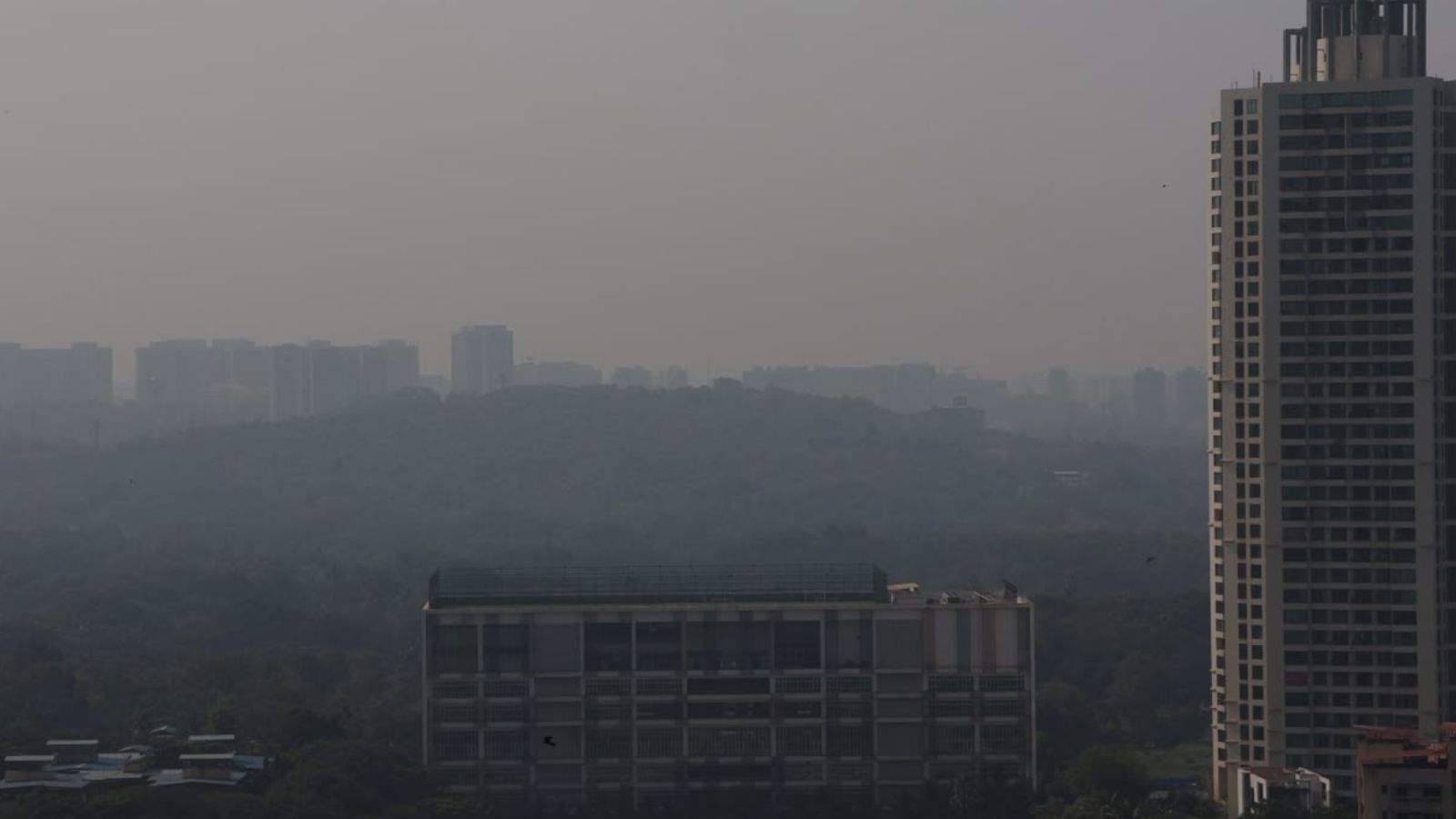
Mumbai woke up to a haze the morning after Diwali, with eight locations across the city and suburbs recording ‘poor’ air quality.
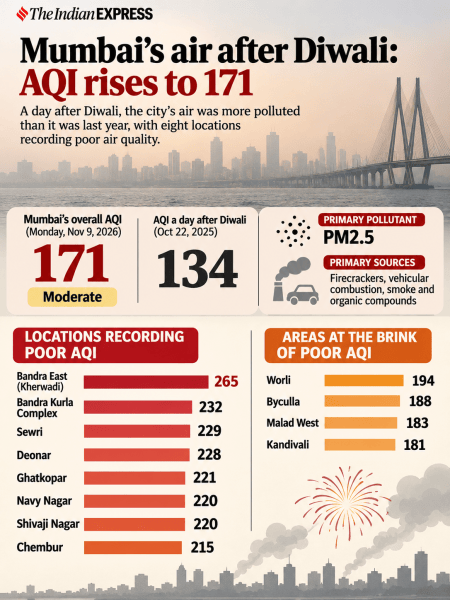
The city’s overall Air Quality Index (AQI) stood at 171 at 9 am on Monday, according to the Central Pollution Control Board (CPCB) dashboard. That’s in the ‘moderate’ category, which is considered unhealthy for vulnerable groups such as senior citizens and children. It’s also 28 per cent higher than the reading of 134 on October 22 last year, the day after Diwali.
The jump came fast. On Sunday afternoon, Mumbai’s AQI was 131, its lowest on Diwali day in four years. But last year’s cleaner air on the morning after Diwali had help. Showers around Diwali washed pollutants out of the lower atmosphere. This year the city is under an El Niño pattern, which has brought deficient rainfall and higher temperatures.
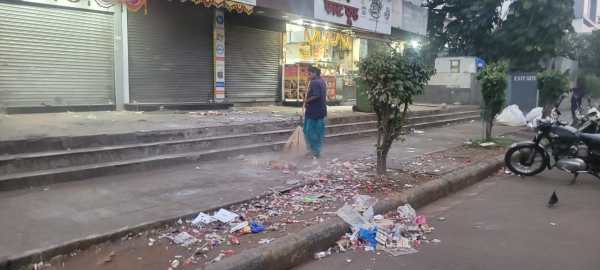 A civic worker sweeps up firecracker debris on a road in Navi Mumbai on Monday morning, after a night of nonstop bursting across the region. (Express photo by Narendra Vaskar)
Eight locations in ‘poor’ category
Bandra East (Kherwadi) recorded the worst reading at 265, followed by Bandra Kurla Complex at 232, Sewri at 229, Deonar at 228, Ghatkopar at 221, Navy Nagar (Colaba) and Shivaji Nagar (Mankhurd) at 220 each, and Chembur at 215. An AQI above 200 is ‘poor’, and poses a risk to all age groups, including cardiovascular damage, systemic inflammation and acute respiratory irritation.
Four more areas were on the edge of the ‘poor’ band: Siddharth Nagar in Worli at 194, Byculla at 188, Malad West at 183 and Kandivali at 181.
The CPCB dashboard identified PM2.5 as the main pollutant at these locations. These are fine particles with a diameter of 2.5 micrometres or less, about 30 times smaller than a strand of human hair. They come largely from smoke and combustion, and are small enough to be inhaled deep into the lungs.
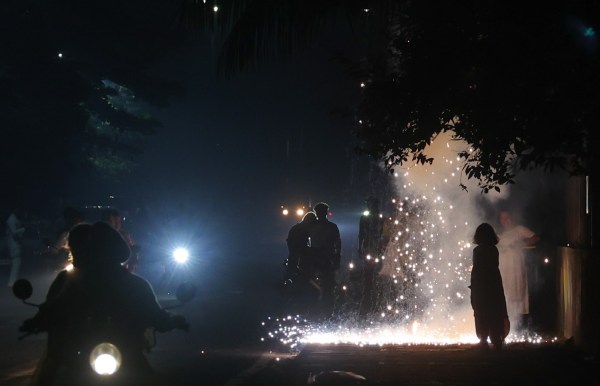 A firecracker lights up a smoke-filled street in Navi Mumbai on Diwali night. By 9 am on Monday, eight locations in Mumbai had recorded ‘poor’ air quality, with PM2.5 from crackers identified as the main pollutant. (Express photo by Amit Chakravarty)
“The AQI has worsened because of the massive fire crackers bursting that took place across Mumbai last night. PM 2.5 is emitted largely from the crackers and the plummeting AQI corroborates that. However, the overall AQI of Mumbai appears to be comparatively lower, possibly due to the onset of wind reversal,” Gufran Beig, atmospheric scientist and chair professor at the National Institute of Advanced Studies (NIAS), told The Indian Express.
Story continues below this ad
Mist-spraying through the night
As crackers went off across the city, the Brihanmumbai Municipal Corporation (BMC) deployed mist-spraying and water-sprinkling vans in all of its municipal wards. Civic officials said the vans ran through the night.
“In several locations like Worli, Malad, Andheri and Ghatkopar, the AQI readings were much worse at night. As a result, we had deployed these mist spraying vans for spraying water into the atmosphere in order to clean it from pollutants,” an official said.
The vans are trucks with a water tanker mounted on the back and four cannons on top that spray water into the air. They draw non-potable water from the sewage treatment plant at Colaba, as well as from wells and ponds.
KioskNews shows a cleaned-up reading view extracted from the publisher’s page — the original always lives on their site, not ours.