Taiwan is expanding its military draft. Will those troops make a difference?

Under the revised Physical Classification Standards introduced late last month, the maximum body mass index (BMI) threshold for exemption has risen from 35 to 45 – equivalent to about 130kg (286lbs) for a man measuring 170cm (5 feet 7 inches), roughly the average height of Taiwanese men. The minimum BMI threshold has also been reduced from 15 to 14.
The minimum height threshold has been lowered from 154cm to 144cm, while requirements covering hypertension and intellectual ability have also been tightened.
Alternative service has been divided into two categories. Category A personnel can be assigned to field duties with agencies such as the police and fire services, while Category B personnel will generally perform office-based, government support or social service duties.
The IQ threshold for exemption has fallen from below 85 to below 70, with men scoring between 70 and 84 now eligible for Category B alternative service rather than regular military duties.
Taiwan’s Ministry of the Interior estimates the changes will halve the exemption rate from 16 per cent to 8 per cent, adding about 4,500 men to regular military service annually and another 2,700 to alternative service.
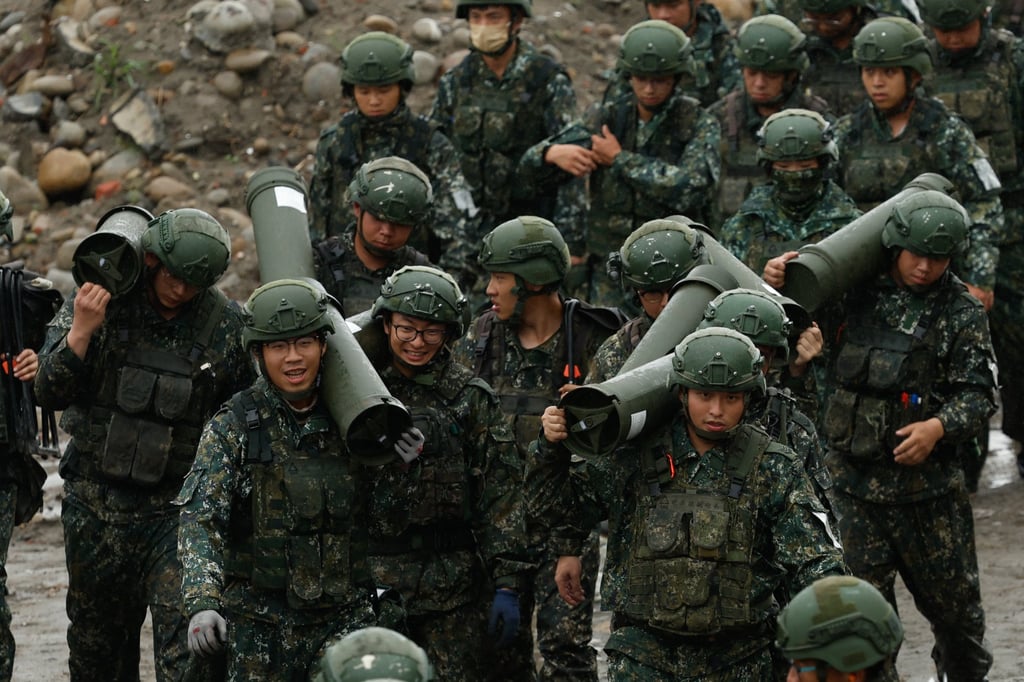
The overhaul comes as Taiwan’s military grapples with declining birth rates, persistent personnel shortages and growing pressure to prepare for a potential conflict with the People’s Liberation Army.
Beijing regards Taiwan as part of China to be reunited by force if necessary. Most countries, including the United States, do not recognise Taiwan as an independent state, but Washington is opposed to any attempt to take the self-ruled island by force and is committed to supplying it with weapons.
The changes have drawn mixed reactions since the defence ministry announced last year that it would revise the standards.
Some young people support the tougher rules, arguing that the previous BMI threshold allowed physically capable men to avoid military service simply because they were overweight or heavily built.
“I’ve seen some people who are incredibly energetic on the basketball court but suddenly become ‘disabled’ when it’s time for their military medical examination,” said Chen Kuo-wei, 24, who completed his year-long compulsory service earlier this month.
Taiwan restored one-year compulsory military service in 2024, extending the previous four-month requirement as part of efforts to strengthen military readiness amid growing pressure from Beijing and calls from Washington for military reforms.
02:55
Taiwan concludes annual war games, including preparing for PLA sea blockade
But for some prospective conscripts, the immediate concern is not Taiwan’s defence strategy but whether they can safely endure their service.
“Raising the exemption threshold to a BMI of 45 is practically putting people’s lives at risk,” said Liu Wan-hsiung, 21, who is due to graduate from a Taipei university next summer.
“At my current weight, I get completely out of breath after walking a short distance or climbing a flight of stairs. I also suffer from high blood pressure,” said Liu, who is 162cm tall and weighs 113kg, giving him a BMI of 43.
“Now the new rules say I have to serve. If I suffer heatstroke or have a heart attack during training, who’s going to take responsibility?”
Taiwanese men generally undergo medical examinations to determine their eligibility for compulsory service from the age of 19, although students may receive deferments while completing their education.
On Dcard, a popular online forum among university students, discussions have reflected similar concerns over whether military supervisors will respect recruits’ physical and psychological limitations.
Some students who deferred their examinations for further studies have complained that conditions previously qualifying them for exemption might no longer do so.
Andy Ho, a 20-year-old university student from the southern city of Tainan, said he would not have sought a deferment two years ago had he known the rules would change.
“I would have gone straight for the medical examination and secured my exemption,” said Ho, who has autonomic nervous system disorder.
“It feels as though we’ve been ambushed by the policy change, almost as if the government has deliberately moved the goalposts. It’s extremely unfair.”
09:58
Will Batanes become the next South China Sea flashpoint?
In a joint statement on June 30, five youth advocacy groups called for stronger safeguards for medically vulnerable men assigned to Category B alternative service.
They highlighted concerns about severely underweight recruits and those with asthma, diabetes or scoliosis, questioning whether military facilities could accommodate their medical needs and prevent assignments that might worsen their conditions.
Medical professionals have also raised concerns about the potential health consequences.
“A BMI of 45 represents extreme obesity and risks triggering medical emergencies, including sudden cardiac events,” warned Su Yi-feng, a Taipei-based doctor.
Yang Tsung-tsai, a psychiatrist affiliated with Tri-Service General Hospital in Taipei, offered a more nuanced assessment of the revised IQ requirements.
He argued that people with borderline intellectual functioning could perform useful non-combat duties if given appropriate assignments and clearly structured instructions.
“Not everyone is suited to carrying a rifle, but that doesn’t mean they are incapable of contributing,” Yang said.
Tien Hsin-chiao, a psychiatrist at Shin Kong Wu Ho-Su Memorial Hospital in Taipei, agreed that such recruits could learn routine tasks through repetition but warned that psychological adjustment could be a greater challenge.
With asymmetric warfare and technological advances, not everyone needs to be on the front line carrying out bayonet drills or long-distance marches
Tien said they might struggle to keep pace with others, leaving them vulnerable to ridicule, bullying or harsh treatment by supervisors.
The changes have also drawn criticism from retired senior military officers who question whether expanding eligibility will improve combat effectiveness.
“Making the numbers look better is meaningless if it doesn’t translate into actual fighting strength,” said Chang Yen-ting, a retired air force lieutenant general.
Chang warned that severely overweight recruits could face increased medical risks, while exceptionally short personnel might struggle to operate standard military equipment.
“You might even have to assign another soldier to look after them,” he said.
“So while you’ve added one person to your manpower figures, you’ve effectively lost another person’s combat capability.”
Retired army major general Li Cheng-chieh raised similar concerns, warning that accommodating recruits with significant physical or intellectual limitations could divert commanders’ attention from combat training to medical supervision and care.
“If someone can’t even understand combat orders, how can he serve as a soldier?” he said. “What happens if he ends up shooting his own comrades?”
However, some defence analysts argue that such criticism overlooks the changing nature of combat.
“In modern warfare, brainpower can be more important than physical strength,” said Zivon Wang, a military analyst at the Chinese Council of Advanced Policy Studies in Taipei.
“With asymmetric warfare and technological advances, not everyone needs to be on the front line carrying out bayonet drills or long-distance marches.”
Wang said recruits unsuitable for physically demanding duties could operate drones, monitor radar systems, maintain command-and-control networks or undertake information technology and logistical assignments, freeing more capable personnel for frontline operations.
But he cautioned that assignments must reflect recruits’ actual abilities.
Taiwan’s government has defended the revisions, saying the new rules will promote fairness without compromising the physical requirements for frontline military service.
Defence Minister Wellington Koo Li-hsiung said the revised minimum height for regular service was consistent with standards for volunteer soldiers, while officials promised differentiated training and accommodation arrangements for Category B personnel.
Chieh Chung, a researcher at the Taipei-based Association of Strategic Foresight, said the overhaul reflected Taiwan’s demographic pressures and growing need for personnel to defend its territory.
He noted that previous governments had relaxed exemption requirements as the military moved towards an all-volunteer force, but the restoration of one-year compulsory service and Beijing’s expanding military capabilities had changed those calculations.
Nevertheless, Chieh warned that increasing recruitment figures would achieve little if young men regarded their service as a waste of time.
“What discourages young men isn’t necessarily how tough the training is,” he said.
“It’s the feeling that their time is being spent on miscellaneous chores rather than combat-relevant skills.”
05:03
Which PLA generals are going to fill the theatre command posts left by China’s anti-corruption crackdown?
Complaints from former conscripts about being assigned cleaning and maintenance tasks unrelated to military operations have reinforced such perceptions.
Max Lo, executive director of the Taiwan International Strategic Study Society, said the biggest challenge would be ensuring that newly eligible recruits could perform their assigned duties safely.
“If someone has a heart condition near the permissible threshold and is ordered to run 1,000 metres (3,280 feet), he could collapse halfway through,” Lo warned.
He called for better medical assessments, emergency care and psychological counselling to help reluctant recruits adjust to compulsory service.
Lo said the military must demonstrate that additional personnel would actually strengthen operational capabilities rather than create new burdens.
He also argued that young people’s willingness to fight would depend on the circumstances surrounding a conflict.
They might be more prepared to defend Taiwan if they believed they were responding to an external attack, he said.
“But their willingness could weaken if a war was perceived as having been triggered by provocative actions taken by the Democratic Progressive Party government.”
Ultimately, analysts said, the overhaul’s success would depend less on how many additional men entered service than on whether the military could turn them into able, motivated personnel without compromising their safety.
KioskNews shows a cleaned-up reading view extracted from the publisher’s page — the original always lives on their site, not ours.