US report warns of Chinese AI persona tactics targeting Taiwan elections
TARGETING ELECTIONS: The ‘New York Times’ said the activity is different from past Chinese disinformation campaigns, sprinkling disinformation among mundane chatter
By Lin Chia-yu and Jonathan Chin / Staff writers


Artificial intelligence (AI)-generated personas aligned with China are being used in a bid to interfere in Taiwan’s nine-in-one local elections, the New York Times reported on Monday, citing a Vanderbilt University study.
Last year, Vanderbilt researchers discovered an effort by GoLaxy (中科天璣), a China-based company, to develop AI tools to create sophisticated disinformation campaigns, the report said.
Working with the Taiwan-based non-profit Doublethink Lab, the researchers began searching for evidence of China-directed AI disinformation operations, it said.
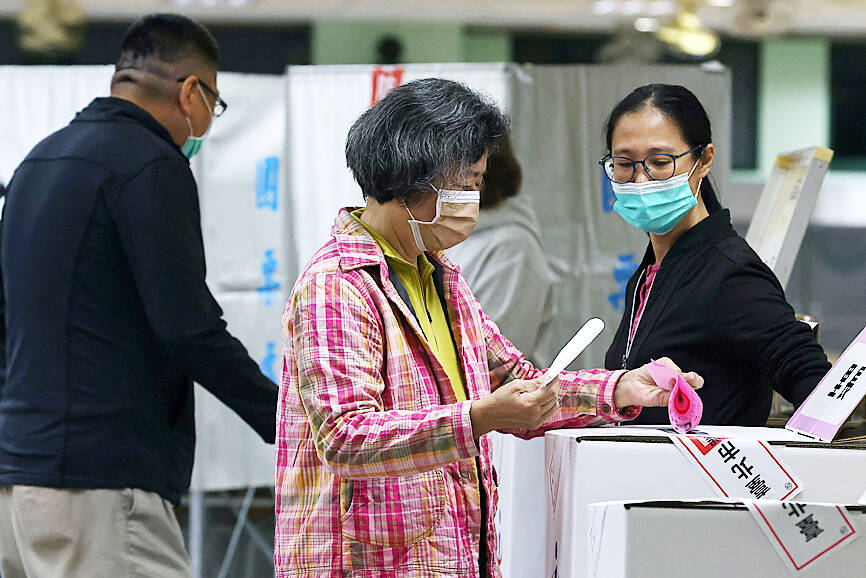
A woman votes in Taipei on Nov. 26, 2022.
Photo: Ann Wang, Reuters
Utilizing a Vanderbilt lab-developed tool that spots tonal and word-choice differences between humans and agents, the team last month and this month observed “traditional, hybrid and AI-powered inauthentic activity” aimed at influencing voting in Saturday’s elections, it said.
The activity is different from past Chinese disinformation campaigns, which traditionally lacked sophistication, but seems to have improved with the use of AI, possibly learning from Russian interference campaigns, it said.
“The tool and the researchers found inauthentic accounts aligned with Beijing that were either posting on nonpolitical topics, like food, animals or celebrities, or creating social media feeds featuring sexualized imagery,” the report said.
Messages supporting China or the so-called “unification” of Taiwan were interspersed in seemingly entertainment-focused content, it said.
The technique of packaging political messages in unrelated, celebrity-centric feeds was observed during the US midterm elections, the report said.
Threat intelligence company Alethea identified the fake accounts, which targeted Democrats, as originating in Russia, it said.
Some of the accounts posted material that directly attacked the Democratic Progressive Party (DPP), accusing it of corruption or ineffectual governance, the report said.
Other accounts displayed more sophisticated behavior, it said.
One inauthentic account presented itself as supporting the DPP administration, but engaged with pro-China accounts that were not gaining traction to bolster Beijing’s message, the report said.
Many of the accounts tracked by the researchers appeared to be “cyberborgs” that combine AI-generated images with messages created by human propagandists, it said.
Some accounts posted during regular business hours, suggesting that they were managed by people and not wholly automated, it said.
Vanderbilt researchers found accounts that spent months posting provocative AI-generated images on Instagram and then added political content on Threads as the elections neared, it said.
China’s new disinformation campaign directed at Taiwan displayed remarkable patience, Brett Benson, a Vanderbilt University associate professor of political science and Asian studies, said in the report.
“Synthetic personas sometimes spend months posting nonpolitical content, cultivating followers and establishing an apparently authentic social media presence before introducing political messaging,” Benson said. “AI is making it easier to construct and maintain synthetic identities that can establish credibility within social networks before being mobilized for political purposes.”
The previous Vanderbilt study on GoLaxy showed that the company was trying to use AI in hyper-targeted messaging in a bid to create a large number of messages to convince people holding specific views, the report said.
The research team did not find evidence of hyper-targeting, but would continue to observe China-directed disinformation, it said.
KioskNews shows a cleaned-up reading view extracted from the publisher’s page — the original always lives on their site, not ours.