5 Forgotten Adventure Movies That Are Amazing From Start to Finish

Sign in to your Collider account
People discover a movie with 200,000 Letterboxd logs and act like they’ve pulled the only surviving print from a basement in Prague. No sir/ma’am. This is the list about actually forgotten movies. And to niche it down, forgotten adventure movies. These are different. They are the movies people vaguely remember liking, the ones that somehow slipped out of everyday conversation while lesser franchise entries got sequels, reboots, legacy sequels, and commemorative popcorn buckets.
Put one back on and the reaction is usually the same. Wait, why did we stop talking about this? That is the beautiful part. There is no homework attached. No cinematic universe to refresh, no mythology wiki required, no promise that “it gets good in the sequel.” Let’s get started.
5 'The Rocketeer' (1991)

This movie is set against 1930s Hollywood. The Rocketeer turns that into a beautifully old-fashioned scramble involving the FBI, Nazis, mobsters, movie stars, and Cliff’s girlfriend Jenny (Jennifer Connelly) getting pulled directly into the mess. Pilot Cliff Secord (Billy Campbell) finds an experimental jetpack hidden by gangsters and, because this is exactly the sort of decision an adventure hero should make, eventually straps the thing onto his back.
What is so easy to love now is how sincere the whole thing is. Cliff is not trying to become a superhero brand. He wants to fly, save Jenny, and survive people who understand the rocket far better than he does. Neville Sinclair (Timothy Dalton) is especially fun once his polished movie-star persona starts cracking and the Nazi plot underneath it comes into view. Then the finale heads to the Griffith Observatory and a burning zeppelin because apparently the movie decided subtlety had already done enough. Disney had the bones of a franchise sitting right there. We got one movie. At least it is a terrific one.
4 'The Adventures of Tintin' (2011)

The Adventures of Tintin takes maybe ten minutes to start moving and then spends the rest of its runtime behaving like stopping would be personally offensive. Tintin (Jamie Bell) buys a model ship at a market and immediately attracts enough unwanted attention to realize he has purchased more than a decoration. Hidden inside is a clue connected to the Unicorn, a legendary vessel, a lost fortune, and the family history of Captain Haddock (Andy Serkis).
Captain Haddock is the secret weapon because he turns exposition into chaos simply by being incapable of experiencing anything quietly. Snowy repeatedly solves problems before the humans do. And the Bagghar chase is still ridiculous in the best possible way, with Tintin racing through collapsing streets while a falcon, a motorcycle, a tank, a hotel, and multiple pieces of the same clue somehow keep colliding in one continuous set piece. The motion-capture faces remain divisive, fair enough. The adventure underneath them is absolutely alive. The real crime is that Steven Spielberg and Peter Jackson never got to turn this into the series it obviously wanted to become.
3 'The Count of Monte Cristo' (2002)

This film’s title always reminds me of the c*** of Monte Cristo reference from Succession. Nonetheless, this is about Edmond Dantès (Jim Caviezel) beginning with a promising life, a woman he loves, and enough trust in his closest friend to miss the betrayal coming straight at him. Fernand Mondego (Guy Pearce) helps frame him for treason, Edmond is thrown into the brutal Château d’If, and years disappear before another prisoner gives him the education, purpose, and information he needs to become someone entirely different. The Count of Monte Cristo then delivers the part revenge stories live or die on. Edmond gets out.
From there, the pleasure is almost indecent. He finds the treasure of Spada, rebuilds himself as the mysterious Count, enters Parisian society dripping money and confidence, and begins moving the people who destroyed him into position without announcing why. Jim Caviezel’s Edmond has the right haunted restraint after prison, while Fernand becomes the sort of villain you cannot wait to watch realize that the universe has kept receipts. Alexandre Dumas’ novel is far more sprawling, but this adaptation understands exactly what a two-hour adventure needs. Betrayal, escape, reinvention, revenge. Sometimes the classics were onto something.
Collider Exclusive · Action Franchise Quiz What Action Series Would You Thrive In? Wick · Fast · Mission · Die Hard
Four franchises. Four completely different ideas of what a hero is: the assassin with a code, the family that never leaves anyone behind, the man who does his own stunts, and the guy who simply refuses to die. Only one of them runs on your particular brand of trouble. Eight questions will tell you which one you would survive.
🐕Wick
🏁Fast
🧨Mission
🎄Die Hard
01
How does a room know you've walked into it? Every action hero arrives differently. Some of them arrive before they arrive.
02
It turns physical. What does your fighting actually look like? Choreography is character. Yours says something about you.
03
Who is standing beside you when it starts? Some franchises are built on a team. Others are built on one person walking in alone.
04
It has gone badly wrong. What keeps you upright? Act two exists to find out what you're actually made of.
05
There's a vehicle. What are you driving, and how? No action franchise has ever survived without a car chase. This one is yours.
06
How do you feel about the people giving the orders? There is always an institution. There is rarely a good one.
07
Underneath all of it, what are you actually doing this for? The stunts are the reason people come. This is the reason they stay.
08
When the credits roll, what do people say about you? Every franchise is really an argument about what makes someone worth watching.
Casting Has Been Completed Your Franchise Is…
Four action series. One of them is built around exactly the way you handle pressure, people, and a room that has just gone very quiet. Here is where you would survive the trilogy, and probably headline it.
John Wick
You are precision with a grudge. You don't posture, you don't escalate, and you don't warn anybody twice. That is exactly why the people who know you are so careful never to be the reason you start.
- The Wick films run on discipline: an underworld with actual etiquette, a hero who honours every rule of it, and a world that unravels the instant someone breaks one against him.
- You share that quality. You are extraordinarily reasonable right up to the line, and then completely immovable past it.
- Focus, commitment and sheer will. You'd be the one carrying grief through three sequels and turning it into technique rather than noise.
- People wouldn't call you dangerous. They'd say your name quietly and let that do the work.
Fast & Furious
You understand the thing the whole franchise is secretly about: the cars are spectacular, but the crew is the point. You collect people, you keep them, and you'd drive through a building for any one of them.
- This series went from street racing to orbit without ever changing its actual subject, because loyalty scales and plot doesn't have to.
- You have the same instinct. You build a family out of whoever turns up, and then you defend it past the point of reason.
- You'd thrive here because the franchise rewards exactly your strengths: warmth, nerve, an absolute refusal to leave anyone behind, and a relaxed relationship with physics.
- The mission can wait. The barbecue cannot.
Mission: Impossible
You over-prepare and then take the dangerous part yourself anyway. It looks like control, but it's really responsibility. You have never worked out how to ask somebody else to carry the risk.
- This is the franchise of the plan that collapses on schedule: the team, the mask, the rooftop, and the one person sprinting flat out because sprinting is all that's left.
- You share that refusal to accept an outcome. Told the odds, you treat them as an administrative error.
- You'd thrive here because these films reward competence and loyalty in equal measure. The mission matters, but nobody on the team gets left on the wrong side of a door.
- Some people delegate the cliff. You have never once been that person.
Die Hard
You are not the most trained person in the building, the best equipped, or the one anybody would have picked. You are simply the one still standing at the end, which turns out to be the only qualification that matters.
- Die Hard invented the modern action hero by making him mortal: outgunned, out-planned, bleeding, and extremely funny about it.
- You share that stubbornness. Adversity doesn't make you noble, it makes you sarcastic, and then it makes you unstoppable.
- You'd thrive here because these films reward improvisation and nerve over preparation, and you've never had the luxury of preparing anyway.
- You didn't want any of this. You just declined to be the person who let it happen.
2 'Master and Commander: The Far Side of the World' (2003)

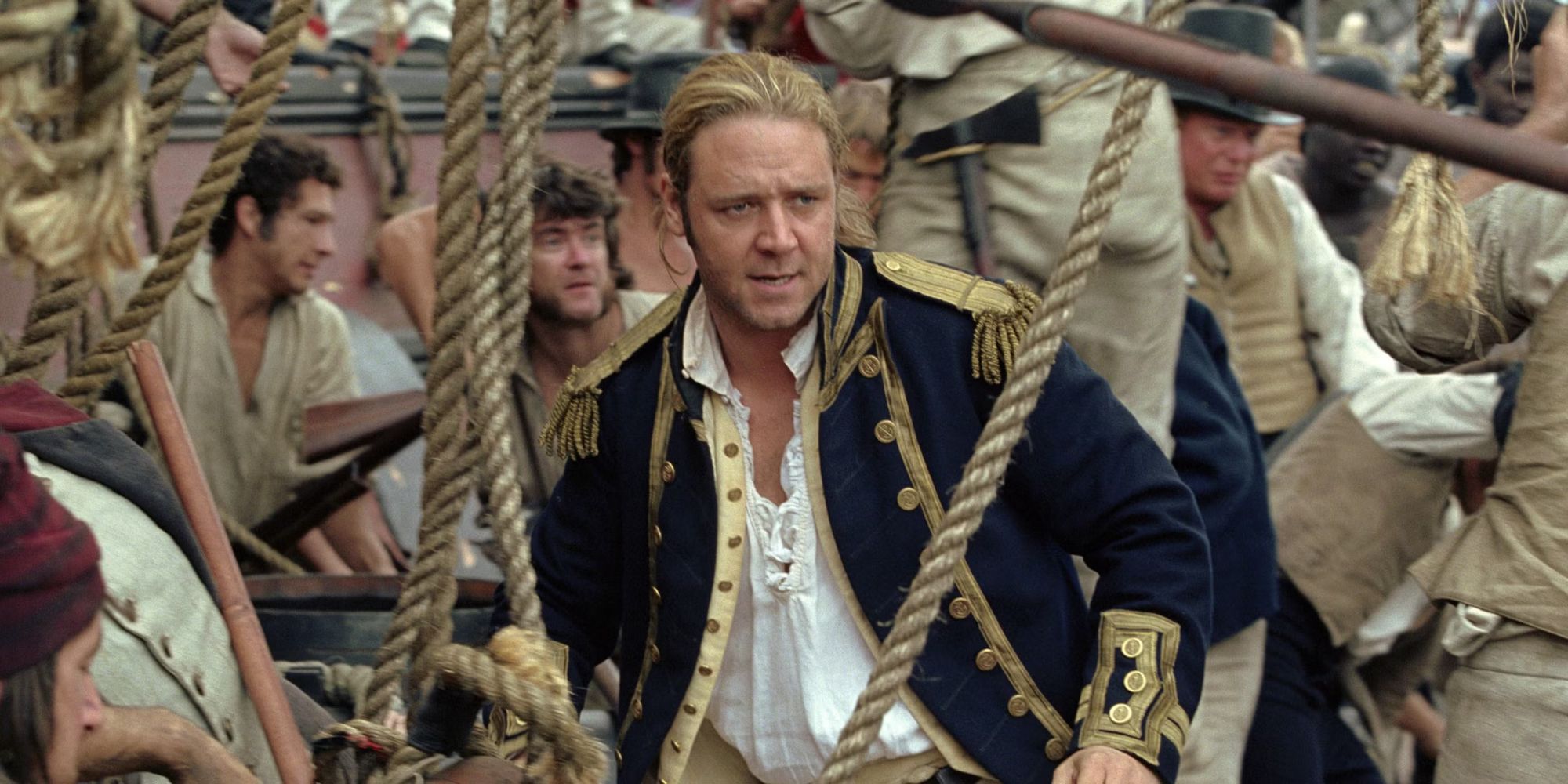
Captain Jack Aubrey (Russell Crowe) is commanding HMS Surprise during the Napoleonic Wars when a larger, faster French privateer begins hunting his ship across the Pacific. That is essentially the whole engine of Master and Commander: The Far Side of the World, and it is enough because the movie makes life aboard that ship so specific that every damaged mast, cannon blast, sick sailor, and change in the wind feels important.
The first attack comes through fog before the crew can properly see what is hitting them, and from that point the sea never feels remotely safe. Aubrey has to decide how aggressively to pursue an enemy that may simply be better equipped, while ship surgeon Stephen Maturin (Paul Bettany) keeps reminding him that the world contains things worth studying beyond warfare. Their friendship gives the movie warmth without softening either man. And when the crew eventually disguises the Surprise as a whaling vessel to lure the enemy close, you feel how much practical knowledge has gone into earning that move. This should have launched a decade of naval adventures. Instead, we got one nearly perfect one and have been complaining ever since.
1 'The Mask of Zorro' (1998)

Don Diego de la Vega (Anthony Hopkins) loses everything after his final victory as Zorro, including his wife, his freedom, and his infant daughter Elena. Twenty years later, he finds Alejandro Murrieta (Antonio Banderas), a reckless bandit with his own reason to hate Captain Harrison Love (Matt Letscher), and decides this angry young man might be useful if he can first teach him how to hold a sword without embarrassing everyone involved. The Mask of Zorro has barely assembled those pieces before the chemistry starts doing half the work.
Alejandro trying to behave like an aristocrat after years of outlaw life is funny because Antonio Banderas never loses the character’s rough edges. Elena (Catherine Zeta-Jones) matches him immediately, especially in the famous sword fight where flirting and fencing become basically the same activity. Anthony Hopkins’ older Zorro gives the story something deeper, since training Alejandro is tied to a daughter who has grown up believing another man is her father. Then the movie gives you horses, mines, explosions, revenge, secret identities, and actual swashbuckling without a trace of embarrassment. This is what people mean when they say movies used to have charm. Put it on. Ten minutes later, the cape starts making sense again.
KioskNews shows a cleaned-up reading view extracted from the publisher’s page — the original always lives on their site, not ours.