European Union eyes battle over ‘pervert’ AI glasses
SECRET FOOTAGE: A 17-year-old girl told British broadcaster Channel 4 that she had been approached by a man who covertly recorded her and their interaction
Calls are growing louder in Europe for action against “pervert” smart glasses after secretly filmed footage of girls and women appeared online — with a petition in Britain demanding a ban on their sale.
Anyone wearing smart glasses can take photos, film videos, listen to music, make phone calls, translate text or interact with an artificial intelligence (AI) assistant, with sales now hitting millions.
The devices grabbed attention this summer after a marketing tie-up between Kylie Jenner, beauty mogul and member of the Kardashian dynasty, and tech giant Meta.
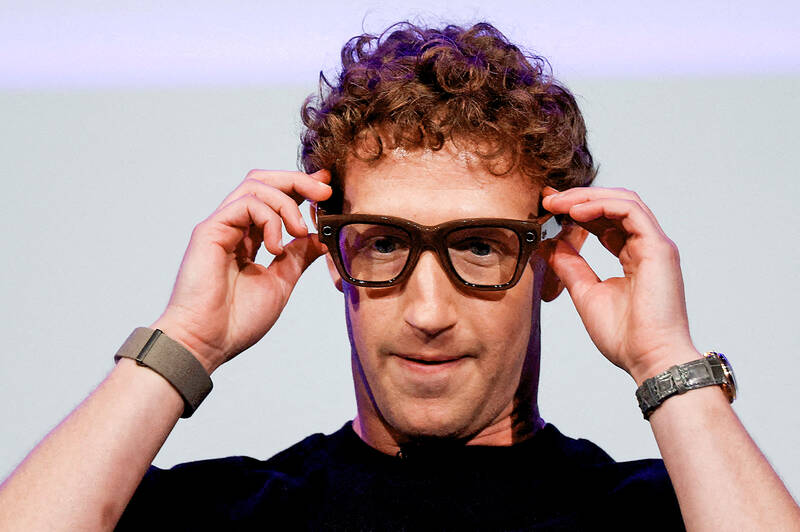
Meta CEO Mark Zuckerberg wears the Meta Ray-Ban Display glasses as he delivers a speech during the Meta Connect in Menlo Park, California, on Sept. 17 last year.
Photo: Reuters
Since smartphones are now embedded in daily life, “big tech” is increasingly looking to glasses as the next big thing in wearable technology, helped by AI’s advances.
A 2013 push by Google failed to take off, but Meta’s smart spectacles, developed in partnership with Ray-Ban maker EssilorLuxottica, have fared much better.
Meta sold about 7 million pairs last year, up from a total of 2 million in 2023 and 2024. Others, including Google and Snap, are also preparing to roll out AI-powered glasses.
However, with exponential growth came the backlash.
Worries reached a peak in the summer in Europe, especially in Britain which saw intense media coverage of so-called “pervert glasses” alongside reports that Meta is developing a facial recognition feature to be integrated into the devices.
In one case, a 17-year-old girl told British broadcaster Channel 4 News last month how she had been approached by a man who covertly recorded her and their interaction.
Meta said it has taken multiple steps to prevent tampering with the blinking LED light intended to show other people the device is recording — a key concern of critics.
“These investments are already having a deterrent effect,” it said, saying that companies offering to disable the LED lights had shut down as a result.
In the meantime, Norway’s capital Oslo banned the glasses in schools this week as the government mulls regulating their use and considers a ban on features that enable facial recognition in public.
There are similar calls for the EU to take up the issue, while France’s National Commission on Informatics and Liberty data protection watchdog has urged “vigilance.”
A Swedish designer, Mateusz Pozar, launched a “Ban Ray” site earlier this year, providing signs to ban smart glasses from venues and selling stickers.
Pozar said he started the site after his girlfriend was approached by two men wearing the glasses and recording her, which “freaked her out.”
He said he wanted a discussion about how “we as a society feel about this technology” before it becomes ubiquitous.
“This is a lever to have a discussion about privacy, personal rights, control over my data,” he said.
Pozar also pointed to his concerns about data extraction after reports about Kenya-based workers who reviewed graphic content captured by Meta’s AI glasses.
Slovakian Member of the European Parliament Veronika Cifrova Ostrihonova said that she raised the issue with the bloc’s executive after the first cases of women being secretly filmed, seeking to know if the glasses comply with data protection and AI rules.
“I am still awaiting an answer,” the Slovak lawmaker said.
“We need clear EU rules to protect and strong enforcement to make sure new technologies don’t come at the expense of our fundamental rights,” she said.
The European Commission said national data protection authorities were “responsible for monitoring and enforcing” privacy rules.
The EU executive would not be drawn on what further action it could take, but the independent European Data Protection Board commissioned a report expected in autumn looking at the glasses’ “social acceptability.”
That report would guide the European Parliament, where Member of the European Parliament Alex Agius Saliba said there were concerns across the political spectrum.
“We must act as soon as possible,” he said.
“For me, they are still pervert glasses,” Saliba said.
“As things stand today, we should definitely go for a ban” until they are proven safe, he added.
A “Stop Smart Glasses” campaign launched in Britain and Ireland, with a petition and call for supporters to contact stores to stop their sale.
The petition has more than 9,100 signatures so far. The British government must respond if it reaches 10,000.
One of the campaign’s founders, teacher Guy Holder, said he had several concerns about the glasses including their effects on girls and women and a broader “invasion” of public spaces that could lead to “total surveillance.”
“We are also concerned more broadly about an atmosphere in which it feels like anybody can film anybody without their knowledge or consent,” he said.
KioskNews shows a cleaned-up reading view extracted from the publisher’s page — the original always lives on their site, not ours.