Takaichi retains key ministers in reshuffle
Japanese Prime Minister Sanae Takaichi yesterday retained her key ministers in a Cabinet reshuffle and made two appointments of Taiwan-friendly politicians.
Takaichi — who has high approval ratings nearly a year into office — kept core members of her team, according to a Cabinet list announced by government spokesman Minoru Kihara.
They include Kihara, Minister of Finance Satsuki Katayama, Minister of Foreign Affairs Toshimitsu Motegi and Minister of Defense Shinjiro Koizumi.
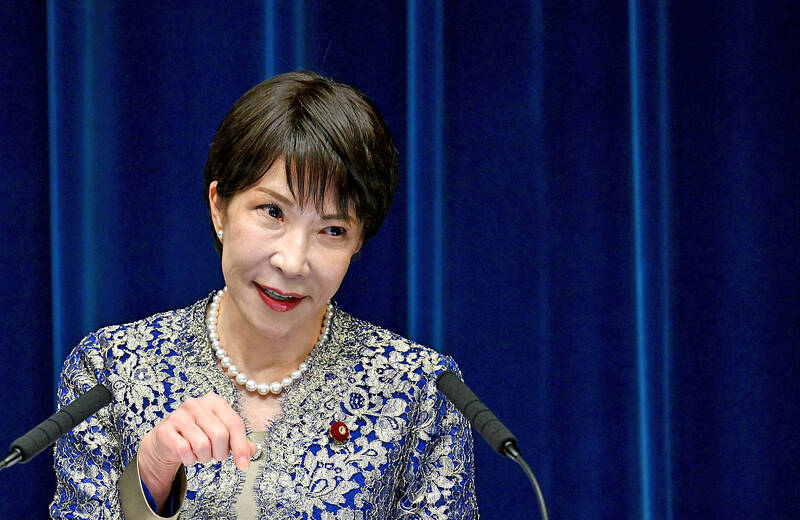
Japanese Prime Minister Sanae Takaichi speaks at a news conference at her office in Tokyo yesterday.
Photo: AP
The prime minister also made new appointments, with Hisayuki Fujii named minister for internal affairs and communications, and Takashi Yamashita returning as minister of justice.
Fujii and Yamashita have represented the ruling Liberal Democratic Party in the “two-plus-two” policy dialogues with Taiwan.
At the talks between the Democratic Progressive Party (DPP) and the LDP, the two have engaged in face-to-face discussions on issues such as Taiwan Strait security.
Fujii participated in the dialogue in 2024, while Yamashita engaged in the seventh, expanded edition of the dialogue on Monday with DPP representatives, including Legislator Puma Shen (沈伯洋), the party’s candidate for Taipei mayor.
During the meeting, the LDP’s Taiwan policy project team identified enhancing deterrence, civil defense, “gray zone” contingencies and economic cooperation as areas for further discussion.
While Fujii has engaged in Taiwan-Japan exchanges through the lens of diplomatic and security policies, Yamashita has been more involved in the internal deliberation of Taiwan policy within the LDP.
The small-scale reshuffle comes as Takaichi navigates rising inflation and a weak yen while pursuing a consumption tax cut on food starting next year.
While Takaichi’s tax cut pledge is popular among voters, economists have criticized the plan, warning that she has failed to identify about ¥5 trillion (US$32 billion) needed annually to fund it.
Takaichi’s policy of expansive government spending has also rattled markets, pushing Japan’s benchmark bond yield to about 3 percent, its highest in three decades.
With Katayama in the finance role, Japan has repeatedly intervened in the foreign exchange market to prop up the falling yen.
On defense, Koizumi remains tasked with updating Japan’s foundational national defense strategy.
“Revising our strategy is something that has a major impact on Japan’s security and on the entire region,” Koizumi told reporters after he was reappointed.
The defense ministry “must marshal all our resources and move forward with a greater speed” with the review with “a strong sense of urgency,” he added.
KioskNews shows a cleaned-up reading view extracted from the publisher’s page — the original always lives on their site, not ours.