Make statutory rules to bar social media firms from adding minors: Supreme Court to Government
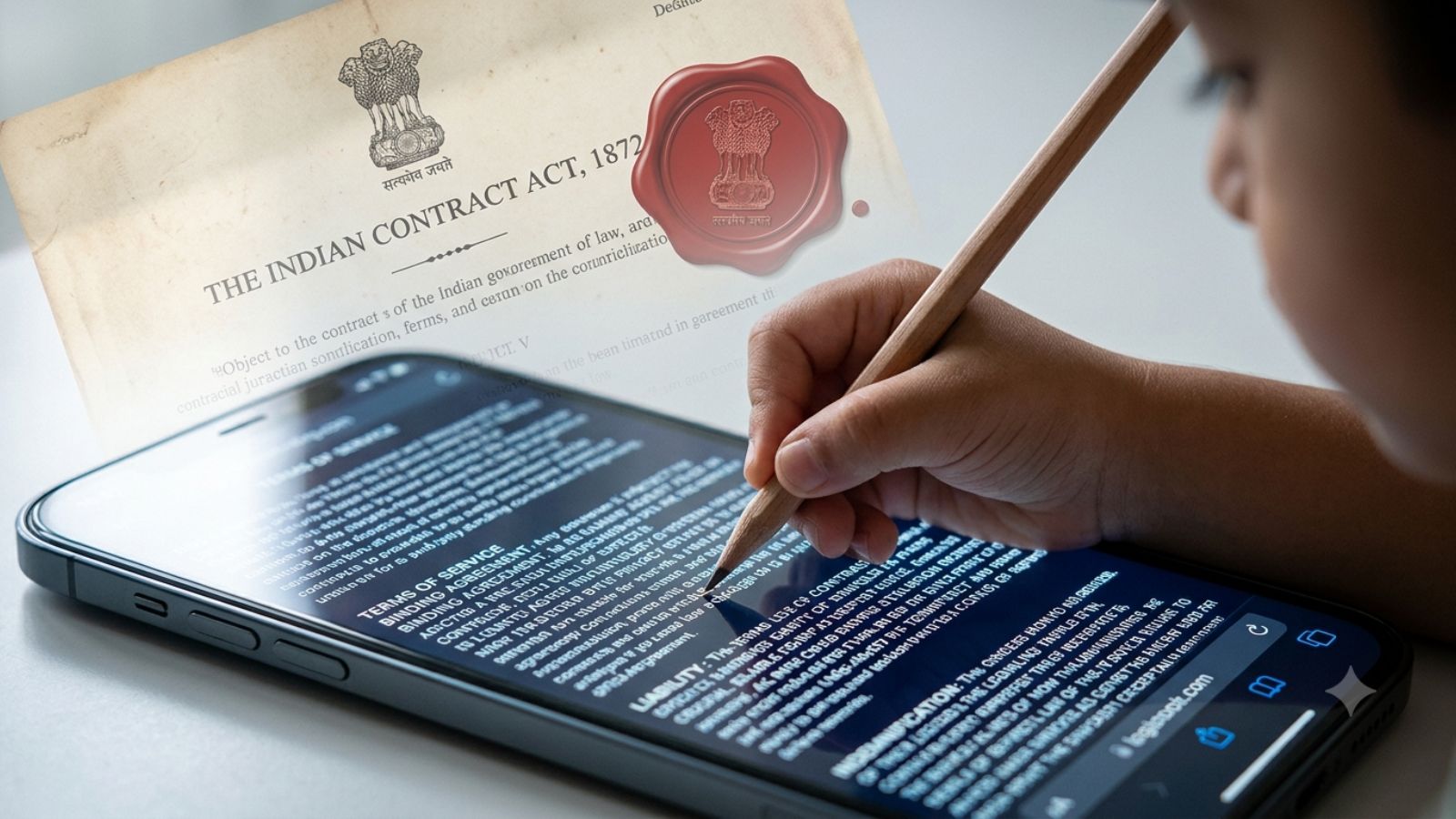
Social media platforms operating in India presently permit minors, generally aged 13 years and above, to independently create and maintain accounts by merely declaring their age or date of birth, the petition said. (AI generated image)
The Supreme Court on Monday asked the Centre to put in place statutory rules to ensure that social media platforms and other digital intermediaries comply with Indian laws on minors and make 18 years of age the minimum requirement for extending membership.
“Our request to you, as the Government of India, you please pass some directions under the intermediary rules that they should fashion their software or platform in conformity with Indian law. They must conform at least in respect of membership of a minimum threshold of 18 years,” Justice Joymalya Bagchi, who was part of a three-judge bench, said.
The bench, presided by Chief Justice of India Surya Kant, was considering a petition by the NGO Just Rights for Children Alliance, seeking measures to bar minors from creating and operating social media accounts.
The PIL, filed through advocate Saksham Maheshwari, pointed out that children below the age of 18 years are currently permitted to independently create and maintain social media accounts despite their statutory incapacity to enter a contract under Section 11 of the Indian Contract Act.
On September 10, the bench, also comprising Justice V. Mohana, had issued notices to the Ministry of Electronics and Information Technology, the Ministry of Law and Justice and the Ministry of Labour on the petition.
On Monday, Solicitor General Tushar Mehta, appearing for the government, agreed with senior advocate H S Phoolka that minors cannot enter into contracts under the Indian law.
Justice Bagchi pointed out that the argument is that “they (social media intermediaries) are registered under the laws of the United States, (and) they have imported into Indian digital space the restrictions which are applicable in the US”.
Story continues below this ad
“Yes, we will have to control the intermediaries”, said Mehta.
Justice Bagchi said that the government should act to get the intermediaries to follow Indian laws. CJI Kant said that the government can invoke sections 4 and 9 of the Information Technology (Intermediary Guidelines and Digital Media Ethics Code) Rules, 2021, to issue directions to the intermediaries. To that, Mehta said, “Government is ready to do that. I have no manner of doubt.”
Justice Bagchi said, “They must conform at least in respect of membership of minimum threshold of 18 years,” adding, “Please examine the intermediary rules where there is a direction to that effect…”
The PIL has urged the court to direct the government to ensure that minors are not permitted to enter into contracts with digital platforms, including social media, but they be permitted access to educational content through accounts maintained and controlled by their parents or guardians.
Story continues below this ad
The petition seeks directions to social media platforms to implement effective age-assurance mechanisms and to stop allowing independent accounts of minors. The PIL pointed out that there is a “fundamental legal and regulatory inconsistency” in minors accessing social media. “Under Section 3 of the Majority Act, 1875, a person attains majority only upon completing 18 years. Under Section 11 of the Indian Contract Act, 1872, a person who has not attained the age of majority is not competent to contract”.
Social media platforms operating in India presently permit minors, generally aged 13 years and above, to independently create and maintain accounts by merely declaring their age or date of birth, the petition said.
© The Indian Express Pvt Ltd

Ananthakrishnan G. is a Senior Assistant Editor with The Indian Express. He has been in the field for over 26 years, kicking off his journalism career as a freelancer in the late nineties with bylines in The Hindu. A graduate in law, he practised in the District judiciary in Kerala for about two years before switching to journalism. His first permanent assignment was with The Press Trust of India in Delhi where he was assigned to cover the lower courts and various commissions of inquiry. He reported from the Delhi High Court and the Supreme Court of India during his first stint with The Indian Express in 2005-2006. Currently, in his second stint with the daily newspaper, he reports from the Supreme Court and writes on topics related to law and the administration of justice. Legal reporting is his forte though he has extensive experience in political and community reporting too, having spent a decade as Kerala state correspondent, The Times of India and The Telegraph. He is a stickler for facts and has several impactful stories to his credit. ... Read More
KioskNews shows a cleaned-up reading view extracted from the publisher’s page — the original always lives on their site, not ours.