Russia calls 2nd plague case false
INFORMATION ABYSS: In the town where a worker at a plague lab died, residents said health precautions had been stepped up amid rumors of what caused her death
The Russian health regulator Rospotrebnadzor yesterday said that reports that a second person had fallen ill following the death of a worker at a plague research laboratory in Siberia were false.
Preventive measures have been completed for all individuals who had contact with the worker who died last week, and no dangerous pathogenic microorganisms have been detected, the watchdog said.
On Wednesday, Russia warned against “false” information as reports emerged of a second suspected, with Washington and Brussels calling for transparency and neighboring Mongolia tightening health surveillance.
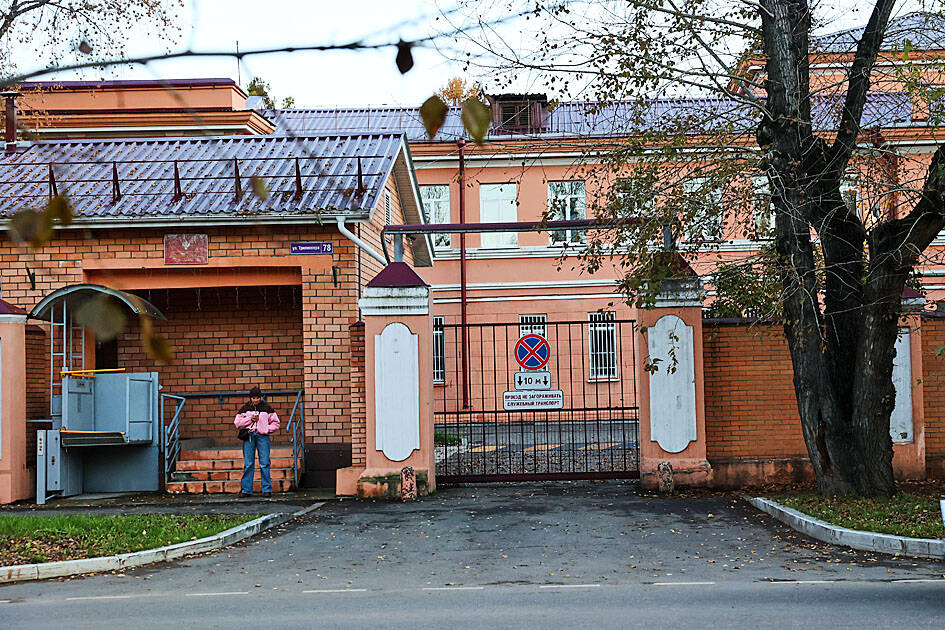
A person stands outside the Irkutsk Anti-Plague Research Institute of Siberia and the Far East in Irkutsk, Russia, on Wednesday.
Photo: AP
Russian news outlet People of Baikal on Friday last week reported that a 28-year-old woman employed at a plague research institute in Siberia’s Irkutsk region had died of the disease, possibly after contracting it from a broken test tube.
International concern has grown over the death and suspicions that a second employee at the institute fell ill.
The US, the EU and the WHO have all called on Russia to be transparent about the situation.
Mongolia’s government on Wednesday said that “health surveillance and monitoring measures [were] being implemented at the border” with Russia.
On Wednesday, WHO Epidemic and Pandemic Management Director Maria Van Kerkhove said the UN health agency did not know what caused the woman’s death, which unconfirmed reports in Russia blamed on pneumonic plague — a severe form of plague that can spread from person to person.
She urged Russia to provide more information about the case.
Russian authorities have played down the reports, determining the woman died of pneumonia and insisting there was no risk of an outbreak.
Asked about reports of a second case, Kremlin spokesman Dmitry Peskov told reporters that “the vast majority of what the media is reporting regarding this situation is false information.”
Asked if a bioweapon was involved, US President Donald Trump told reporters in the Oval Office: “We don’t think so. We’re going to find out soon enough, but we don’t think so.”
“If you listen to them, it’s under control, but you know, people have said that before about other things,” he added.
In Shelekhov, where the 28-year-old lab worker, Darya Shipilova, had been hospitalized before she was reported to have died of plague, residents spoke of stepped up health precautions in place.
“My brother’s in primary school. They’ve already made masks compulsory, so they have to wear them everywhere,” said Alina, a 22-year-old Shelekhov resident.
Oksana, a 35-year-old manager, was admitted to a maternity ward for observation, but said she could not be discharged and spent four days in quarantine.
“In the hospital, people started talking about how a woman had died and they suspected it was the plague,” she said.
“They stopped accepting lab samples and wouldn’t let anyone out. So it was very strict,” she added.
The incident has drawn criticism and comparisons with Moscow’s long history of downplaying or covering up the scale of health disasters — ranging from the Soviet response to the 1986 Chernobyl disaster to the COVID-19 pandemic.
In Shelekhov, rumors have filled the information abyss.
“I’ve read about it being some kind of unclear pneumonia or COVID, something like that. To be honest, I don’t believe in anything anymore,” said Oksana, who declined to give her surname.
“There’s so much information that I no longer know what to believe or who to listen to,” she said.
“The day it happened, my mother rang me, shouting that 10 people had already died, even though there were no official reports,” Alexandra Iskalova, a 22-year-old who works in a medical center, said.
“I’d read somewhere that it was something like Hong Kong syphilis, and that it was actually caused by bears,” she said, referring to a fictional disease from a popular Russian TV show.
“People were absolutely panicking because there were no official statements,” she added.
The Russian health agency on Wednesday said that it had determined “there are no epidemic risks for the population,” adding that extensive investigations had uncovered “no emergencies” and that the lab had complied with “proper control when working with pathogenic microorganisms.”
“More than 90 percent of contacts have completed medical observation,” it added.
The WHO on Tuesday said that its initial risk assessment, based on the information available, was moderate to low for the Irkutsk region, low for Russia as a whole and very low for Europe.
KioskNews shows a cleaned-up reading view extracted from the publisher’s page — the original always lives on their site, not ours.