CAL, Virgin Atlantic ink codeshare pact
CONNECTOR HUB: Up to 70% of CAL’s cargo are from abroad, and connecting passengers account for 60% and 50% of traffic on its North American and European routes respectively
By Shelley Shan / Staff reporter, AMSTERDAM


China Airlines (CAL) yesterday announced that it has signed a codeshare agreement with fellow SkyTeam member Virgin Atlantic Airways to facilitate travel for passengers connecting through Europe.
The airline made the announcement at a ceremony marking the 15th anniversary of it joining the SkyTeam.
Under the arrangement, the codeshare service would cover flights from Taipei to London via Incheon International Airport in South Korea. Additional codeshare routes would be introduced at a later stage.
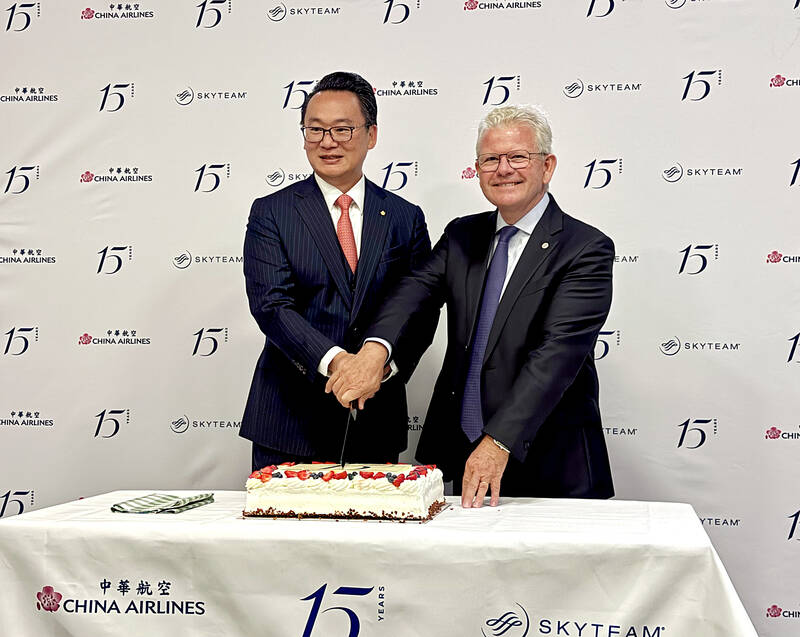
China Airlines president Kevin Chen, left, and SkyTeam CEO Patrick Roux pose for a photograph at a news conference in Amsterdam yesterday.
Photo: Huang Ching-yi, Taipei Times
China Airlines president Kevin Chen (陳漢銘) said Virgin Atlantic has an extensive long-haul network in the UK and provides onward connections from London.
The partnership is particularly useful, because it offers more convenient connections and could help attract more European passengers to Taiwan, Chen said.
Meanwhile, passengers traveling from London via Taipei to Australia and New Zealand represent a significant part of the connecting market, with such passengers accounting for nearly 40 percent of traffic, Chen added.
In addition to China Airlines’ new Boeing 787 aircraft, with deliveries starting last year and expected to be completed in 2028, the airline has ordered 15 Airbus A350-1000 passenger aircraft, 15 Boeing 777-9 passenger aircraft and eight Boeing 777-8F freighters, he said.
Deliveries of the new Airbus 350 and Boeing 777 aircraft are scheduled to begin in 2029.
The airline also plans to begin refurbishing its 18 A350-900 aircraft next year to improve service quality and passenger experience.
China Airlines operates 40 and 30 weekly direct flights to North America and Europe respectively.
Connecting passengers account for about 60 percent of traffic on its North American routes and 50 percent on its European routes, Chen said.
The airline operates six direct routes to Europe: Frankfurt, Amsterdam, London, Vienna, Rome and Prague.
For the flight to Prague, the airline offers a connecting bus service between Prague Airport and Dresden, Germany.
Asked about other airlines testing the waters in the Indian market, Chen said China Airlines welcomes the development, but would prefer to focus its limited capacity on markets where it already has strong advantages.
“We recognize India as a significant and rapidly growing passenger and cargo market. However, the airline is constrained by its current fleet capacity,” Chen said, adding that new aircraft deliveries over the next two years would provide additional capacity.
“Until then, we intend to prioritize strengthening existing routes rather than immediately opening numerous new destinations,” he said.
China Airlines said it expects the air freight market to remain strong in the fourth quarter, with cargo capacity already tight and demand being driven by semiconductors, artificial intelligence-related equipment, consumer electronics and other high-value goods.
The airline said it is maximizing the value and utilization of its limited freighter fleet while also making use of belly cargo capacity on passenger flights.
Only about 30 percent of China Airlines’ cargo originates from Taiwan; about 60 to 70 percent come from across Asia and are routed through Taipei, highlighting the capital’s importance as a regional cargo hub.
With the fourth quarter the peak season for air freight, China Airlines has set a target of NT$10 billion (US$313.60 million) in monthly cargo revenue, above its previous monthly high of about NT$8.085 billion.
China Airlines joined SkyTeam on Sept. 28, 2011, as the alliance’s 15th member and first Taiwanese airline, Chen said.
SkyTeam currently has 18 members.
“During the past 15 years, China Airlines has built up its competitive strength within the global airline alliance network and deepened collaboration with other member airlines,” Chen said.
The airline is leveraging the alliance’s resources to expand its market while working with other partners on innovative services and business operations, he added.
SkyTeam CEO Patrick Roux said China Airlines has been an important member of the alliance in Asia.
Thanks to Taiwan’s central location, and China Airlines’ extensive regional network, and strengths in passenger and cargo services, the airline plays a key role in connecting Asia with global markets through SkyTeam, Roux added.
KioskNews shows a cleaned-up reading view extracted from the publisher’s page — the original always lives on their site, not ours.