It’s time for Australia to tax our gas industry. It is a public policy no-brainer | Rod Simms
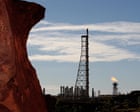
Raising more tax revenue from our gas industry is the closest thing you will find to a public policy no-brainer. There are numerous calls for the government to return the budget to surplus quickly, in contrast to the current forecasts of continuing budget deficits well into the future. Those calling for a return to surplus generally want large net expenditure cuts, which are difficult given the pressure to spend more on an ageing population and on defence, just to name two areas.
I believe this will only succeed if, in addition to better control of expenditure, there is focus on the revenue side. In this context, by far the easiest step is to collect more tax from our gas industry.
Here’s why.
Tax revenue from the gas industry is well under 30% of revenue. All other major gas producers take more, usually a lot more. For example, Norway and the UK collect as tax about 75% of fossil fuel revenues, and still have strong production and a desire to invest. In addition, Norway takes equity positions in projects, but the returns from this are not part of the 75%, which represents only the tax take.
Think of the revenue that is and has been forgone by successive Australian governments, and also the over US$2tn sovereign wealth fund that Norway has steadily built up.
Australia’s gas industry does pay company tax, but it pays close to nothing for the gas that belongs to all Australians.
Let’s understand this. If you start a business in Australia by building a factory or providing services you need to pay only company tax. But if you build a business by getting access to a scarce natural resource that belongs to all Australians, you need to also pay for that. This is what happens all around the world, sometimes by paying royalties or, better, taxes that seek a fair share of the benefits from obtaining the resource.
In Australia the payment for our offshore gas was meant to be through the Petroleum Resource Rent Tax, but all experts agree it is deeply flawed and so only raises a pittance. The threshold for payment was set way too high, so it is rarely met, and it only applies upstream to the gas, not to the liquefied product that is exported. To calculate the tax payment, this requires the difficult calculation of an artificial price as the gas moves into liquefaction.
Effectively, Australia is very close to giving away our gas, which is untenable. The gas industry pays for other inputs into its production, such as for equipment and workers’ wages, but effectively it is not paying for the gas in the ground on which the business depends.
It is also worth mentioning that the north-west shelf gas industry only proceeded with government underwriting and other support. A further argument, not that it is needed, for Australians sharing in the upside from these projects.
There is another anomaly. When gas prices increase, Australian households and companies pay more for gas but Australians, as owners of the gas resource, do not benefit from this upside. The benefit goes to the largely foreign-owned businesses. We own the gas, but Australians are poorer when the price of our gas rises.
There are two main gas taxation proposals that each raise about $15 to 18m per year – a 25% export tax and the fair share levy. The fair share levy is a cashflow tax, the same as applies in Norway. It does not, by definition of its construction, limit the incentive to invest in new gas resources.
Australia’s budget clearly needs more revenue, yet we severely under tax our gas industry. This is like a poor person seeing a $50 note on the pavement and not bothering to bend down and pick it up.
Year-end fundraiser
$0 of $2,000,000 goal
A moment full of possibility – and risk
We hope you appreciated this article. Before you close this tab, can we ask you to support the Guardian at this crucial time for democracy in the US? With Black Friday approaching, our most impactful monthly support option is just $7.50 a month for six months.
In the last two years alone, Donald Trump has eroded many of the pillars of US democracy – slashing funds for universities, undermining science, shutting down arts institutions, and attacking the free press as an “enemy of the American people” and “a threat to our national security”. While he and his allies have enriched themselves and spread lies, federal forces have harassed and imprisoned innocent people and violated the constitutional rights of many Americans.
Now, in a sweeping change election, the American people have spoken: Donald Trump, Pete Hegseth, RFK Jr, Elon Musk and the tech oligarchs may finally be held to account. A majority of American voters have demanded an end to the costly and immoral wars, the flagrant profiteering, and the corrosive attacks on communities and democratic institutions.
It’s a moment full of possibility, with more stories than we can possibly cover. New leaders are emerging from Texas and Michigan to Iowa and South Carolina – and heading to Washington to fight for affordability, against wealth inequality, and for human survival in the face of AI and the climate crisis.
These new leaders will be facing a cornered Trump and his hardline chief of staff, Stephen Miller, who have nothing left to lose. The next few years are critical for the future of the country. Journalism that covers the epic clash between these forces has a vital role to play right now.
Investigative journalism provides a fact-based paper trail for an emboldened Congress to follow. Members of Congress – and the American public – often rely on our in-depth reporting to inform the tough questions, to connect the dots and to pursue accountability for wrongdoing.
At the Guardian, our newsroom is devoted to uncovering the truth and conveying it to as many people as possible. We’re not alone in this mission, but this kind of journalism faces unprecedented hurdles: big tech threatening our financial stability and stealing our work for AI, billionaire owners telling journalists what to publish, and a hostile executive branch intent on suppressing our reporting.
The Guardian is free to dig deep without fear because we’re funded by our readers. Our readers hold us to account, and we hold the powerful to account.
However, this only works when enough of our readers contribute. Against the advice of most industry analysts, we’ve refused to put up a paywall – we believe good journalism should be freely available to all people, regardless of ability to pay. If you’re counting on our reporting, and you can’t afford to pay, please stop reading this message and go back to our articles.
If you can afford to contribute, please know that your support is not only helping yourself – from voters in Kansas to immigrants in Minnesota and families in Gaza, your generosity is bringing factual news to people around the globe.
Today is among our most important fundraising days of the year. To sustain our unique financial model, our goal is to raise $2,000,000 before the new Congress is seated on 3 January. More than 19,000 people have contributed already. All gifts are gratefully received, but for the next several days only, our most impactful monthly support option is $7.50 a month for the first six months. If you can afford 37 seconds, please join our ranks – and show your support for the rekindling of democracy in the US and around the world.
KioskNews shows a cleaned-up reading view extracted from the publisher’s page — the original always lives on their site, not ours.