We’ve lost our manners on public transport. Can we get them back?
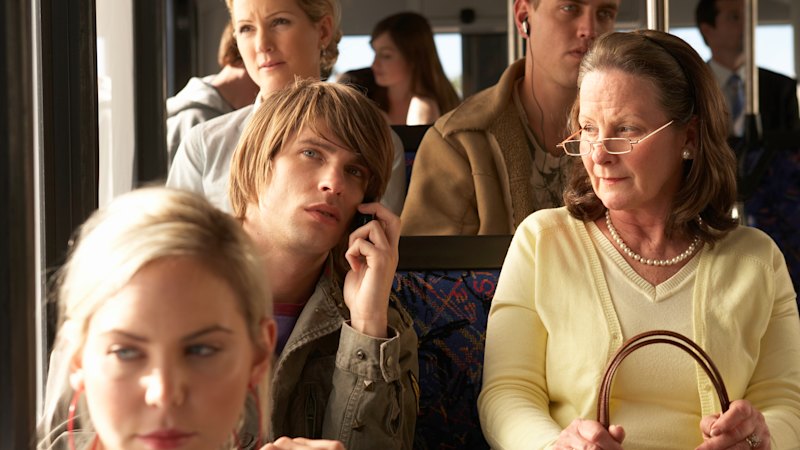
Each week, Good Weekend’s how-to column shares expert advice on how to navigate some of modern life’s big – and small – challenges. This week: How to ask someone to be quiet on public transport.
What are people thinking? What on earth induces them to turn on their phone’s speaker so that their fellow passengers on a train, bus or tram have the dubious pleasure of hearing not just one side of their incredibly tedious conversation, but both sides? Or worse, their noisy videos?
It’s “hugely rude”, says Zarife Hardy, founder of the Australian School of Etiquette, a company that works – mainly with businesses – to foster what were once known as “good manners”. “People are now treating public spaces like their own lounge rooms,” she says.
Hardy defines etiquette, a quaint word, as “a set of standards and rules that we should follow in society, in life, in business, to make our days nicer and our relationships better”. A code of behaviour, perhaps, that allows us to happily share public spaces. Manners are declining as we live faster lives hooked up to personal devices, she believes: “We’ve turned into a society of, ‘It’s all about me.’ We’ve got to come back to ‘It’s about everybody.’ ”
You can fume about rudeness, or you can do something about it, Hardy says, but be careful: etiquette shouldn’t be insisted upon at the expense of your personal safety. “If the offender’s intoxicated or aggressive, just move seats. If you’re going to say something, be polite. Don’t say, ‘Hey, that’s too loud. Turn it down.’ Instead, try, ‘Look, I’m really sorry, but that’s a little bit loud. Would you mind turning it down?’ ” If you’re actually travelling in a quiet carriage, it’s fine to politely point that out. Concentrate on the behaviour you’d like to change, not on attacking the person.
In Victoria, travellers on public transport are free to make or receive phone calls, as long as they’re using headphones; non-compliance could mean a $261 fine. No similar restrictions exist in NSW,
although there are regulations that warn against “disrupting the comfort of others”.
Meanwhile, a push for harsher penalties is becoming global: last year, in the UK, the Liberal Democrats proposed a fine of up to £1000 (about $1880) for “headphone dodgers”.
Hardy says it would be a sad indictment if we needed the heavy hand of the law to force us to consider the comfort of our fellow passengers. “It’s a sad thing in society now that we see signs in shopping centres that read, ‘Please be nice to the staff.’ Like, how much has changed [in our personal interactions with others in public life] that we need those now?”
KioskNews shows a cleaned-up reading view extracted from the publisher’s page — the original always lives on their site, not ours.