‘Autonomy, not flesh’: RAF chief outlines AI drone-powered future
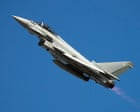
A future Royal Air Force will rely on “autonomy not flesh”, its chief said on Monday as he described plans in which Typhoon fighters are accompanied by four AI-enabled drones capable of patrolling hundreds of miles in the distance.
The technological shift would revolutionise warfare, limit the role of military personnel “towards the outside” and ease the pressure on recruitment, Air Chief Marshal Harv Smyth said in a speech in London.
The senior military officer was setting out a strategy for the RAF, which has been told it must be ready to fight against Russia by 2030, at a time when the use of artificial intelligence by the US, Israel, Russia and Ukraine has made warfare more deadly.
“AI will enable warfare that speeds well beyond human comprehension, meaning that our role will shift towards the outside, and it will shift towards controlling the activity and setting the guardrails,” Smyth said.
The aim, he added, was to mirror the Anglo-American second world war model of “steel, not flesh” – relying on tanks and combat aircraft rather than infantry – to avoid the bloody trench warfare that had led to millions of deaths in the first world war.
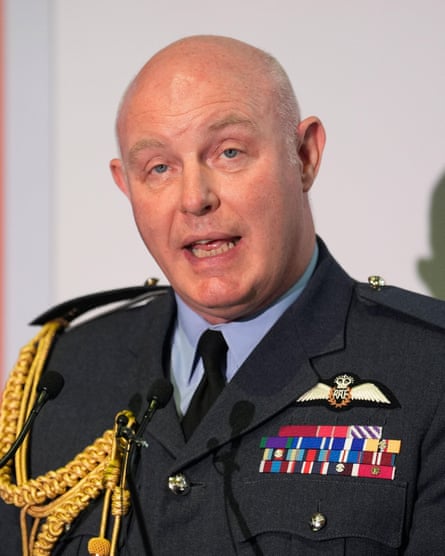
“Given today’s changing character of war, I would argue strongly that the modern paradigm must now become autonomy, not flesh,” the chief of air staff said in a lecture at the Royal United Services Institute.
Few examples were given about the future use of AI by the air force, but Smyth did point to the £300m Storm Fighter programme of “loyal wingman” drones announced in July as part of the delayed defence investment plan. “Crewed platforms are no longer enough,” Smyth said.
Four armed, AI-enabled uncrewed craft would work alongside every RAF Typhoon, with the first tests to be conducted next year. The aim is for the drones to be in service by the end of the decade, in line with a Nato directive for the UK and other alliance members to be ready to fight Russia if necessary by 2030.
Over the weekend Wes Streeting, the defence secretary, said the UK had “a little over 1,000 days to complete our mission: to be ready with our allies to fight and win”.
The drones would “provide force multiplier function and the affordable mass we so definitely require” and, Smyth added, would be “placing sensors, weapons, and unite warfare capabilities well within contested airspace”.
One possibility would be to use the drones to track Russian aircraft seeking to cross the Greenland-Ireland-UK gap into the north Atlantic, controlling them from a cockpit of a Typhoon flying over Scotland, several hundred miles away.
AI has been used by the Israeli and US military to dramatically increase the pace of target selection in the wars in Gaza and Iran, allowing them to run more bombing missions.
The IDF used two databases, Lavender and Habsora (or the Gospel), to increase the pace at which it could attack people and buildings during the war in Gaza. The US’s Maven Smart System, developed in conjunction with Palantir, was used to identify and strike 1,000 targets in Iran in the first 24 hours of the war this spring.
Russia and Ukraine have begun to use AI to identify and strike targets on the ground, eliminating the need for satellite or radio communication as they descend on their bombing mission. In July, Ukrainian investigators concluded that a drone that killed a person near a Zaporizhzhia gas station in July was relying on AI for its attack.
“Autonomous air systems penetrate Russia’s perceived sense of sanctuary on a routine basis,” Smyth said, describing how Ukrainian drones conduct long-range strikes against targets inside Russia, such as oil refineries.
Drones would allow the RAF to increase its ability to strike at a time when recruitment has been challenging. The RAF’s fully trained personnel numbers have fallen from 29,800 in 2020 to 27,850 today, and the total has only begun to increase over the last 18 months.
KioskNews shows a cleaned-up reading view extracted from the publisher’s page — the original always lives on their site, not ours.