SPIL announces deal with Nvidia
CAPACITY BOOST: The agreement ‘helps secure the advanced packaging capacity and turnkey production needed to meet demand,’ an Nvidia executive said
By Lisa Wang / Staff reporter


Siliconware Precision Industries Co (SPIL, 矽品精密) yesterday unveiled a new multibillion-dollar deal with Nvidia Corp, aiming to scale up its advanced packaging capacity in Taiwan to support booming demand for artificial intelligence (AI) infrastructure.
Under the deal, SPIL would execute a multiyear expansion to triple its advanced packaging capacity by the middle of 2029 and support Nvidia’s platforms, the subsidiary of ASE Technology Holding Co (日月光投控) said in a statement.
The expansion includes new production lines for turnkey support from bumping, assembly and testing, as well as facility upgrades, interposer wafer fabrication and increased automation — steps designed to shorten lead times and increase manufacturing resiliency, SPIL said.
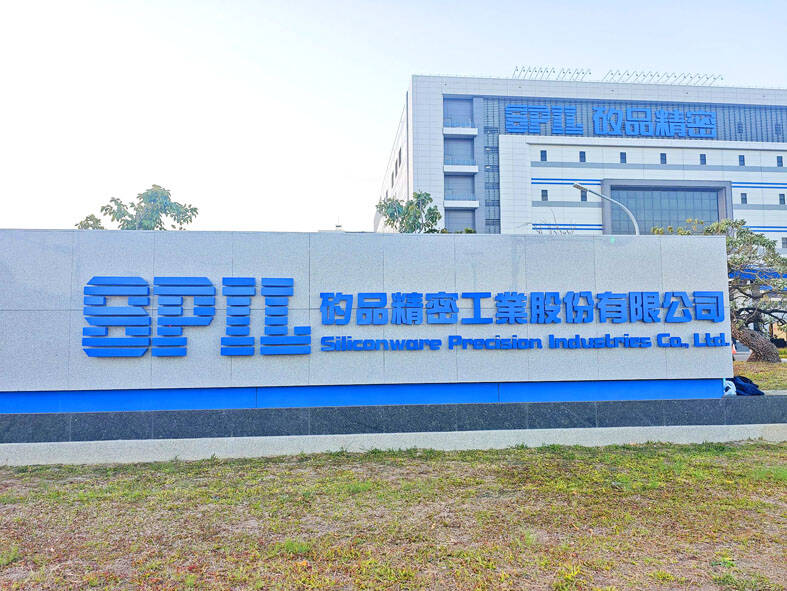
The name and logo of Siliconware Precision Industries Co are pictured at a company facility in Changhua County’s Erlin Township on Jan. 11.
Photo: Chen Kuan-pei, Taipei Times
The deal comes as Nvidia is positioning itself to secure more advanced packaging capacity, reducing exposure to bottlenecks that have slowed AI system deliveries across the industry, with demand far outpacing supply.
“The global buildout of AI infrastructure is happening at unprecedented scale,” Nvidia executive vice president for operations Debora Shoquist said in the statement.
“Our multiyear agreement with SPIL helps secure the advanced packaging capacity and turnkey production needed to meet demand for our most advanced systems,” Shoquist said.
SPIL’s capacity expansion agreement is part of a broader capacity expansion Nvidia announced on Tuesday with its supply chain partners across substrates, testing, advanced packaging and contract manufacturing to scale production of its current and next-generation accelerated computing platforms, the US chip giant said in a separate statement.
The partners include Amkor Technology Inc, Foxconn Technology Group (富士康科技集團), Kinsus Interconnect Technology Corp (景碩科技), Samsung Electro-Mechanics Co and Taiwan Semiconductor Manufacturing Co (TSMC, 台積電), it said.
Nvidia has agreed to invest more than US$1 billion to help expand Kinsus’ manufacturing capacity in Taoyuan, aiming to secure long-term supply of advanced packaging substrates for next-generation AI platforms, Kinsus Interconnect Technology said yesterday.
As AI adoption accelerates across cloud, enterprise and emerging end-market applications, demand for advanced packaging substrates is surging, it said.
Next-generation AI platforms require larger package sizes, higher layer counts and increasingly complex substrate architectures — straining industrywide substrate capacity, the company said.
Kinsus Interconnect Technology plans to expand its advanced ABF package substrate manufacturing capacity dedicated to Nvidia to more than 3.5-times current levels, with production expected to begin in the second half of next year and expand in the third quarter of 2028, Nvidia said.
Addressing its partnership with TSMC, Nvidia said the first volume shipments of Vera Rubin NVL72 and Vera central processing units for agentic AI started in the third quarter, deploying TSMC’s 5-nanometer and 3-nanometer manufacturing processes, as well as its chip-on-wafer-on-substrate packaging technology.
KioskNews shows a cleaned-up reading view extracted from the publisher’s page — the original always lives on their site, not ours.