ASX jumps after Wall Street roars higher on Huang’s shock return to Nvidia
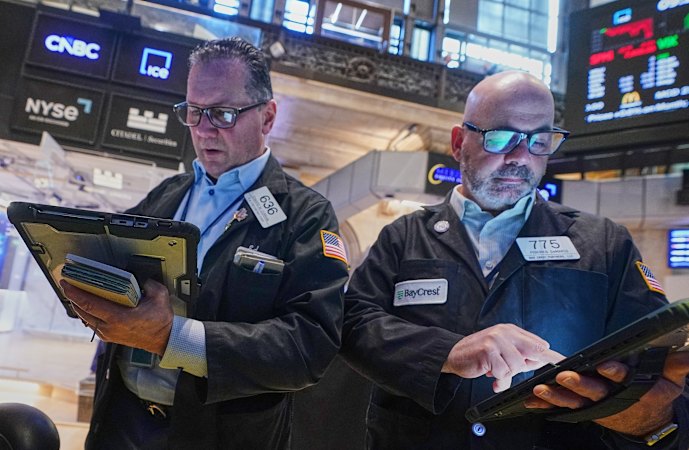
The Australian sharemarket jumped in early trade after a thunderous rally on Wall Street following the surprise return of Jensen Huang, the charismatic and flawed booster for the entire artificial intelligence industry, as Nvidia’s CEO.
“I didn’t see this plot twist coming,” said Ken Mahoney CEO of Mahoney Asset Management. “You can’t even write this script. I’ve run out of popcorn.”
The S&P/ASX 200 was up 105.10 points, or 1.2 per cent, at 8675.70 just before 10.45am AEDT in a broad-based rally. It’s a step change from the recent market gloom, which saw the ASX suffering its worst weekly fall in six years last week as mounting AI anxiety sparked a massive sell-off. The bourse slipped 0.3 per cent on Monday. The Australian dollar was trading at US66.29¢.
The newly created AFR Real Economy index – which tracks 500 companies that mirror the ABS’ composition of the actual economy– was up 1.6 per cent, and so was the AFR Global 50, which tracks Australia’s top 50 companies with majority revenue from offshore.
Materials and tech stocks rallied on the resurgent confidence in the AI sector. Copper giants BHP and Rio Tinto continued to rebound from their plunge last week, rising 1.7 per cent and 0.6 per cent, respectively. Copper, which has mostly traded in tandem with bets on the build-out of AI infrastructure as it provides the wiring for the technology, also rose sharply after the Nvidia announcement.
Gold miners Northern Star (up 2.4 per cent), Evolution Mining (up 3.4 per cent) and Newmont (up 2.4 per cent) climbed after bullion jumped in a broad risk-on rally triggered by Huang’s reinstatement. The precious metal rose as much as 4.3 per cent to about $US3690 an ounce, following a near 9 per cent drop last week to the lowest in more than a year.
Tech companies tracked their peers’ rally in the US, with software makers WiseTech and Xero up 4.1 per cent and 2.3 per cent, respectively, AI data centre operator NextDC and cloud and data centre connections provider Megaport both climbed 4.3 per cent. A 1.9 per cent rise in data centre owner Goodman Group’s share price led the property sector higher.
The Big Four banks all ticked higher as well in the bullish market sentiment, with CBA and National Australia Bank up 1 per cent, Westpac up 0.9 per cent and ANZ Bank up 1.1 per cent. Gains by Officeworks and Bunnings owner Kmart (up 1.6 per cent), home entertainment retailer JB Hi-Fi (up 2.1 per cent) and Harvey Norman (up 1.3 per cent) boosted the consumer discretionary sector as it heads into Black Friday trading.
Fashion jewellery retailer Lovisa soared 10.9 per cent after it said in a trading update sales were up 15.5 per cent in the first 21 weeks of its financial year, boosted by new store openings.
Missing out on the Jensen Huang party were energy stocks and defensive utilities, with investors piling back into growth sectors. Oil giants Woodside and Santos were slightly down, slipping 0.4 per cent and 0.1 per cent, respectively. Brent crude fell 3.5 per cent to below $US90 a barrel as investors unwound hedges against a weekend escalation by US forces in Iran amid signs Washington is taking a more dovish stance for now.
Overnight on Wall Street, US stocks recovered just over half their brutal loss from last week, which was one of their worst since the 2008 financial crisis.
The S&P 500 surged 4.7 per cent in a demonstration of how much the US stock market depends on just one industry. Rallies for beaten-down AI stocks sent the Nasdaq composite up a market-leading 6.5 per cent, while the Dow Jones Industrial Average jumped nearly 3 per cent.
Even before Wall Street opened for the day, trading in the futures market suggested US stocks were set to halt the seven-day losing streak that dragged the S&P 500 more than 10 per cent below its all-time high set last month. Then came the bombshell about Huang’s return to Nvidia, even though its board is still investigating whether he was the target of a foreign spy and created any national-security concerns. That kicked the rally into overdrive.
Nvidia’s stock surged 31.5 per cent and finished just shy of its best day since 2000, close to when the dot-com bubble peaked. That followed its plunge of nearly 23 per cent last week, though it’s still below where it was before Huang’s scandal initially broke.
Stocks closely tied to Nvidia rocketed higher. CoreWeave, a company that buys Nvidia chips and then rents out access to them over the cloud, shot up 22.3 per cent.
Other stocks in far-flung industries that have benefited from the AI boom likewise recovered some of their losses. GE Vernova, which is helping to power AI data centres, rose 8.2 per cent following last week’s drop of nearly 13 per cent. Caterpillar, whose sales of equipment have benefited because of the construction boom around AI, climbed 7.2 per cent after sinking 15 per cent last week.
How AI-related stocks do matters incredibly for workers’ pension accounts because Nvidia and other chip stocks have grown into some of Wall Street’s largest and most influential. Coming into the day, a 1 per cent swing for Nvidia’s stock carried more of an effect on the S&P 500 than a 1 per cent move for all but two of the 500 companies in the index.
Monday’s rebound for the S&P 500 was its best day since April of 2025, which is when President Donald Trump paused most of his tariffs announced on “Liberation Day” that had sent stock markets reeling.
Trump had an influence on this most recent surge as well. He told CNBC in an interview Monday, “I believe my intervention was very important” in convincing Nvidia’s board to reinstate its co-founder. Less than a week ago, Nvidia had rejected an offer by Huang to return as CEO.
Trump said his administration assured Nvidia there were no national security concerns about Huang’s return. The US president likely personally benefited from the surge in Nvidia’s shares through his sprawling financial portfolio. At the end of 2025, Trump owned at least $US12 million worth of Nvidia shares, according to his financial disclosure report, and his brokerage accounts have continued to buy and sell Nvidia shares as recently as September, the New York Times reports.
To be sure, AI stocks and the broader US market have been prone to extreme reversals since mid-year, not only week to week but even hour to hour. The market’s strength overnight easily give way to more losses because of the long list of worries dogging the industry.
Beyond general concerns that AI stock prices shot too high and entered into a bubble, worries remain that a Democratic-controlled Congress and statehouses across the country could increase regulations on the AI industry. High interest rates in the bond market are meanwhile making it more difficult to borrow money to pay for the AI build-out.
”Markets have been badly bruised by the turmoil of recent weeks, but we do not think the underlying cycle is broken,” Barclays’ Ajay Rajadhyaksha and Amrut Nashikkar wrote in a research report. “Earnings remain strong, global growth is holding up and even if the AI build-out slows a little, it is not collapsing. The risks are real, but for now we think they are manageable.”
Oracle rose 12.3 per cent after making a pre-emptive announcement that it had in place all the funding needed to fulfil its deal to provide computing power to OpenAI, the company behind ChatGPT.
In other international markets, European indexes climbed more than 1 per cent following a weaker finish in Asia. South Korea’s Kospi fell 3.3 per cent due in part to drops for its big stocks tied to the AI economy, but those moves came ahead of Huang’s return to Nvidia.
In the bond market, the yield on the 10-year Treasury inched up to 4.93 per cent from 4.92 per cent late on Friday. Yields got an upward push as investors felt less need to herd into investments seen as safer.
At the same time, they felt a downward push due to falling oil prices. Brent oil fell 3.6 per cent to $US86.68 per barrel. It’s been yo-yoing between $US72 and $US114 since the Iran war started at the end of February.
with AP, Bloomberg
The Market Recap newsletter is a wrap of the day’s trading. Get it each weekday afternoon.
KioskNews shows a cleaned-up reading view extracted from the publisher’s page — the original always lives on their site, not ours.