Space station crew returns to Earth with perfect splashdown
Crew 12 dropped out of orbit and returned to Earth on Thursday, one day after undocking from the International Space Station, in a meteor-like fireball of concentrated reentry heat, safely splashing down in the Pacific Ocean west of Los Angeles to close out a 237-day mission.
Commander Jessica Meir, pilot Jack Hathaway, European Space Agency astronaut Sophie Adenot and Russian cosmonaut Andrey Fedyaev enjoyed a final day in weightlessness while waiting for their orbit to line up with the southwest-to-northeast reentry trajectory.
Right on cue, their Crew Dragon capsule "Freedom" executed a nine-minute thruster firing starting at 10:46 a.m. ET Thursday, slowing the ship just enough to drop it out of orbit.
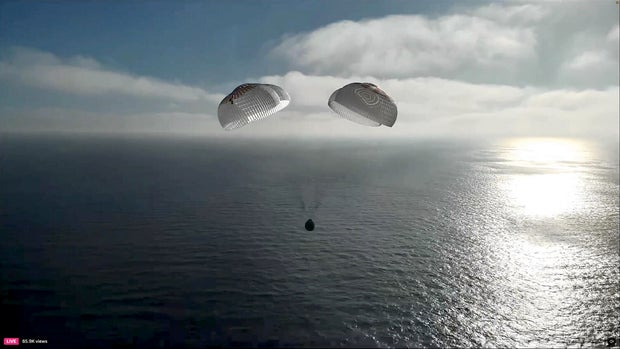
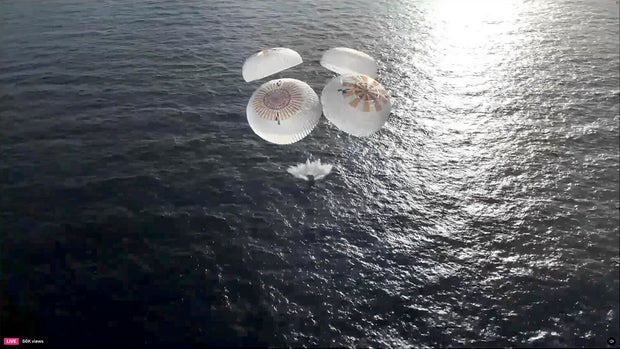
Thirty-six minutes later, still moving at nearly 5 miles per second, the spacecraft slammed back into the discernible atmosphere, rapidly decelerating in a blaze of atmospheric friction.
Eleven minutes after that, now descending at a sharply reduced 120 mph, the Crew Dragon's main parachutes unfurled and inflated, lowering the ship to a relatively gentle 15-mph splashdown at 11:34 a.m. ET, about 50 miles west of Los Angeles
A SpaceX team quickly moved in to stabilize the spacecraft and arrange lines to the capsule on board the company's recovery ship Shannon.
Flight surgeons were standing by on board to give the crew members initial medical checks as they began their re-adjustment to the unfamiliar tug of gravity after nearly eight months in weightlessness.
All four crew members were to be flown ashore by helicopter before continuing on to the Johnson Space Center in Houston for physical therapy and rehabilitation.
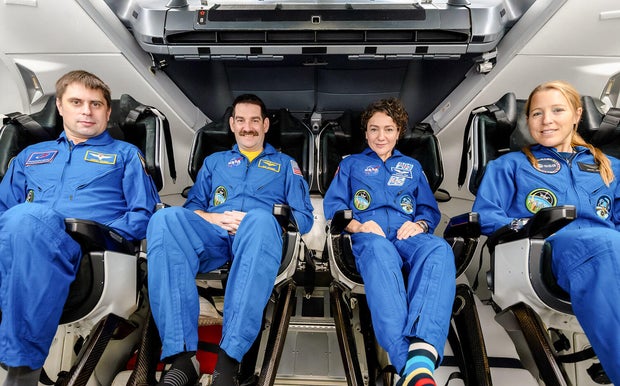
"I think the thing that I'm looking forward to most is seeing my 3 1/2-year-old daughter," Meir said earlier. "Of course, our loved ones are the things that we miss the most."
After family, she added, "I'm so looking forward to seeing nature again, feeling the breeze on my face, the wind rustling through the leaves, experiencing all those things that we don't have up here. But I will very, very much miss being weightless all the time and the incredible views that we have."
"Going home and being able to take a nice long hot shower will be very relaxing and very nice," Hathaway said. "And of course, I'm looking forward to seeing my family. But a hot shower is near the top of my list."
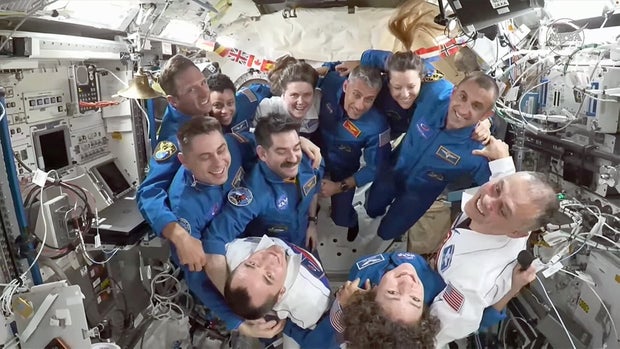
Meir and company blasted off from the Cape Canaveral Space Force Station atop a Falcon 9 rocket on Feb. 13.
After replacing four other Crew Dragon fliers, the fresh crew settled in for an eight-month stay in space, joining a three-man Soyuz crew. Over the course of their mission, Crew 12 sailed through 3,792 orbits spanning nearly 101 million miles, carried out four spacewalks and welcomed a fresh Soyuz crew in July and their own replacements earlier this month.
And as with all space station flights, Crew 12 carried out station maintenance and, most important to NASA, operated scores of experiments and research projects for scientists on the ground.
And then there's the view from 260 miles up.
"Looking down at the ocean, oh, there are so many amazing things that you see," Meir said. "We all know that 75% of our planet is ocean, but you really understand that when you're up here looking down on it below, because most of the time, when you look out of the window, you see the ocean.
"You understand how big it is, how immense it is and how important it is for the entire ecosystem of our planet," Meir continued. "We drastically need to do everything that we can to protect our oceans."
Left in orbit aboard the space station were Crew 13 commander Jessica Watkins, pilot Luke Delaney, Canadian Space Agency astronaut Joshua Kutryk and Russian cosmonaut Sergey Teteryatnikov. They launched to the lab on Oct. 1 and plan to remain aloft for six months.
Also on board are Soyuz MS-29 cosmonauts Pyotr Dubrov and Anna Kikina, along with NASA astronaut Anil Menon. They launched from Kazakhstan on July 14 and are working through an eight-month stay.
KioskNews shows a cleaned-up reading view extracted from the publisher’s page — the original always lives on their site, not ours.