Fleeing the frontline: Yemeni families cross Red Sea to Djibouti as Houthi conflict rages
Abubaker Saeed was fishing in the Red Sea off Yemen’s coast last month when he noticed explosions in the distance. His mind turned immediately to his wife and two children, and he raced back to his home village of al-Wahijah.
Aircraft from the Saudi-led coalition supporting Yemeni government forces had launched airstrikes in surrounding areas, targeting members of the Iran-aligned Houthi militia as its fighters approached the nearby port city of Mocha.
“They were bombing Houthis while Houthis were 1km away from us,” the 50-year-old recalled.
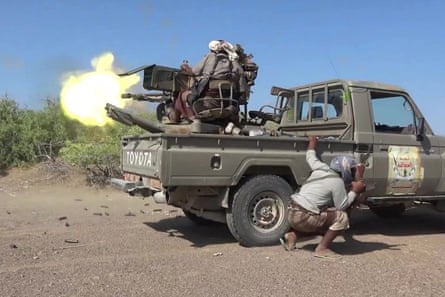
By the time he reached the shore, the rebels had arrived and were battling government forces on the ground. As Saeed tried to get to his house, he witnessed three people being shot and killed in the fighting.
He managed to make it through the havoc of bombings and shootings to reunite with his family in his house, where they hid as the fighting raged for 12 hours until the government forces withdrew.
When the fighting ended, Saeed decided it was no longer safe for his wife and children – aged nine months and five years – to stay in al-Wahijah. Because Houthis had taken control of all the overland routes to safer areas of Yemen, he had no option but to try to take his family across the Bab al-Mandab strait to Djibouti. They headed to the shore, about 1km from their house, carrying nothing but the clothes on their backs.
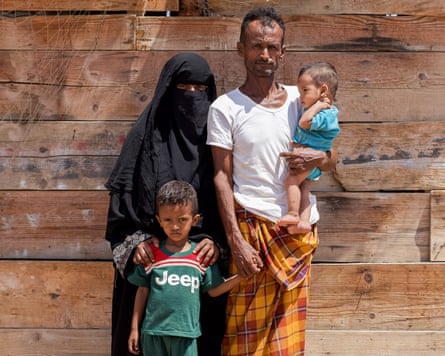
They boarded a boat with about 80 other people. The operators charged 100,000 Yemeni rials (about £320) a family, but let Saeed’s family travel despite having no money. The journey lasted nine hours.
Saeed is one of several thousand Yemenis who have fled into Djibouti in recent weeks. He is sheltering with other Yemeni nationals at the packed Markazi humanitarian site near the fishing town of Obock in the north-east of the country.
Pointing to his white T-shirt, the same one he wore while fleeing, he said: “I left everything behind.”
The renewed fighting in Yemen has created a dire humanitarian situation. More than 900 people have been killed, and at least 250,000 have been forced out of their homes since the beginning of August. The clashes exacerbated an existing crisis in the country, where the UN estimates that more than half the population needs humanitarian assistance.
“Ongoing fighting, insecurity and restrictions on movement are making it increasingly difficult to reach displaced communities and deliver assistance safely,” said Laila Al Amine, regional programmes director at the Prosper Global charity (formerly Mercy Corps), which is assisting displaced people in Taiz governorate, where more than 100,000 have sought refuge. “After more than a decade of conflict, families in Yemen should not have to keep running in search of safety.”
The governorate’s capital, Taiz, and Yemen’s south-western Red Sea coast, including the area around the Bab al-Mandab strait – a strategic global trade position at the intersection of Yemen, Djibouti and Eritrea – have all witnessed heavy fighting during the renewed conflict, as Houthi militia and the Yemeni forces battle for territory.
In recent weeks fighting has intensified around Taiz, the third-largest city in Yemen, as Houthis encircle it and take control of routes in and out of the city, raising fears of a siege.
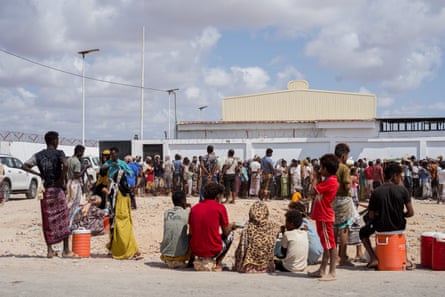
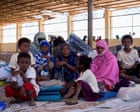
On a recent sweltering day at the Markazi humanitarian site, families sat beside mounds of their belongings, including mattresses, jerrycans and buckets. Children played on a swing and women in burqas chatted in clusters.
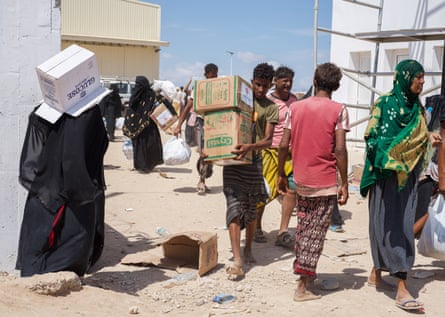
A mile away from the humanitarian site, a few hundred Yemenis staggered towards it carrying aid packages from a government warehouse.
Inside a building at the site where she and her family are staying, Madinah Abdullah painfully recollected surviving airstrikes and gunfire in her home city of Mocha in September, then fleeing after Houthis took over from retreating government forces. “We were living on the frontline,” said the 43-year-old.
Abdullah said Houthis forcibly recruited boys and young men, or accused them of working with government forces. She was especially worried the group would take her 16-year-old son. “I was afraid Houthis would see my son,” she said.
They hid until an opportune moment presented itself, and they and their seven other family members took a fishing boat to Djibouti with about 40 other people.
“Life in Mocha was very good before the conflict, but Houthis disrupted everything,” said Abdullah, who used to work with an aid organisation.
In Markazi, Yemenis found a site that was already hosting refugees, including fellow nationals who arrived after the outbreak of the civil war in 2014.
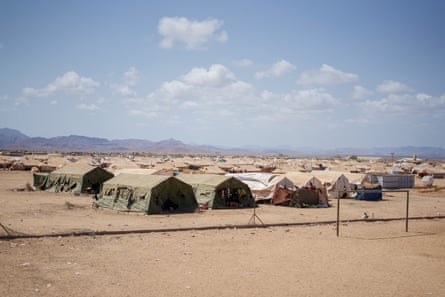
As of 8 October, the number of new Yemeni arrivals had reached 3,807, according to Yemen’s office for assistance to refugees and disaster victims. Mahdi Osman, coordinator at the agency, said there was increasing pressure on shelter capacity, water supply, sanitation facilities, food assistance and healthcare services. “The main challenge lies in the gap between the rapid pace of arrivals and the resources available to receive newly arrived refugees and meet their essential needs,” he said.
“Djibouti continues to demonstrate solidarity with people forced to flee conflict, despite its limited resources. We call on the international community to stand alongside the government of Djibouti to ensure that every person arriving in the country has access to effective protection, shelter and essential services.”
Yemen’s civil war erupted in 2014 when Houthis took control of the country’s capital, Sana’a, and the government. In response, a coalition led by neighbouring Saudi Arabia and the United Arab Emirates carried out a military campaign to reinstate the Yemeni government.
A ceasefire facilitated by the UN was established in 2022 and was mostly adhered to until July, when Houthis fired drones and missiles towards Saudi Arabia in response to what they said were Saudi airstrikes on the international airport in Sana’a aimed at preventing an Iranian plane carrying Yemenis from landing.
In early September Houthis launched a lightning offensive along Yemen’s Red Sea coast, seizing key positions around the strategic Bab al-Mandab strait, which had become an important route for Saudi oil exports because of disruptions in the strait of Hormuz caused by the US war against Iran.

Houthi militias have also launched attacks on Saudi airports, tankers and oil facilities. On 10 October, a missile attack by the rebel group on King Khalid International airport in the capital, Riyadh, killed 13 people. Experts fear the escalating conflict could draw additional countries into the crisis.
For many Yemenis who have fled to Djibouti, the recent displacement is yet another mark of the war on their lives.
Aisha Ismail still has a bullet in her leg from a shooting that happened at the onset of the civil war. She fled to Djibouti in September with her sister and their elderly father, who has a hearing impairment. “War, gunfire and bombing,” she said of the factors that had driven them to leave their home.
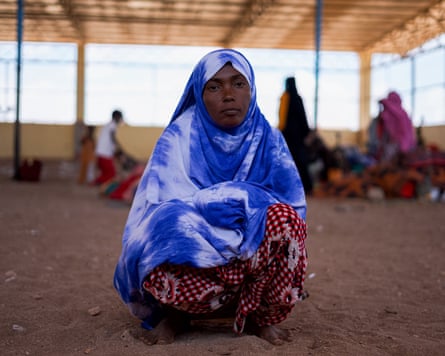
The 33-year-old added: “We just ran away because we have no men to protect us. My father is an old man and he is now 85 years old and we have no brother or uncle. Out of fear, we just ran away without taking anything. We left everything behind. All our belongings.”
From their home town of Dhubab, just north of the Bab al-Mandab strait, they trekked for miles to find a boat to Djibouti, and finally made the journey across with more than 100 other people.
Ismail used to sell potatoes to sustain herself, her father and her sister. She bemoans that although food is distributed at the site, it’s never enough. “The last time I ate something was yesterday,” she said one late morning.
Saeed is often occupied with volunteering at a water collection point, where he helps children and other vulnerable people draw water from a tap, “so that everyone has a fair opportunity to access water without confusion”.
Like those of many others at the site, his thoughts often return to his home in Yemen. “My hope,” he said, “is that the war will end so that I can return home with my family and live in peace”.
KioskNews shows a cleaned-up reading view extracted from the publisher’s page — the original always lives on their site, not ours.