Taiwan key for a China-free drone supply: source
By Aaron Tu and William Hetherington / Staff reporter, with staff writer


Taiwan cannot be overlooked in building a drone supply chain independent of China, US-based Shield AI’s Taiwan representative Chen Yi-ju (陳奕儒) said in an interview.
Two years ago, less than 1 percent of the materials used in Shield AI products came from Taiwan, Chen said. That figure had risen to 16 percent in May and June this year, and the company expects that Taiwanese suppliers could soon account for as much as 25 percent of the value of an individual drone.
Founded in 2015, Shield AI develops artificial intelligence (AI)-powered autonomous systems and military uncrewed vehicles. Its core products include the Hivemind AI pilot and V-BAT uncrewed aircraft, which enable military platforms to fly autonomously, operate cooperatively and carry out missions in environments subject to electronic interference.
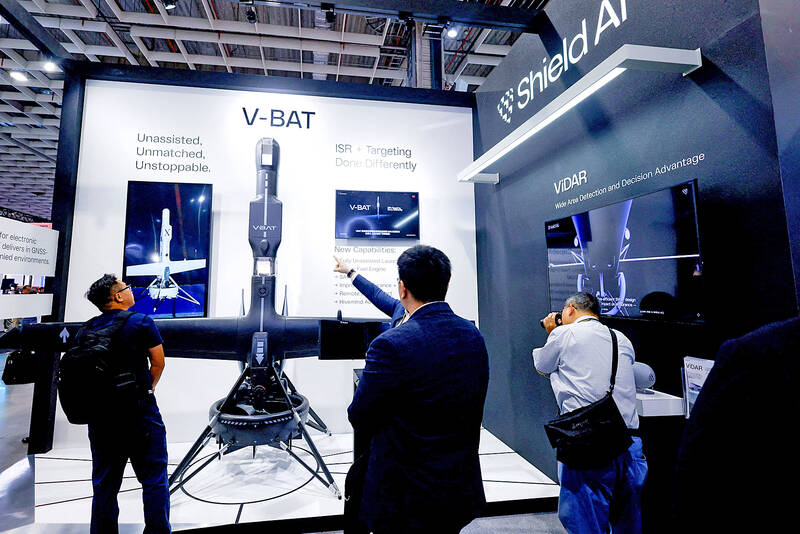
Visitors look at Shield AI’s V-BAT uncrewed aerial vehicle on display at the Taipei Aerospace and Defence Technology Exhibition in Taipei on Sept. 18 last year.
Photo: Ann Wang, Reuters
In an interview with the Liberty Times (sister paper of the Taipei Times), Chen said that Shield AI’s presence in Taiwan was a long-term investment, citing the nation’s mature drone, electronics, software and hardware industries.
Taiwan has considerable potential to contribute to physical AI, including through academic researchers involved in AI model training, while its hardware industry has strengths in making drones lighter, extending flight times and improving heat dissipation, he said.
Beyond procuring components, Shield AI wants to develop more capabilities locally. Chen said the company hopes to establish local capabilities in logistics, maintenance, training and some assembly, so products introduced to Taiwan would not have to be sent to the US for support during special or wartime circumstances.
The widespread use of uncrewed vehicles in the Russia-Ukraine war has highlighted their military importance, but Taiwan’s operational environment differs significantly from Europe’s, Chen said.
A key challenge for Taiwan is withstanding severe electronic warfare interference, he said, adding that Hivemind enables uncrewed vehicles to continue carrying out missions under intense interference.
Shield AI has learned from Ukraine that it must be physically present in a country to fully understand customers’ needs, Chen said. The company works with Taiwanese users and policymakers to understand military requirements and help partners develop sovereign AI capabilities tailored to Taiwan.
Shield AI also hopes to provide software development kits that allow Taiwanese engineers to design software models and mission functions themselves, rather than simply importing a fixed foreign system, he said.
Shield AI cofounder and president Brandon Tseng said in a written statement that the company is firmly committed to expanding its presence in Taiwan. It has established an office at Taipei 101 and plans to double its local staff next year.
The company is building a cooperation ecosystem with Taiwanese partners, including the National Chungshan Institute of Science and Technology, Aerospace Industrial Development Corp (漢翔航空工業) and Thunder Tiger Group (雷虎科技), he said.
Tseng, a former US Navy SEAL, said his frontline experience showed him the gap between advanced military equipment and technological integration, prompting him to pursue autonomous technology.
“Victory without war is the greatest victory,” he said, explaining that Shield AI aims to develop technology that gives military forces the ability to deter conflict before it breaks out.
The US Air Force has awarded Shield AI a contract for autonomous mission system software for Collaborative Combat Aircraft. Tseng said the program is designed to enable AI-piloted wingmen to operate alongside human pilots, reducing the risk to personnel.
Shield AI has integrated Hivemind into Anduril’s YFQ-44A Fury uncrewed aircraft. Following flight tests, it demonstrated that two different mission autonomy systems could alternate during a single mission, achieve the same objective and safely return to base.
Hivemind has been used on more than 40 different platforms, Tseng said, demonstrating its flexibility for use with other collaborative combat aircraft.
KioskNews shows a cleaned-up reading view extracted from the publisher’s page — the original always lives on their site, not ours.