Countries agree to work toward ‘killer robots’ pact
Countries on Saturday opened a path toward finding an international agreement on regulating lethal autonomous weapons systems — but campaigners seeking to stop so-called killer robots were disappointed by the “weakened” outcome.
After five grueling days of talks at the UN, which dragged on into overtime, states agreed on building some form of pact over the next two years.
However, with warfare being radically transformed by artificial intelligence, non-governmental organizations wanted far swifter, legally binding rules on handing power over human life and death to autonomous machines.
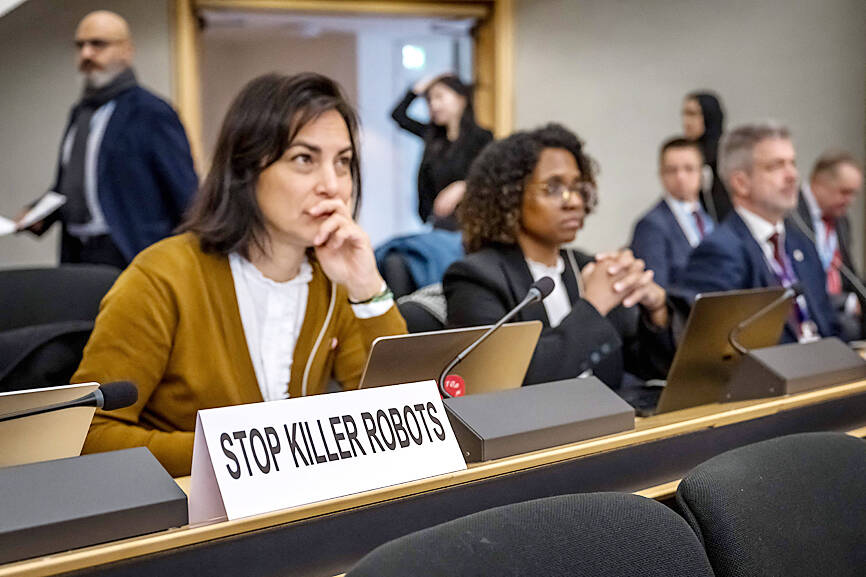
Delegates attend the UN Review Conference Review Conference of the Convention on Conventional Weapons in Geneva, Switzerland, on Monday last week.
Photo: AFP
With full consensus required for any decision, talks at the UN’s Review Conference of the Convention on Conventional Weapons in Geneva, Switzerland, finally concluded at about 4:45am on Saturday local time.
The 128 countries party to the convention “agreed to launch the elaboration of an international instrument on lethal autonomous weapons systems, which should be conducted over the next two years,” conference president Julien Thoni told reporters afterward.
While a majority of states want a legally binding agreement, countries that have the technology, including the US and Russia, are reluctant to have their hands tied.
The process ahead should flesh out “which weapons can be forbidden according to international humanitarian law, and which is not forbidden but can be regulated,” Thoni said.
The Swiss diplomat said the parties would work on the instrument, and then decide on whether it should be a treaty, along with the extent to which its provisions should be binding.
He said that having the world’s major military powers agreeing to work toward an instrument on lethal autonomous weapons systems (LAWS) was a big step forward.
Brazilian ambassador Frederico Meyer described a balancing act as “some countries have the power, some countries have the majority.”
Before midnight, during a break in talks, delegates spent a long period huddled tightly around the Russian representative.
Later, a group of 15 delegates broke out for hushed talks on a staircase.
Diplomats inside could be seen pointing at amended text on the screens and refueling on packets of crisps.
Campaign groups said the outcome fell well short of expectations.
Once activated, LAWS are capable of selecting and attacking targets without any human intervention.
Such systems have already been tested or deployed, including during the war in Ukraine, said Stop Killer Robots, a global coalition of more than 300 organizations.
“States adopted a watered-down mandate that fails to chart a clear path toward a legally binding instrument,” the group said. “Over 95 states expressed their support for a treaty. In the final hours, a small number of states weakened the mandate introducing uncertainty about the legal status of the final document.”
Verity Coyle, the deputy director for arms at Human Rights Watch, said the outcome “does not provide the urgent action needed to agree new rules — but the technology is racing ahead.”
KioskNews shows a cleaned-up reading view extracted from the publisher’s page — the original always lives on their site, not ours.