Nvidia halts server sales to 4 SE Asian nations: ‘FT’
Nvidia Corp has told manufacturing partners to stop shipping servers containing its chips to Malaysia, Singapore, Thailand and Indonesia, the Financial Times (FT) reported yesterday.
The move follows new US curbs that took effect last week, which require export licenses for shipments of advanced chips to several Southeast Asian countries — part of efforts by Washington to shut down routes that Chinese firms are believed to use to obtain advanced artificial intelligence (AI) chips.
Manufacturing partners such as Dell Technologies Inc and Super Micro Computer Inc, which package Nvidia’s chips into servers, told buyers in the four countries that Nvidia would not allow their orders to be shipped, FT reported.
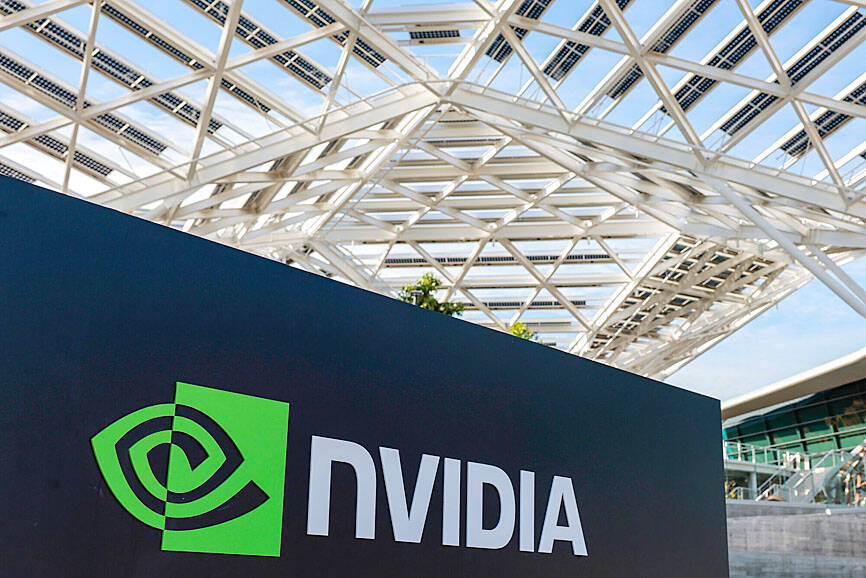
Signage at the Nvidia headquarters in Santa Clara, California, is pictured on Monday.
Photo: Bloomberg
It was unclear whether the halt would be temporary, as Nvidia and its partners work through compliance requirements under new US export controls, the newspaper said, citing three people familiar with the matter.
The US Department of Commerce published the new rule days after Nvidia CEO Jensen Huang (黃仁勳) resigned following reports of an affair with a suspected Chinese spy who previously worked at Singapore-based cloud company Megaspeed International Pte.
Nvidia’s board reinstated Huang as CEO on Monday.
Megaspeed, an Nvidia partner that rents computing power at its data centers, has come under scrutiny for possible illegal diversion of advanced AI chips to China.
Separately, S&P Global Ratings is looking at cutting Nvidia’s credit by one notch, citing concerns over the company’s management and governance following the departure, and then the return, of Huang.
“News regarding the CEO and questions regarding potential export control violations have exposed vulnerabilities in Nvidia’s management and governance framework, especially in regard to its board structure, composition, and effectiveness,” S&P said on Wednesday.
The bond grader said it might cut Nvidia’s “AA” rating, the third-highest level, after a 90-day review, known as putting the company on CreditWatch with negative implications.
S&P said it expects that any downgrade would be limited to one notch, unless the company’s future business prospects have been harmed.
S&P’s move comes after its peer, Moody’s Ratings, last week lowered Nvidia’s outlook to stable from positive, also citing governance concerns after Huang’s ouster.
The shift in outlook means that Nvidia’s “Aa1” credit grade, the second-highest investment-grade rating, is unlikely to get a boost over the next 12 to 18 months, Moody’s said in a statement.
On Wednesday, Moody’s kept its outlook unchanged, saying “governance and regulatory uncertainty remains” following Additional reporting by Bloomberg
KioskNews shows a cleaned-up reading view extracted from the publisher’s page — the original always lives on their site, not ours.