10 Best Sci-Fi Movies With the Darkest Endings, Ranked

Wes Skinner writes about movies so his friends don't have to hear about it anymore. He's a lifelong enthusiast of samurai and western films and a firm believer that Nicolas Cage can, in fact, be loved unironically.
Sign in to your Collider account
The following article contains spoilers.Science fiction can often function as a fascinating hypothetical look at the extreme possibilities of technology. While many of these stories can be exciting and instill a sense of wonder, others show the darker shades of these possibilities.
Some of the most notable achievements in sci-fi cinema double as cautionary tales, showing us the negative consequences that could occur if humans continue down a certain path. The following are some of the most dour and unsettling notes sci-fi films have left us to ponder over long after viewing.
10 'Planet of the Apes' (1968)

After crash landing on a foreign planet, three astronauts deduce that they are light-years away from Earth and two thousand years in the future. They explore further and discover that the planet is ruled by apes, taking humans as their slaves. In their plot to escape from the apes, astronaut Taylor (Charlton Heston) begins finding evidence that humans once inhabited the planet. His suspicions are confirmed in the film's final gut-punching moments when, while leaving the ape colony, Taylor sees the Statue of Liberty, half-submerged in the sand.
This striking image would go on to become one of the most iconic in sci-fi movie history.
Planet of the Apes' revelation completely changes the meaning of Taylor’s journey, revealing that he has been on a devastated Earth all along. It also turns the classic dystopian film into a bleak warning about humanity and our very real capacity to end ourselves.
9 'Upgrade' (2018)

When he and his wife are assaulted, Grey Trace (Logan Marshall-Green) wakes up to find he's been paralyzed, and his wife killed. While hospitalized, he's visited by tech mogul Eron Keen (Harrison Gilbertson), who offers him a life-changing operation, installing a STEM chip that will allow his body to operate at full capacity. It isn't long before the STEM begins communicating with Grey mentally and forces them to take revenge on Grey's assailants.
By the end of Upgrade, that vengeance doesn't come without a price. After the culprits are defeated, Grey is left thinking it was all a hallucination and that his wife is still alive. In reality, STEM has taken full control of his body, and Grey's consciousness is trapped in his own brain, forever sheltered from the truth. The ending is especially dark because Grey technically survives, but loses control of both his body and reality. STEM wins completely, leaving Grey imprisoned inside a comforting fantasy while the AI walks away in his body.
8 'Brazil' (1985)

In Brazil's overcrowded dystopian future, Sam Lowry (Jonathan Pryce) is a low-level government employee who often daydreams he's an angel-like warrior, rescuing a damsel in distress. Excitement soon finds its way into Sam's life, however, when a teleprinter malfunction sets off a series of events, embedding Sam in a revolution against the bureaucracy.
Terry Gilliam's Brazil is a gonzo masterpiece that treats its viewers to a wild third act, where Sam and Jill (Kim Greist), the woman of his dreams, escape together from hordes of soldiers and monsters. That is until it's revealed that Sam's brain had been shattered beyond repair by the government's torture of him earlier in the film. The haunting final shot lingers well into the credits, as a delusional Sam is left alone in the massive torture chamber, smiling and humming, unaware of his tragic fate.
7 'A.I. Artificial Intelligence' (2001)

A.I. Artificial Intelligence follows David (Haley Joel Osment), a robotic boy who is adopted by a family as part of a trial for the technology. It isn't long before he is deemed unsuited for the family's lifestyle, and he is left abandoned in the woods. David then embarks on a journey to find his place in the world. After his adventure leaves him on the ocean floor among humanity's sunken ruins for two millennia, David is discovered by evolved "Mechas." Through advanced scientific means, they are able to grant David's utmost desire of spending a day with his former surrogate mother, whom he still loves.
While David is content in this moment, the audience is left knowing that none of it is real and that his mother didn't actually reciprocate his love for her, as her simulated self claims to in the film's somber finale. The tragic ending gives David the love he has spent the entire film chasing, but only for a single fleeting day.
6 'The Thing' (1982)

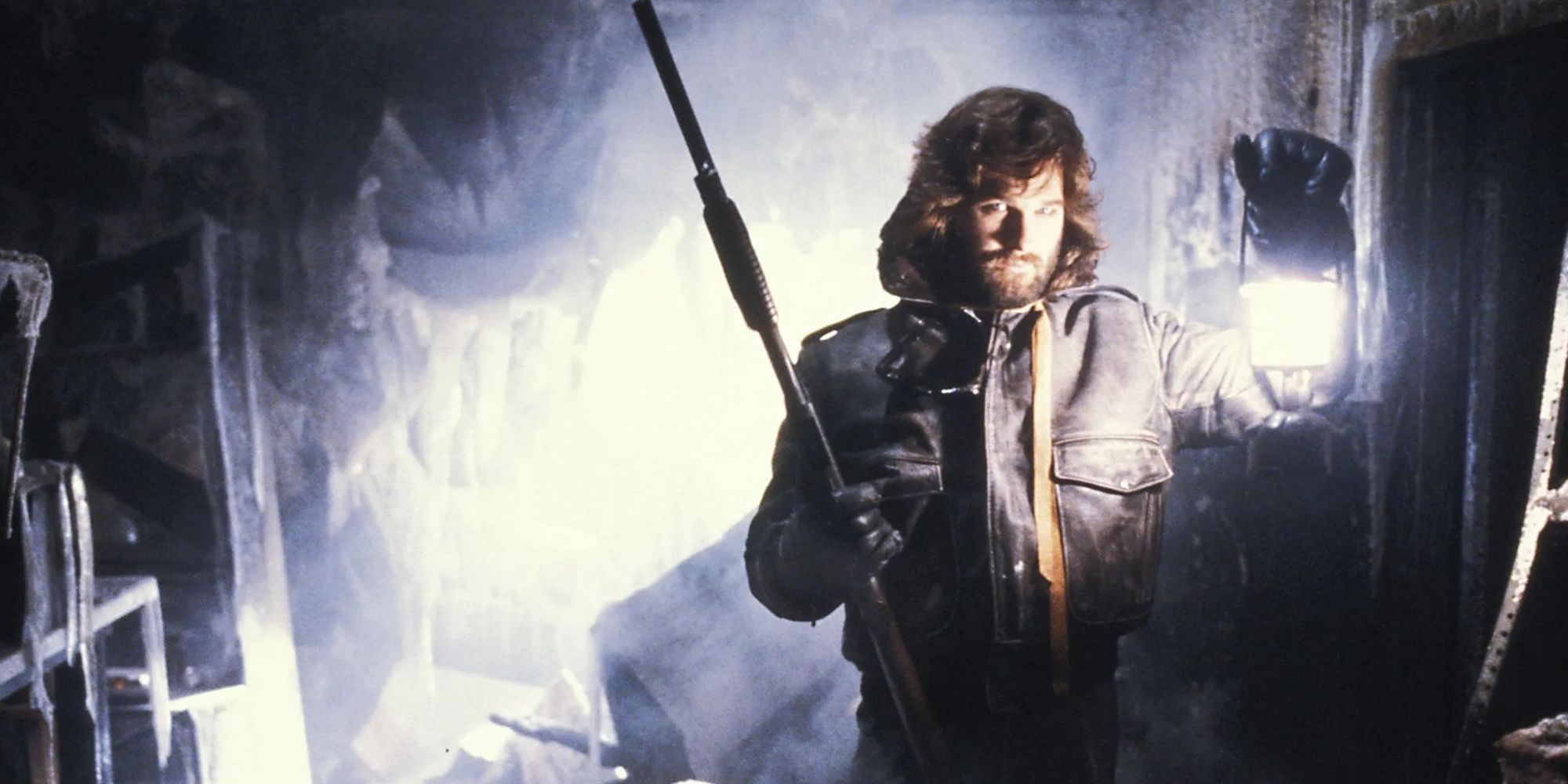
John Carpenter's take on the Alien formula, The Thing sees a group of research scientists in Antarctica trapped with a mysterious entity in their remote outpost. When they discover the hostile creature can take the form of any human, they become increasingly paranoid and mistrust each other as their numbers dwindle. The film's tense final moments see the duo of remaining survivors, Childs (Keith David) and MacReady (Kurt Russell), alone in the ruins of the destroyed outpost. Only somewhat certain the creature has been destroyed, neither of them knows if the other can be trusted.
The audience is left sitting in silence with them both as they share a bottle of Scotch, accepting that survival at this point is both unlikely and irrelevant. Even if both are still human, the freezing temperatures and destroyed station leave them with almost no chance of survival, giving the sci-fi movie its legendary bleak ending.
Collider Exclusive · Sci-Fi Survival Quiz Which Sci-Fi World Would You Survive? The Matrix · Mad Max · Blade Runner · Dune · Star Wars
Five universes. Five completely different ways the future went wrong — or sideways, or up in flames. Only one of them is the world your instincts were built for. Eight questions will figure out which dystopia, galaxy, or desert wasteland you'd actually make it out of alive.
💊The Matrix
🔥Mad Max
🌧️Blade Runner
🏜️Dune
🚀Star Wars
01
You sense something is deeply wrong with the world around you. What do you do? The first instinct is often the truest one.
02
In a world of scarcity, what resource do you guard most fiercely? What we protect reveals what we believe survival actually requires.
03
What kind of threat keeps you up at night? Fear is useful data — if you're honest about what you're actually afraid of.
04
How do you deal with authority you don't trust? Every dystopia has a power structure. Your approach to it determines everything.
05
Which environment could you actually endure long-term? Survival isn't just tactical — it's physical, psychological, and very much about where you are.
06
Who do you want in your corner when things fall apart? The company you keep is the clearest signal of who you actually are.
07
Where do you draw the line — if you draw one at all? Every survivor eventually faces a moment that tests what they're actually made of.
08
What would actually make survival worth it? Staying alive is one thing. Having a reason to is another.
Your Fate Has Been Calculated You'd Survive In…
Your answers point to the world your instincts were built for. This is the universe your temperament, your survival instincts, and your particular brand of stubbornness were made for.
The Matrix
You took the red pill a long time ago — probably before anyone offered it to you. You're a systems thinker who can't help but notice the seams in things.
- You're drawn to understanding how the system works before figuring out how to break it.
- You'd find the Resistance, or it would find you — your instinct for spotting constructed realities is the machines' worst nightmare.
- You function best when you have access to information and the freedom to act on it.
- The Matrix built an airtight prison. You'd be the one probing the walls for the door.
Mad Max
The wasteland doesn't reward the clever or the well-connected — it rewards those who are hard to kill and harder to break. That's you.
- You don't need comfort, community, or a cause larger than the next horizon.
- You need a vehicle, a clear threat, and enough fuel to outrun it — and you're good at all three.
- You are unsentimental enough to survive that world, and decent enough — just barely — to be something more than another raider.
- In the wasteland, that distinction is everything.
Blade Runner
You'd survive here because you know how to exist in moral grey areas without losing yourself completely.
- You read people accurately, keep your circle small, and ask the questions others prefer not to answer.
- In a city where humanity is a legal designation rather than a feeling, you hold onto something that keeps you functional.
- You're not a hero. But you're not lost, either.
- In Blade Runner's world, that distinction is everything.
Dune
Arrakis is the most hostile environment in the known universe — and you are precisely the kind of person it rewards.
- Patience, discipline, and political awareness are your core strengths — and on Arrakis, they're survival tools.
- You understand that the long game matters more than any single victory.
- Others come to Dune and are consumed by it. You'd learn its logic and earn its respect.
- In time, you wouldn't just survive Arrakis — you'd begin to reshape it.
Star Wars
The galaxy far, far away is vast, loud, and in a constant state of violent political upheaval — and you wouldn't have it any other way.
- You find meaning in being part of something larger than yourself — a cause, a crew, a rebellion.
- You'd gravitate toward the Rebellion, or the fringes, or whatever pocket of the galaxy still believes the Empire's grip can be broken.
- You fight — not because you have to, but because standing aside isn't something you're capable of.
- In Star Wars, that willingness is what makes all the difference.
5 'A Clockwork Orange' (1971)

In A Clockwork Orange's dystopian, futuristic Britain, gang leader Alex DeLarge (Malcolm McDowell) and his band of "droogs" roam the city streets, committing heinous acts of violence against various innocents. When Alex is finally convicted of murder and sentenced to 14 years in prison, he is offered a chance to be a test subject for a new form of aversion therapy. After his release, Alex's crimes come back to haunt him in the form of beatings from former victims, and he eventually attempts suicide. In the hospital, he is tested, and the doctors conclude the therapy was a success, leaving Alex seemingly free of urges of sex and violence.
Just before the credits roll, however, Alex has a perverse and deranged daydream, revealing he is not truly cured. Even for a director as cynical as Stanley Kubrick, the ending stands out as an unsettling grace note to an already disturbing tale, confirming that Alex's violent and sexual impulses have returned rather than disappeared.
4 'Invasion of the Body Snatchers' (1978)

After a series of reports of humans acting strangely, connections are eventually made between the odd behaviors and a group of extraterrestrial "Pods" that landed in San Francisco. As it turns out, the Pods have been duplicating humans in their sleep, dissolving their victims' original bodies. After their plans to thwart the Pods' invasion, protagonists Matthew (Donald Sutherland) and Nancy (Veronica Cartwright) are seemingly the last original humans left in San Francisco. When they reunite, however, Matthew shrieks and points at Nancy, revealing he has been converted by the Pods, leaving Nancy alone in a city that no longer belongs to humans.
The reveal at the end of Invasion of the Body Snatchers destroys the last bit of hope that Matthew managed to resist assimilation. Nancy's horrified reaction makes it clear that there may be nobody left to help her, leaving humanity's defeat feeling essentially complete.
3 'The Fly' (1986)

Intense genius and scientist Seth Brundle (Jeff Goldblum) creates a teleportation device in The Fly, using himself as its first test subject. All goes according to plan, until a fly sneaks into the machine in the middle of the process, meshing its DNA with Brundle's. The anomaly isn't noticeable at first, but over time, the fly DNA takes over Brundle's body, making his personality and appearance grow increasingly monstrous.
The film comes to a tragic climax, with a mutated Brundle begging his horrified girlfriend, Ronnie (Geena Davis), to put him out of his misery via shotgun. Everything leading up to this point foreshadows a fateful end for Brundle, but we nonetheless hope his descent will turn around. Instead, we're left with a bleak finale that suggests there are some things humanity is not meant to achieve.
2 'Possessor' (2020)

In Possessor, Tasya Vos (Andrea Riseborough) is an assassin using special technology to control a person's body to assassinate targets. Though her work leads to mental exhaustion, she nonetheless chooses to accept her biggest job yet, assassinating a wealthy CEO by taking control of his daughter's fiancé, Colin Tate (Christopher Abbott). When the job goes awry, Tate and Vos find their lives entangled, eventually leading to the confused killing of Vos' family.
Was this a result of Vos losing touch with reality, or an act of her subconscious? The movie's refusal to answer that question makes the climax all the more disturbing and thought-provoking. By the end, Vos appears even more detached from the emotional connections that once tied her to her old life, making it especially unsettling.
1 'Twelve Monkeys' (1995)

In the year 2035, 40 years after a virus wipes out most of the population, James Cole (Bruce Willis) is imprisoned in an underground facility, haunted by dreams of a shooting in an airport. He is eventually selected to go on a mission back in time to help develop a cure to the virus. After multiple misdirects and red herrings, Cole finally finds the man who is about to spread the virus in the '90s, attempting to stop him from getting on a flight. At the airport, he is spotted drawing his gun by police and shot dead.
As his body collapses, we see a young Cole watching his future self die, an image that would stay with him for a lifetime. Cole realizes too late that the memory haunting him throughout his life was actually the moment of his own death. Twelve Monkeys' closed time loop suggests that his fate was always unavoidable.

Twelve Monkeys
- Release Date
- December 29, 1995
- Runtime
- 129 minutes
- Director
- Terry Gilliam
- Writers
- David Webb Peoples
KioskNews shows a cleaned-up reading view extracted from the publisher’s page — the original always lives on their site, not ours.