Ministry extends mercury-containing banned products list
By Esme Yeh / Staff reporter


The Ministry of Environment has announced that it has extended the list of banned products containing mercury to 15 items, saying that the move is in line with global standards.
The ministry earlier this week made a presentation regarding Taiwan’s mercury management efforts over the past decade.
The Minamata Convention on Mercury came into effect in 2017 with 50 countries’ approval, Chemicals Administration Director-General Tsai Meng-yu (蔡孟裕) said.
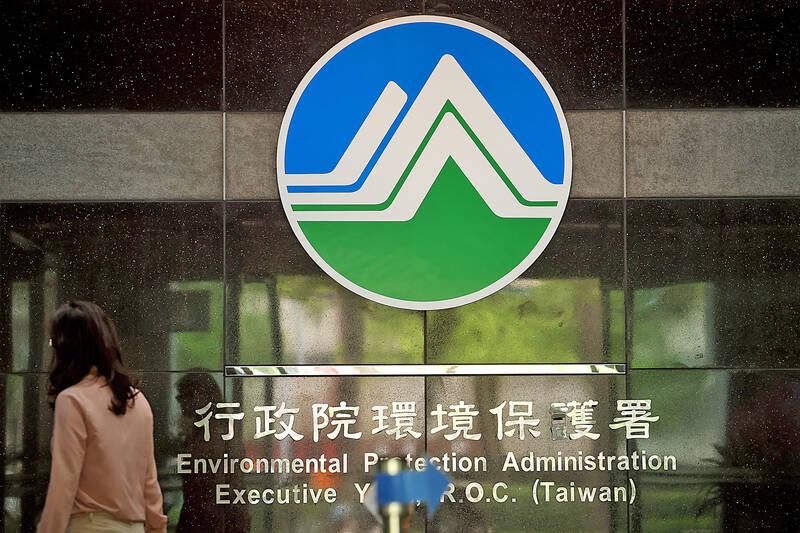
The name and logo of the Ministry of Environment are pictured at its headquarters in Taipei in an undated photograph.
Photo: CNA
The Executive Yuan set up a program in 2016 when the convention was under discussion, to promote its implementation in Taiwan, Tsai said.
The ministry in 2021 banned the use of mercury in manufacturing electrical appliances such as batteries and electrical switches, he said.
In April, it banned mercury production and the element’s import, sale or use, excluding some industrial applications in which it cannot be substituted, he said.
Taiwan’s annual mercury consumption was reduced to 0.02 tonnes last year from 1.18 tonnes in 2016 after the nation banned mercury mining, the ministry’s data showed.
The decline was especially sharp following the ministry’s ban on manufacturing of some mercury-added products in 2021, Tsai said.
In addition to the nine products that have been banned since 2021 — such as thermometers, blood pressure monitors or cosmetic products — the ministry has extended the ban to six other products, he said.
These include photographic film and paper, mercury vacuum pumps, propellants for spacecraft, tire balancers and wheel weights, strain gauges used in plethysmographs, as well as melt pressure transducers, transmitters and sensors, ministry data showed.
The ministry has also established guidelines for regulating mercury emissions, Tsai said.
Taiwan’s annual mercury emissions to air have decreased by one-third from 2016 to 2024, he said.
Tsai called on the public to avoid mercury exposure by consuming different fish species, as mercury converted into methylmercury would accumulate in fish.
Composite resin should be used for dental fillings instead of dental amalgam, and people should avoid using improperly labeled cosmetic products, he said.
The ministry said the government continues to monitor and test mercury levels in products such as foods, crops, livestock feed or traditional Chinese medicines.
Most tested items were found to comply with regulations, with the non-compliant products promptly recalled and destroyed, it said, adding that mercury management requires long-term, cross-disciplinary commitment.
KioskNews shows a cleaned-up reading view extracted from the publisher’s page — the original always lives on their site, not ours.