The Queensland ebike scheme keeping regional riders off the road: ‘If you live north of Rockhampton, bad luck’
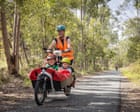
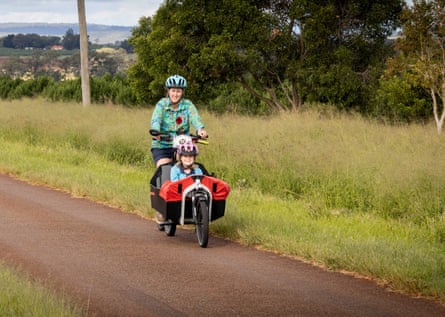
An ebike has saved Queensland mother Rhianna Steindl thousands of dollars in petrol and other vehicle running costs.
In the six years since she bought her large cargo bike, it has became a common sight in her regional town of Bundaberg. Steindl often used it to commute to work, take the kids to school and more, giving up her car despite a lack of cycling infrastructure.
But a new law will probably prevent Steindl and other regional ebike users from being able to use their legal bikes.
Under new legislation passed by the Queensland state government earlier this year, e-vehicles are banned from use in public if they don’t meet a new standard capping their power at 250 watts.
Steindl says her ebike meets all the new requirements of the Electrically Power-Assisted Cycle (EPAC) assurance scheme but one: it doesn’t have the sticker that demonstrates it has been assessed at a bike retailer under the state’s new assurance scheme.
The state government quietly announced the scheme on 2 November. Just nine bike shops across the state have signed up.
Steindl’s nearest is 287km away in Rockhampton, the most northerly assurance location in the state. Owners have until just February to get their bike checked, at a capped cost of $70.
Active transport groups claim the scheme has become just the latest rushed feature of a crackdown they say has been done on the cheap and not properly thought through. They warn it risks ending the state’s e-vehicle revolution and forcing people back behind the wheel of a car.
‘This is a fiscal question’
Matt Burke, the CEO of Bikes Queensland, estimates that between 20,000 and 50,000 legal ebike across the state don’t have a sticker. He owns one of them.
A recent university of Queensland study backs this up. According to the study published last month, there are about 1m e-vehicles in the state, a fleet worth about $2.2bn.
Dr Richard Buning, the study’s author, estimates that there are 200,000 or more “legal” vehicles in the state that need a sticker.
Ebikes aren’t just common in the cities. A third of Queensland households own an e-mobility device, including about 28% of households in remote Queensland, the study found.
Burke said most big retailers have already declined to be part of the scheme because it isn’t worth their while and is labor intensive.
“This is a fiscal question. The government has chosen not to fund this appropriately, that’s what’s happened,” he said.
He said there will be no way for owners in most owners in regional Queensland to get their vehicle accredited before an enforcement grace period runs out.
“If you live north of Rockhampton, bad luck,” he said. “There’s going to be no one within almost 700km of some of these cities, like Cairns and Townsville, where you can get your bike verified.
“So not the greatest outcome of a government service scheme.”
Some ebike owners argue that the Christmas holidays may complicate the scheme even further, given that, for many shops, it’s the busiest time of year.
Others are questioning why service centres operated by the Department of Transport and Main Roads (TMR)are not participating, given that they already do vehicle inspections for cars virtually everywhere in the state.
Peter Bourke, the general manager of Bicycle Industries Australia, said they are working with TMR to expand the scheme’s coverage across Queensland “very rapidly”, though it won’t be universal.
“We will be increasing the number of stores online. I’m hoping by the end of the month there will be 20 stores, with further stores in the new year that will be able to undertake verifications,” he said.
He said an assessment will take about half an hour to complete, so there should be no capacity problem. Bike shops were chosen as the delivery arm because they already had the skills, which TMR service centres do not, he said.
The TMR website says “alternative arrangements” will be available for those who live in a rural or remote area without reasonable access to an authorised verifier, “including the potential for a temporary, conditional permit”. It promises an update early next year. There are no further details available.
The only alternative
Like most of the world’s transport agencies, Queensland’s says it aims to encourage more people to give up their car and ride.
after newsletter promotion
According to the Queensland Cycling Strategy 2017-2027, active transport “can reduce traffic congestion and have many health benefits for those who choose to cycle”, reduces the state’s carbon footprint and saves the state government money.
The department particularly commits to encouraging “active school travel” and to prioritise “people who need more support to start riding such as children, women and older people”, because they are the least likely to already cycle.
But Buning said the legislation risks undermining progress towards those goals.
He said ebike technology had had a “transformative” effect in Europe and Asia, proving to be a remarkably effective tool for shifting people out of a car, substantially increasing cycling rates – disproportionately among more vulnerable users – because ebikes don’t require as much physical fitness.
“The real benefit of e-mobility devices is it’s made active transport that more attractive to just so much wider a segment of the population,” he said.
“There’s nothing in my time of researching this space for nearly two decades that’s encouraged people to want to use active transport as much.”
Queensland’s legislation targets exactly the groups the department wants to encourage to cycle, banning children under 16 and many old people from riding an e-vehicle at all. The first draft of the legislation would have also banned much of the state’s disabled community, but was amended to provide a medical exemption.
According to the law’s explanatory note, it was designed to force e-vehicle riders away from almost all of Brisbane’s safe cycling network into general traffic – which Buning said would also discourage female riders, who are known to be less risk averse.
The government-dominated Queensland parliamentary committee, which recommended the legislation, heard that there is no evidence of any public safety risk associated with legal ebikes. It identified just a single fatal accident involving a legal ebike during its year-long inquiry, an elderly woman killed by a car.
Buning’s research shows that, for a quarter of the state’s e-mobility users, a private car is their only alternative, particularly in regional areas.
“If you live in one of those areas, you have no access to public transport. You have no other access way of getting around.”
Burke said the scheme had been rushed and not properly thought through. Queensland is falling behind the rest of the world, he said.
“Queensland is slow on the adoption of e-mobility and of cycling more generally,” he said.
“New York has just tripled in recent years, Paris has multiplied it by about seven times. London has had really steep increases.
“We’re not in a good space in Queensland. We will be even more behind where everyone else in the world is headed.”
A spokesperson for Transport and Main Roads said the scheme is “already helping Queenslanders retain and use eligible devices safely and legally”.
“Authorised verification locations are now operating across the state and more locations are expected to come online in the coming weeks,” they said.
Steindl says she has given up riding the ebike as a result of the legislation and instead drives her four-wheel drive everywhere. Diesel is now among her highest household bills.
“You know what? It’s just easier to get in the car,” she said.
KioskNews shows a cleaned-up reading view extracted from the publisher’s page — the original always lives on their site, not ours.