Health advocates demand solutions to years-long TB drug shortage
Already have Rappler+?
to listen to groundbreaking journalism.
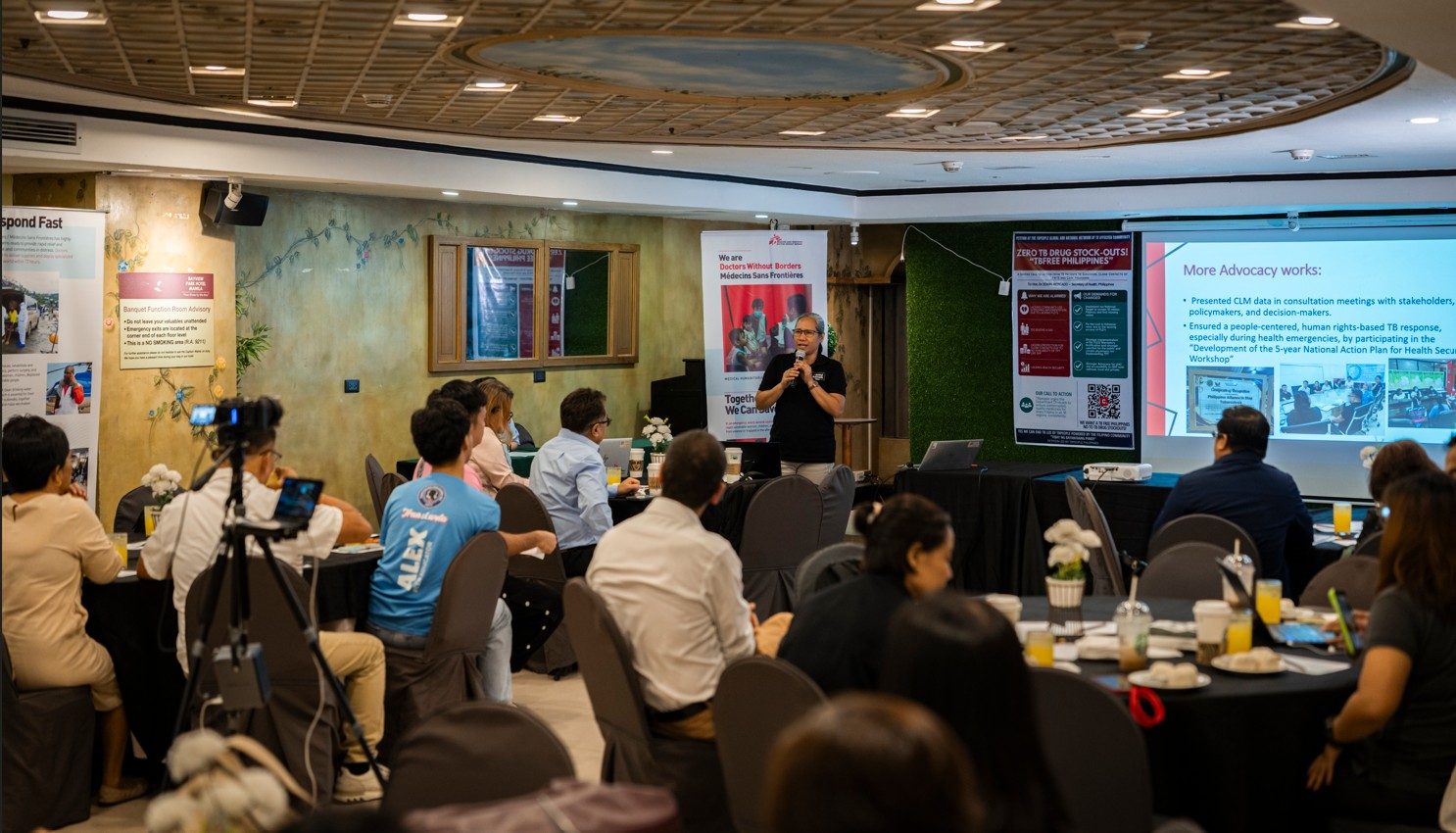
STOCKOUT. Florita Dalida, founder of TB HEALS, speaks in front of health experts and advocates about on-the-ground TB drug shortage reports across 18 regions during a roundtable discussion on August 25, 2026.
Doctors Without Borders/Médecins Sans Frontières
Mass TB drug shortages have been reported since the last quarter of 2023 due to multiple failed and canceled biddings
AT A GLANCE
- Health groups in the Philippines are raising concerns over ongoing shortages of TB medicines, urging the Department of Health to treat this issue as a national emergency.
- Advocates are calling for improved drug procurement schedules, better coordination among health regions, and a commitment from the DOH to ensure free and accessible TB treatment for all patients.
This is AI-generated. Read the article for full context. Report any errors.
MANILA, Philippines – Health groups and affected communities sounded the alarm over continuing shortages of tuberculosis (TB) medicines in the Philippines, urging the Department of Health (DOH) to develop efficient solutions to prevent delays in healthcare delivery.
Florita Dalida, founder of TB Health Education and Livelihood Support Community, Inc. (TB HEALS), told Rappler on Monday, September 14, that shortages or stockouts of TB medicine should be treated as a national emergency, as TB is highly contagious.
“Dahil tayo ay top 3 sa buong mundo na contributor ng TB cases, [imagine] kung ilan ‘yung kayang magkaroon ng TB habang hinihintay natin na mag-treatment sila,” she told Rappler.
(Because we are the third-highest contributor to TB cases worldwide, imagine how many Filipinos can acquire TB while we wait for them to be treated.)
Mass TB drug shortages or stockouts — specifically, first-line medications for drug-susceptible patients — have been reported since the last quarter of 2023 due to the DOH’s multiple failed and canceled TB drug biddings. All unsuccessful procurement activities, despite rebiddings, amounted to P2 billion.
Dalida added that it’s a “national concern” because of the procurement problems of the DOH. It’s the DOH, she said, that should purchase all allocations of “first-line drugs.”
Chris Muñoz, president of the Philippine Alliance of Patient Organizations (PAPO), said on Sunday, September 13, the DOH should recalibrate its drug distribution process to prioritize local government units and strengthen reimbursements, too, from the Philippine Health Insurance Corporation (PhilHealth).
Diagnosis and treatment are free through PhilHealth’s TB-DOTS (Directly Observed Treatment Short-course) package, valued at more than P7,000 in total. Case rates are also available for reimbursement, from P12,000 to P19,000 depending on the condition.
“The choice of where to seek care should belong to the patient, not the healthcare facility,” Muñoz said.
The Philippines has had the highest number of people infected with TB per 100,000 population in Southeast Asia since 2013. In 2024, the country has the third-highest TB burden in the world, after Indonesia and India.
Ironically, TB is preventable and highly treatable with fixed medication. TB treatment is free in all government-run health facilities nationwide.
When medicines are unavailable, patients may be forced to pay for treatment out of pocket, while treatment delays could increase the risk of transmission.
Reports from the ground
Louie Zepeda-Teng, president of TBPeople Philippines and a TB survivor, said on Friday, September 11, that she has been encountering reports of TB drug shortages across various regions during their community work.
She mentioned Tondo in Metro Manila, Rizal, Cavite, Bicol, Tacloban, Tawi-Tawi, and Cotabato as some of the areas they visited that had shortages — to the extent that health centers became hesitant to screen people for TB because they had no available medicine.
“I visited some places in Manila where I was told not to bother with medical missions and screenings, or even give talks at X-ray events for Manila residents, because supposedly there was no medication available anyway,” Zepeda-Teng said in Filipino.
Dalida also mentioned in a separate interview on August 29 that their data from the community feedback platform KomuKonek showed 30 reports of TB drug shortages in nine regions between 2025 and August 2026.
Appeal to DOH
Zepeda-Teng asserted that the DOH should strengthen its commitments to lowering the number of cases, following its own roadmap to TB eradication.
“When we commit to this being free, you’re supposed to make sure na walang mamamatay dito (that no one will die). Kasi nga [pinangako mong] libre ito (Because you promised that this will be free),” she said.
In a roundtable discussion about TB stockouts on August 25, TBPeople Philippines shared an “urgent” appeal letter to stop recurring shortages, addressed to Health Secretary Edwin Mercado.
They asked to:
- Improve the schedule of first-line drug procurement and not disturb the 16-million screening target for 2026
- Strengthen coordination with all 18 regions through more accurate reporting of needed supplies
- Have stronger mandatory notification and increase preventive treatment
- Not to limit procurement access at the national level by encouraging LGUs to plan for universal healthcare funds and not just rely on national delivery
Dalida added that since the bureaucracy had already been identified as the root cause of the shortages, the DOH should realign with all concerned agencies to address it.
She said in Filipino, “I hope they fix the system. They should talk amongst themselves and prioritize those who have TB.” – Rappler.com
KioskNews shows a cleaned-up reading view extracted from the publisher’s page — the original always lives on their site, not ours.