Why a jailed ex-president’s son is leading Brazil election race, and the Trump factor
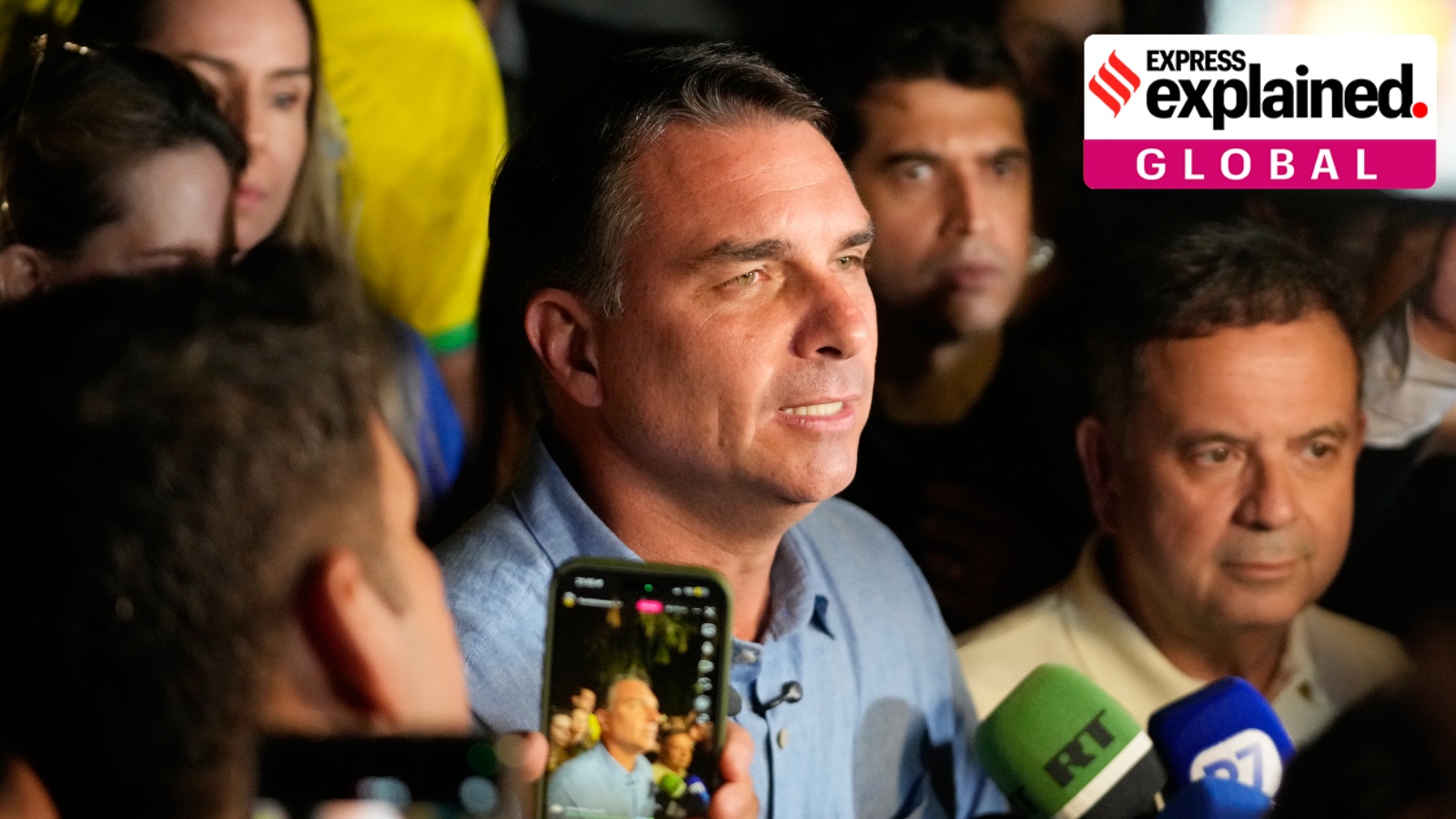
Brazil voted in the first round of its presidential elections on Sunday (October 4), with incumbent President Luiz Inácio Lula da Silva and Flávio Bolsonaro receiving 45% and 47% of the vote, respectively.
Since neither won over 50% of the vote but still secured the most votes among all candidates, they will go head-to-head in another round of voting on October 25.
Bolsonaro is the son of former President Jair Bolsonaro, who won the 2018 elections and rejected the 2022 poll results after losing to Lula. His supporters stormed government offices in the capital, Brasília, evoking visuals of US President Donald Trump’s supporters attacking the US Capitol building in 2021. This is only one of many ways Bolsonaro and Trump are linked, with Trump backing him strongly over the years and expressing solidarity with him over supposed “witch hunts” for not accepting the results.
Today, Jair Bolsonaro is serving a 27-year sentence in relation to the attempted 2023 coup. How did his son become the frontrunner to lead Brazil? And what has been Trump’s role in the elections for the continent’s biggest country and economy?
Who is Flávio Bolsonaro?
Flávio, 45, is a lawyer by training and Jair Bolsonaro’s eldest son. A senator from Rio de Janeiro, he bears a striking physical resemblance to his father, which may or may not lend him a political advantage given Bolsonaro Sr.’s reputation as a polarising figure. Take the 2022 election, the closest in Brazil’s history, where Lula received 50.9% of the votes against Bolsonaro’s 49.1%.
When Jair first came to power as the leader of Brazil’s Liberal Party (LP), his supporters saw him as a conservative, pro-business politician who would “tell it like it is”, similar to other populist right-wing leaders globally. Among his key policies was relaxing protections for the Amazon rainforest to encourage commercial activities.
He vowed to combat corruption, which was noteworthy since his own political rise was fuelled by mainstream political figures in Brazil getting implicated in major corruption scandals.
Story continues below this ad
Bolsonaro is also known to make homophobic and misogynistic statements, telling a woman legislator who accused him of being a rapist: “I wouldn’t rape you because you don’t deserve it.” He was also criticised for his handling of the Covid-19 pandemic, with Brazil having the second-highest death toll among countries, after the United States.
As the Financial Times put it in a profile of the Bolsonaro family, “Flávio is the self-styled moderate of the family: a “vaccinated Bolsonaro”, in his own words. In the constant shadow of his father, he treads a difficult line… He all but acknowledges being an inferior substitute. “How can you compare Pelé’s son to Pelé himself?” Flávio asked the FT in an interview earlier this year during which he refused to sit behind his father’s desk in the party HQ.”
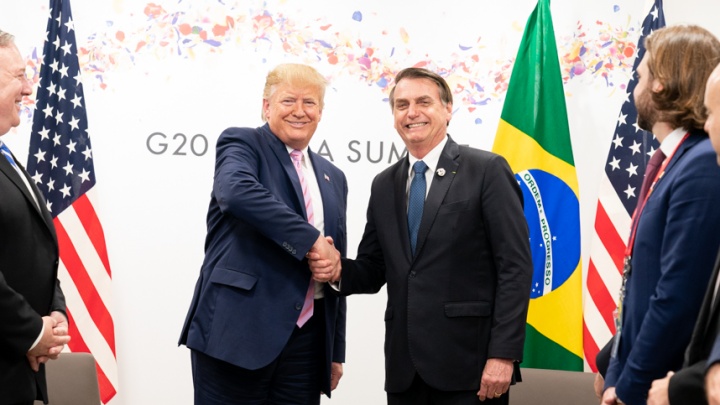 Jair Bolsonaro and Trump at the G20 meeting in 2019. (Wikimedia Commons)
The Bolsonaros have enjoyed voter support among more well-off groups, the more conservative Evangelical Christians, and the country’s southern regions. On the other hand, Lula, 80, is a veteran socialist leader now contesting for a fourth term with supporters such as Catholics, progressives and poorer groups. Flávio has criticised Lula for not being tough enough on crime and drug gangs.
Lula was also president when the first BRIC meeting comprising Brazil, Russia, India and China was held in 2009 (South Africa was not a member of the grouping then).
Story continues below this ad
And what is Trump’s role in the Brazilian elections?
Since Jair Bolsonaro’s first term, which partly overlapped with the first Trump administration, Trump has publicly supported him owing to their similar ideology and disdain for critics. He met Flávio earlier this year, calling him a “smart young man, who loves his country, Brazil, very much.”
Within months of his second term, Trump announced 50% tariffs on imports from Brazil in July 2025 for “threats” to the US. The executive order also noted that Brazilian officials were “persecuting” Bolsonaro and that this “contributes to the deliberate breakdown in the rule of law in Brazil.”
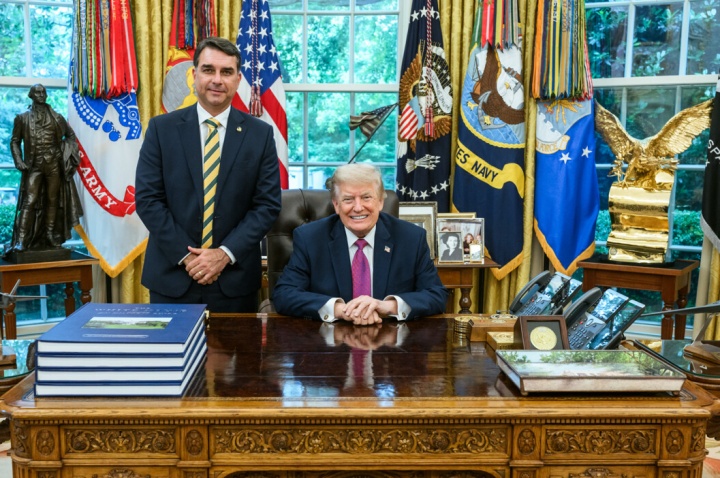 Donald Trump with Flávio Bolsonaro earlier this year at the White House, Washington, DC. (Wikimedia Commons)
Trump has earlier warmed up to other strongman leaders globally, with vocal support for those from South America. Another prominent example is Argentina’s Javier Milei. This approach is also in line with the US National Security Strategy, released in November 2025. It laid out intentions for the US to be dominant in the Western Hemisphere, and its effects were seen in the military capture of Venezuelan President Nicolas Maduro in January this year.
As The New York Times said of South America in a recent report, “Candidates aligned with President Trump on issues like fighting drug gangs and “woke ideology” have won the last seven elections in the region, with Brazil the biggest remaining prize.” This period of rightward political shift comes not too long after a “pink tide” around 2022. The term was first used around the early 21st century, with the election of Hugo Chavez in Venezuela, followed by a roughly decade-long period that saw many countries reject neo-liberalism in favour of socialism (hence “pink”, rather than Communism’s red).
Story continues below this ad
Oliver Stuenkel, Visiting Scholar at the Carnegie Endowment for International Peace in Washington, wrote back in 2022 for Americas Quarterly that this wave would be more short-lived. His reasons ranged from greater geopolitical instability translating into tougher economic circumstances for governments to their declining interest in maintaining a sense of regional unity and convergence.
“Today’s leftist presidents are less likely to prioritize ties to their neighbors because they are less relevant from an economic point of view. Intraregional trade amounted to over 20% of Latin America’s total exports in 2008, but this share has declined by a third and is set to fall further as commodity exports to China are on the rise,” he wrote.
KioskNews shows a cleaned-up reading view extracted from the publisher’s page — the original always lives on their site, not ours.